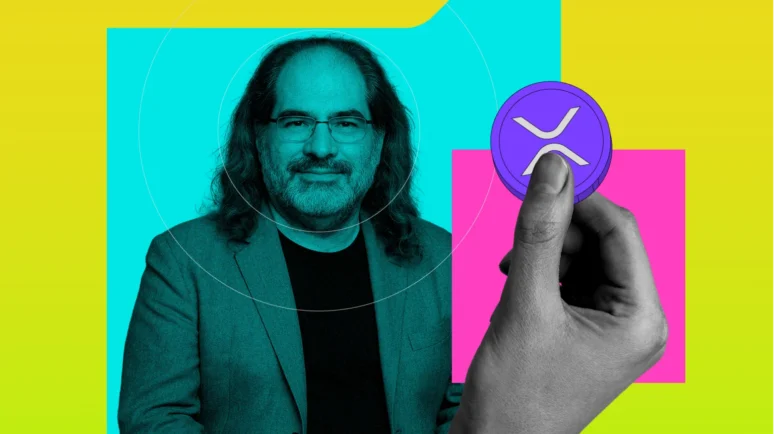
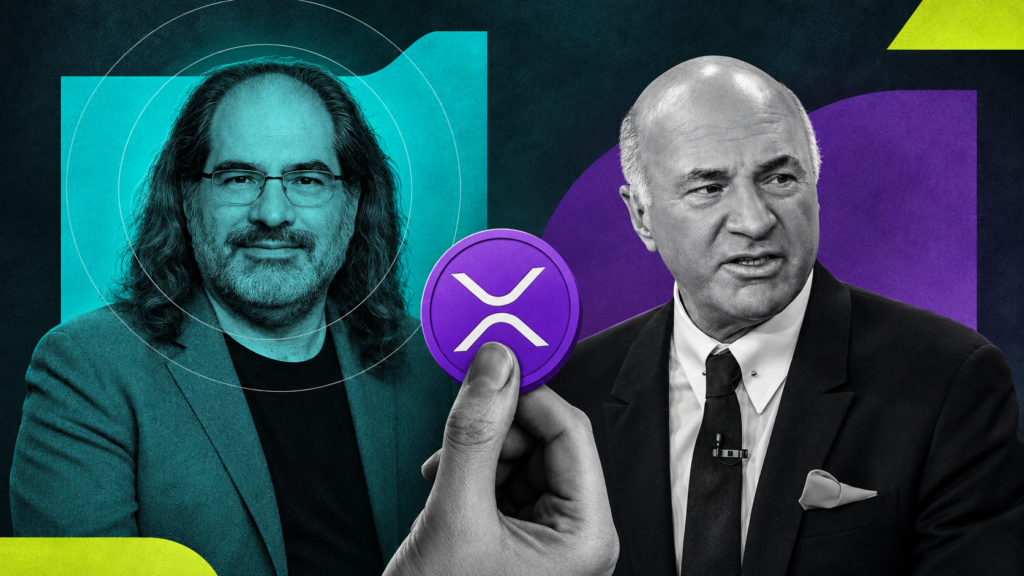
Ripple’s David Schwartz questioned Kevin O’Leary’s claim that anyone can become wealthy through hard work after the investor debated 20 Gen Z workers.
Share
Key Takeaways
Ripple’s David Schwartz questioned Kevin O’Leary’s claim that anyone in America can become wealthy if they work hard enough.
Schwartz backed O’Leary’s advice for people trying to get ahead, while arguing that “plenty of people will do everything right and still fail.”
With XRP trading near $1, a rally to $10 would turn a $100 holding into $1,000.
Ripple’s David Schwartz has challenged Shark Tank investor Kevin O’Leary’s claim that anyone can work their way to wealth, after a Gen Z security guard told O’Leary that he worked 80 hours a week and still spent more than half his income on rent.
Schwartz, the XRP Ledger co-creator and Ripple’s chief technology officer emeritus, said O’Leary had sound advice for someone looking to advance their career.
However, he took issue with the broader claim, questioning whether it encouraged people to blame poverty on a lack of effort.
Try Our Recommended Crypto Exchanges
Sponsored
Disclosure
We sometimes use affiliate links in our content, when clicking on those we might receive a commission at no extra cost to you. By using this website you agree to our terms and conditions and privacy policy.
“My next claim is anyone in America can become wealthy if they’re willing to work hard enough,” he said.
O’Leary argued that people who get their work done more efficiently tend to advance faster.
Kieran, who works in unarmed security, said it was hard to apply to a job where he had to be on-site in case something happened.
He had already asked his bosses about moving up and was told there were only so many supervisor positions.
Kieran said he spent 55% of his income on rent and had applied for 10 jobs in the previous month without getting an interview.
O’Leary told him he sounded capable of managing other guards and suggested that he record a short video to pitch himself for supervisor jobs elsewhere.
“Work should advance you is what I’m saying,” O’Leary said.
Why Schwartz Agreed With Both Sides
Schwartz initially focused on what O’Leary’s claim implied about people who never became wealthy.
If anyone could get rich through hard work, he asked, would it follow that people who struggled had not worked hard enough?
In a follow-up to venture investor Michael Arrington, Schwartz called O’Leary’s advice “precisely correct for someone who wants to get ahead.”
Arrington slammed the advice as “terrible on a macro scale; not everyone will succeed. But it’s priceless on an individual level.”
There are all kinds of things that increase your chances of getting ahead in life. That is absolutely true. What is not true, and absolute nonsense, is thinking that if someone is poor, it's probably because they failed to do something they should have known you need to do.
Schwartz also sided with Kieran on how difficult that had become.
“But the kid is correct that things have gotten much harder and plenty of people will do ev everything right and still fail,” he wrote.
In a separate exchange, the ex-Ripple CTO argued that there were all kinds of things “that increase your chances of getting ahead in life.”
“What is not true, and absolute nonsense, is thinking that if someone is poor, it’s probably because they failed to do something they should have known you need to do,” he added.
How Much XRP Would You Need to Become a Millionaire at $10?
For small XRP holders, the debate raises a different question about how to get rich.
How much would a tenfold rally actually put in your pocket?
A hypothetical rally to $10 would represent a gain of roughly 900% and put XRP’s market capitalization near $635 billion, based on about 63.52 billion tokens in circulation.
Starting investment at $1 XRP
Holding value at $10 XRP
Gain before fees and taxes
$100
$1,000
$900
$500
$5,000
$4,500
$1,000
$10,000
$9,000
$10,000
$100,000
$90,000
$100,000
$1,000,000
$900,000
A buyer putting in $100 and another putting in $100,000 would earn the same percentage return — but only one would, hypothetically, get “rich.”
For someone who put $100 into XRP at $1, a rally to $10 would mean a $900 gain before fees and taxes.
That could help cover bills, but it would still leave the holder a long way from a $1 million position.
To reach that figure at $10 per token, a buyer would have needed to put $100,000 into XRP at $1 per token.
A smallholder could get there with a much bigger rally, but the numbers show how much bigger it would have to be.
Someone who bought 100 XRP for $100 would need the token to reach $10,000 to hold $1 million worth.
That’s where the debate over pay and rent comes back in.
Disclaimer:
The information provided in this article is for informational purposes only. It is not intended to be, nor should it be construed as, financial advice. We do not make any warranties regarding the completeness, reliability, or accuracy of this information. All investments involve risk, and past performance does not guarantee future results. We recommend consulting a financial advisor before making any investment decisions.
Kurt Robson is a London-based reporter at CCN, specialising in the fast-moving worlds of crypto and emerging technology. He began his career covering local news in Cornwall after graduating from Falmouth University with First Class Honours in Journalism. There, he cut his teeth on everything from council meetings to missing swans.
He quickly rose through the ranks to become a frontline journalist at several of the UK’s leading national newspapers. Over the years, he has interviewed musicians and celebrities, reported from courtrooms and crime scenes, and secured multiple front-page exclusives.
Following the upheaval of the COVID-19 pandemic, Kurt shifted his focus to technology journalism—just ahead of the AI boom. With a natural curiosity and a trained eye for emerging trends, he has found a new rhythm in reporting on innovation.
At CCN, Kurt's work focuses on the cutting edge of crypto, blockchain, AI, and the evolving digital world. Drawing on his background in people-first reporting and his deep interest in disruptive tech, Kurt delivers stories that are insightful, entertaining, and human-centric.











 Bitcoin To $200,000, Says Kevin O Leary — Claims ‘Only Two Crypto’ Are Worth Investing In