Are Prediction Markets Gambling? Inside the Fight Over Kalshi, Polymarket and Sports Contracts
Share
Key Takeaways
Prediction markets traded about $53 billion in July 2026, with sports driving most of the recent surge.
Kalshi and Polymarket US operate through federally regulated derivatives infrastructure, but multiple states and Native American tribes argue sports event contracts are effectively unlicensed gambling.
Courts are now split: the Third Circuit backed Kalshi against New Jersey, while the Ninth Circuit rejected key parts of its federal-preemption argument in Nevada and sided with California tribes under federal tribal gaming law.
Is buying a contract that pays $1 if an NFL team wins fundamentally different from placing a bet on the same team at a sportsbook?
That increasingly difficult question sits at the center of one of the biggest regulatory battles in US financial markets.
Prediction markets have moved far beyond their political-election niche. Combined monthly trading volume across Kalshi and Polymarket more than doubled from approximately $25.7 billion in May 2026 to $53 billion in July, according to a Pew Research Center analysis of The Block data. Sports accounted for much of that acceleration.
The legal system, however, has not produced an equally simple answer.
Kalshi just LOST another major case and appealed to the Supreme court
the coming ruling will decide the future of the entire Prediction Market industry
an alliance of 8 different states have tried to ban Kalshi and so far won every appeal :
Kalshi‘s position is built around federal derivatives law: its event contracts trade through a Commodity Futures Trading Commission-regulated designated contract market. State regulators counter that calling a sports wager an “event contract” does not necessarily prevent state gambling laws from applying.
The result is an unusual jurisdictional fight in which the same basic product can look like a federally regulated derivative to one court and a gambling subject to another legal regime to another.
Top Crypto Betting Sites
Sponsored
Disclosure
We sometimes use affiliate links in our content, when clicking on those we might receive a commission at no extra cost to you. By using this website you agree to our terms and conditions and privacy policy.
Mechanically, prediction markets are straightforward.
A trader buys an event contract tied to a defined outcome. A contract priced at $0.40 might pay $1 if the event occurs and zero if it does not. As participants buy and sell, its price changes and can be interpreted as the market’s implied probability of the outcome.
The CFTC itself explains that event contracts are typically structured as swaps and may be used either to hedge economic risks or to speculate on events. They have existed in regulated US markets for more than two decades.
That description works comfortably for some products.
A farmer could theoretically hedge weather risk. A business could trade a contract linked to an economic release, government decision, or other event affecting its operations.
Sports make the classification much harder.
Consider two products:
A sportsbook lets someone bet on whether an NFL team will win on Sunday.
A prediction market lets someone purchase a binary event contract whose settlement depends on whether that NFL team wins on Sunday.
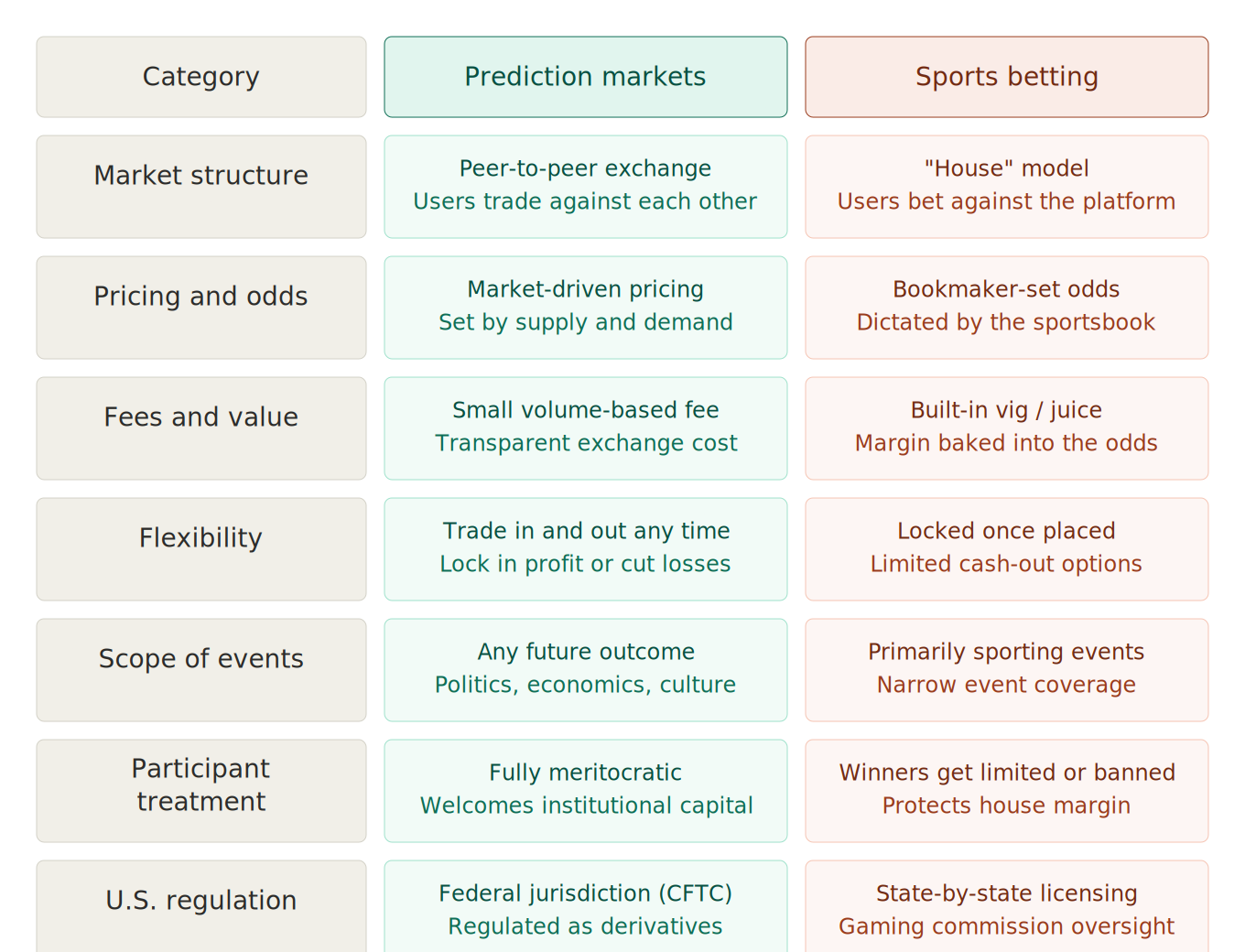
Prediction Markets vs. Sports betting | Source: eddiefitzgibbon
The economic exposure can look remarkably similar even though the regulatory structures are different.
This is why the current fight is not really over, as users are speculating. The CFTC explicitly acknowledges that event contracts can be speculative. The harder question is which law governs that speculation.
Sports Have Turned a Regulatory Debate Into a $50B Market
Prediction markets could once plausibly be described primarily as forecasting tools for elections, economics, and public policy.
The trading data now complicates that description.
Pew found that combined Kalshi and Polymarket volume reached approximately $53 billion in July 2026, up from $26 billion in May. During June and July, sports trading exceeded $58 billion on Kalshi and approached $22 billion on Polymarket, coinciding with the FIFA World Cup.
Sports are now the largest trading category on both platforms by a substantial margin.
For comparison, Pew noted that Americans wagered roughly $40 billion at legal sportsbooks during the first quarter of 2026, approximately comparable to prediction-market sports volume over the same period, although the two volume measures and market structures are not perfectly interchangeable.
This growth explains why states care.
Licensed sportsbooks operate under state-specific rules involving taxes, licensing fees, age requirements, responsible-gambling programs, and restrictions on what events can be offered.
A federally regulated event-contract exchange could create another route to sports exposure without having to adhere to each state’s sportsbook licensing framework.
Kalshi operates a CFTC-regulated designated contract market.
Its central legal argument is that contracts traded on that market fall under the Commodity Exchange Act and therefore the CFTC’s federal jurisdiction. Under this interpretation, states cannot simply reclassify federally regulated contracts as illegal sports betting.
In February, the agency told the Ninth Circuit that it has exclusive jurisdiction over US commodity derivatives markets, including prediction markets. By April, the dispute had escalated considerably: the CFTC sued Wisconsin after the state brought actions against Kalshi, Polymarket, Crypto.com, Robinhood and Coinbase.
The agency has also brought actions against states, including Arizona, Connecticut, Illinois, New York, and New Mexico, as the jurisdictional fight has expanded. In its New Mexico case, the CFTC asked a federal court to stop the state from applying its gaming laws to CFTC-registered markets.
Polymarket countersues New York over ‘unregulated gambling’ allegations
Are you up to date on what’s trending in the prediction market space?
The federal regulator’s argument is therefore broader than defending one company.
It effectively argues that allowing individual states to regulate federally approved event contracts as gambling would fragment the national derivatives market into dozens of state-specific regimes.
But courts have not uniformly accepted that theory.
Kalshi Beat New Jersey, but Nevada Produced the Opposite Result
New Jersey produced one of Kalshi’s biggest legal victories.
After the state sought to apply gambling laws to Kalshi’s sports contracts, Kalshi obtained a preliminary injunction preventing enforcement.
In April 2026, the Third Circuit affirmed that decision.
The appeals court concluded that sports-related event contracts traded on a CFTC-licensed designated contract market were swaps subject to the CFTC’s exclusive jurisdiction. It found that federal law likely preempted New Jersey from applying its gambling laws to those contracts.
If that reasoning becomes the national standard, Kalshi’s regulatory model becomes considerably stronger.
Nevada went another way.
On Aug. 28, the Ninth Circuit rejected important elements of Kalshi’s preemption argument in its fight with Nevada regulators. The court concluded that Kalshi had not shown that the Commodity Exchange Act displaced Nevada’s regulatory authority, as the company argued.
The contrast is significant.
In New Jersey, Kalshi persuaded an appeals court that federal derivatives regulation blocked state gambling enforcement.
In Nevada, another federal appeals court allowed state gaming oversight to survive.
Those cases are not identical in every procedural and legal respect, but together they illustrate why the national status of sports prediction markets remains unsettled.
Native American Tribes Opened Another Legal Front
The dispute became even more complicated in September.
Blue Lake Rancheria and Chicken Ranch Rancheria of Me-Wuk Indians challenged Kalshi and Robinhood over sports event contracts offered to users on their California tribal lands.
The Ninth Circuit held Kalshi's sports contracts are Class III gaming when bought on tribal land, a first in prediction market litigation. Partner Josh Escovedo breaks down Blue Lake Rancheria v. Kalshi and the path it opens for tribes. Read more: https://t.co/v58Z0RwNGGpic.twitter.com/gkQkxiWEGc
The tribes relied on the Indian Gaming Regulatory Act (IGRA) rather than on state sportsbook laws.
On Sept. 16, the Ninth Circuit ruled that the tribes were likely to succeed on their claim that Kalshi’s sports contracts constituted Class III gaming when entered into from tribal territory. It reversed part of the lower court’s decision and remanded the case for further proceedings on the preliminary injunction.
The court also rejected the argument that other federal statutes displaced the tribes’ IGRA claim.
That ruling does not establish that every Kalshi sports contract everywhere in America is gambling.
Its reach is more specific: the case concerns transactions conducted on tribal lands and the protections created by federal tribal gaming law.
Still, it weakens any simple claim that CFTC registration automatically overrides every other gaming regime.
The political and legal stakes are substantial. Reuters reported that 27 states and Washington, DC, supported the tribes’ position in the litigation.
A Wisconsin tribal case involving Ho-Chunk Nation has also generated litigation over Kalshi and Robinhood’s sports products. In September, a federal district court certified important legal questions for an interlocutory appeal and stayed proceedings while the appellate process moves forward.
Where Does Polymarket Fit?
Polymarket entered the US regulatory story through a different route.
Its international crypto-based prediction platform previously faced US regulatory problems. The company’s US strategy now runs through regulated infrastructure, with Polymarket US growing rapidly during 2026.
Pew found that Polymarket US accounted for only about 4% of Polymarket’s total volume in January 2026, but 39% by July.
CFTC records also show QCEX certifying an expanding collection of binary event products in 2026, including basketball and tennis exact-score contracts, player-transfer contracts and other sports products.
That puts Polymarket increasingly inside the same regulatory conflict as Kalshi.
The important point is that “Polymarket” now encompasses different regulatory contexts. The global crypto platform and the regulated US operation should not be treated as legally interchangeable.
For the US business, the core question is similar to Kalshi’s: how far does federal derivatives regulation protect an event-contract exchange from state gambling restrictions?
Prediction Markets Also Create Financial-Market Problems
Calling prediction markets “financial markets” rather than “sportsbooks” does not eliminate regulatory concerns. It changes which concerns become important.
One example is insider trading.
In February, the CFTC disclosed enforcement cases involving fraud and misuse of nonpublic information on prediction markets traded on Kalshi.
One case involved a political candidate trading contracts linked to his own candidacy. Kalshi imposed disgorgement, a $2,000 penalty and a five-year suspension after the trader acknowledged the transactions violated platform rules, according to the CFTC.
That case illustrates the unusual nature of event contracts.
Someone trading Apple before undisclosed earnings potentially possesses material corporate information. Someone trading an election, sporting event, corporate announcement or personnel decision may instead have direct influence over the event itself.
Prediction markets therefore need surveillance mechanisms capable of addressing information asymmetry and manipulation, even when the underlying event is not a traditional financial asset.
The CFTC’s involvement reinforces the industry’s argument that these are regulated financial products, but it also means prediction markets inherit financial-market compliance problems alongside gambling-related concerns.
So, Are Kalshi and Polymarket Gambling?
There is no single answer that accurately describes every prediction contract across all US legal regimes in October 2026.
Under the federal commodities framework, the CFTC treats qualifying event contracts on registered markets as derivative products and says it has exclusive authority over those markets. The Third Circuit’s New Jersey ruling provides substantial judicial support for that position.
State gaming regulators argue that at least some sports contracts reproduce the substance of sports betting and should therefore remain subject to gambling laws.
The Ninth Circuit has now given those arguments meaningful support in Nevada, while its California tribal decision found that sports event contracts entered into on tribal lands likely constitute Class III gaming under IGRA.
Meanwhile, the market is moving much faster than the courts.
Combined Kalshi and Polymarket trading volume rose from less than $2 billion a month in mid-2025 to roughly $53 billion in July 2026, with sports becoming the dominant category. August still produced roughly $47 billion despite the post-World Cup decline, according to Pew.
That scale makes the fight more than a matter of terminology.
If federal derivatives law ultimately dominates, prediction markets could establish a nationwide alternative for trading sports outcomes under CFTC supervision. If state and tribal gaming regimes retain significant authority, platforms may need geofencing, licensing restrictions, or different products depending on where the trader is located.
For now, Kalshi and Polymarket sit in an unusual position: financial exchanges under one regulatory framework, competitors to sportsbooks in economic reality, and potential gambling operators under legal theories that several courts are still testing.
The contracts themselves settle quickly. The question of what they legally are is taking much longer.
Disclaimer:
The information provided in this article is for informational purposes only. It is not intended to be, nor should it be construed as, financial advice. We do not make any warranties regarding the completeness, reliability, or accuracy of this information. All investments involve risk, and past performance does not guarantee future results. We recommend consulting a financial advisor before making any investment decisions.
Dr. Guneet Kaur is a senior editor at CCN.com and a Science Fellow at Exponential Science. She is a fintech and blockchain expert with extensive experience in digital finance education, blockchain ecosystems, and cryptocurrency markets. She has worked with global media such as Cointelegraph, as well as education and blockchain platforms, to design and lead strategic content and learning initiatives. As an educator and assessor for top-tier executive programs, she bridges real-world fintech trends with academic insight.
Dr. Kaur is also a published researcher and peer reviewer across fintech and data science journals, including Financial Innovation Journal and International Journal of Big Data Intelligence and Applications. Her work spans data-driven analysis, Web3 innovation, and technical content development. With a strong foundation in both industry and academia, she translates complex financial technologies into practical applications, empowering learners, professionals, and institutions across the rapidly evolving digital finance landscape.


 Easy
Easy