




Goldman Sachs Dumps XRP and Solana ETFs, Slashes Ethereum Exposure by 70%
Key Takeaways
The US Securities and Exchange Commission (SEC) is taking a cautious approach toward a new category of exchange-traded funds tied to prediction markets and event contracts, as Chair Paul Atkins confirmed the agency is reviewing the broader implications of these products before allowing them to move forward.
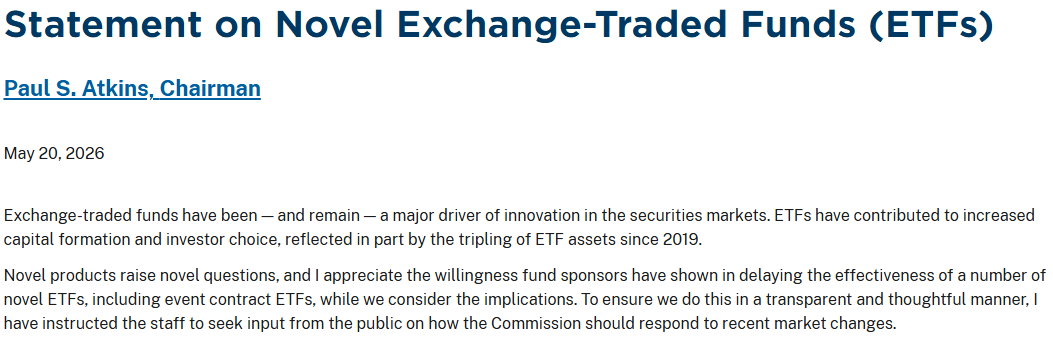
In a statement released this week, Atkins said the SEC staff has been instructed to seek public input on how regulators should respond to the emergence of “novel” ETFs, including those linked to event contracts and prediction markets.
The move signals growing scrutiny around a rapidly expanding corner of the ETF market that blends financial speculation with real-world outcomes such as elections, layoffs, and economic forecasts.
The announcement comes as issuers, including Bitwise, Roundhill, and GraniteShares, await decisions on more than two dozen proposed ETFs that were expected to launch earlier this month.
+81
+76
+217
Atkins acknowledged that the SEC has delayed the effectiveness of several proposed ETFs while regulators assess the risks and legal questions surrounding these products.
“Novel products raise novel questions,” Atkins said in the statement. “I appreciate the willingness fund sponsors have shown in delaying the effectiveness of a number of novel ETFs, including event contract ETFs.”
The SEC chair added that public consultation will be an important part of the process.

“To ensure we do this in a transparent and thoughtful manner, I have instructed the staff to seek input from the public on how the Commission should respond to recent market changes,” Atkins said.
The delayed applications reportedly include 24 ETFs tied to prediction markets and event contracts. The initial proposals filing occurred in February and was approaching the end of the SEC’s standard 75-day review period.
These ETFs would allow investors to gain exposure to the outcomes of future events rather than traditional assets like stocks, bonds, or commodities.
Some of the proposed products are linked to the 2028 US presidential election, recession probabilities, and layoffs in the technology sector.
The delay suggests the SEC is still determining whether such products fit within existing ETF regulations or require additional oversight frameworks.
The SEC’s review comes at a time when prediction markets are experiencing explosive growth, fueled largely by platforms such as Polymarket and Kalshi.
According to industry estimates, the two platforms surpassed $25 billion in monthly trading volume in April, reflecting rising retail and institutional interest in event-based trading.
To drive the surge, regulatory clarity around prediction markets and a more supportive stance from federal regulators are needed.
Prediction markets allow users to speculate on the outcomes of future events ranging from elections and sports to macroeconomic indicators and geopolitical developments.
The concept has gained mainstream attention in recent years, especially during major political cycles and periods of economic uncertainty.
ETF issuers now see an opportunity to package these markets into regulated investment products that can trade on traditional exchanges.
However, regulators remain cautious because event contract ETFs differ significantly from traditional investment funds. Unlike broad-market ETFs or spot crypto ETFs that track asset performance, event contract funds are dependent on binary or highly specific outcomes.
Filings for the proposed funds warn investors that they could lose “substantially all” of their investment if the predicted outcomes do not materialize.
Industry analysts believe the SEC’s cautious stance reflects the unprecedented nature of these products.
Bloomberg Senior ETF Analyst Eric Balchunas said the Commission appears to be carefully evaluating the risks before approving the first wave of event contract ETFs.
“The commission is clearly wrestling with these and wants more time and input,” Balchunas wrote on X. “These are a whole new thing (kinda like crypto) and want to feel comfortable before they open the barn door.”

The comparison to cryptocurrency ETFs is notable. Much like spot Bitcoin ETFs once faced years of regulatory hesitation before receiving approval, prediction market ETFs may now be entering a similar phase of prolonged review and policy debate.
At the same time, the SEC’s willingness to publicly engage with the issue suggests regulators are not dismissing the products outright.
Instead, the agency appears focused on establishing a framework that balances innovation, investor protection, and market integrity.
Giuseppe Ciccomascolo began his career as an investigative journalist in Italy, where he contributed to both local and national newspapers, focusing on various financial sectors.
Upon relocating to London, he worked as an analyst for Fitch's CapitalStructure and later as a Senior Reporter for Alliance News. In 2017, Giuseppe transitioned to covering cryptocurrency-related news, producing documentaries and articles on Bitcoin and other emerging digital currencies. He also played a pivotal role in establishing the academy for a cryptocurrency exchange website. Crypto remained his primary area of interest throughout his tenure as a writer for ThirdFloor.
Goldman Sachs Dumps XRP and Solana ETFs, Slashes Ethereum Exposure by 70%
Morgan Stanley’s Bitcoin ETF Draws $194M With No Outflows — Wall Street Taking Over?
Will Crypto Be Mainstream by 2026? Bitwise CEO Says Yes as Morgan Stanley’s Shift From ‘$0’ Call to ETF Draws Attention
Franklin Templeton’s New ETFs Could Make Millions of Investors Own Bitcoin Without Realizing It
BlackRock Faces $1B Bitcoin ETF Outflow as Tokenized Fund Hits $2.5B
Binance Hackers Move Stolen Crypto Through 800+ Wallets: Can the FBI Stop the $3.25B Laundering Trail?
You’re All Set!
Thanks for signing up. We’ll be in touch soon with the latest insights.