Polkadot’s 9-year journey from the 2016 white paper to Wall Street focus shows a story of architecture, interoperability, and institutional adoption, beyond price. | Credit: Veronica Cestari/CCN.com
Share
Key Takeaways
Polkadot’s nine-year journey reflects innovation in blockchain infrastructure, interoperability, and governance rather than speculation.
The launch of Polkadot Capital Group in 2025 shows a deliberate focus on bridging Wall Street and Web3.
Parachains, shared security, and cross-chain messaging give Polkadot scalability and reliability that institutions require.
With OpenGov, on-chain treasury, and forkless upgrades, Polkadot can evolve quickly while staying transparent and community-driven.
Polkadot has come a long way since its inception in 2016. For beginners entering the crypto space, it’s easy to assume a project’s success is all about token price.
But Polkadot’s nine-year evolution, from a visionary white paper to a network embraced by institutions, tells a different story. Rather than focusing only on speculative gains, Polkadot prioritized innovation: building novel blockchain infrastructure, pioneering on-chain governance, and enabling interoperability across networks.
This journey has led to real technological breakthroughs and growing institutional interest, culminating in the launch of Polkadot Capital Group in August 2025.
To better understand this shift, CCN reached out to Dave Sedacca, lead of Polkadot Capital Group and Director of Finance at Parity Technologies, who has been active in crypto since 2017 and now guides Polkadot’s institutional strategy.
This article explores Polkadot’s origins, its unique multi-chain architecture, governance model, use cases, and why its story is about much more than the DOT token’s price chart.
Let’s dive in and discover how Polkadot went from an idea on paper to a presence on Wall Street, all while staying true to its mission of building the foundation for Web3.
Polkadot Origins: From the 2016 White Paper to the 2017 ICO
Polkadot began in 2016 when Dr. Gavin Wood, Ethereum’s co-founder and former CTO, published the Polkadot white paper. He envisioned a “blockchain of blockchains,” a heterogeneous multi-chain system designed to overcome the scalability and interoperability limits of early blockchains.
Try Our Recommended Crypto Exchanges
Sponsored
Disclosure
We sometimes use affiliate links in our content, when clicking on those we might receive a commission at no extra cost to you. By using this website you agree to our terms and conditions and privacy policy.
By 2017, the Web3 Foundation was created in Switzerland to steward Polkadot’s development. That October, it held an ICO for the DOT token, raising about $144 million, one of the largest blockchain fundraisers of its time.
The journey wasn’t without challenges: a wallet software vulnerability froze a portion of the raised funds. Still, Parity Technologies and Web3 Foundation secured additional private funding through 2018–2019, keeping the project on track.
A major step in this formative period was the launch of Kusama in 2019, a canary network where developers could test features in a real economic environment before deploying to Polkadot.
In August 2025, Wood returned to the position of CEO of Parity Technologies, the technical backbone of Polkadot, following a period focused on protocol development. His return, in August 2025, comes as the Polkadot network matures, with the introduction of Polkadot 2.0 and the upcoming JAM protocol, presenting a new chapter to lead its rollout and focus on real-world applications.
Why Gavin Wood Stepped Away — and Why He’s Back Now
In the 124th episode of When Shift Happens, I sat down with @gavofyork, creator of @Polkadot, founder of @Web3foundation, and soon-to-be CEO of Parity Technologies, to talk about leadership, decentralisation, and the future of… pic.twitter.com/uXLgXHdfi7
2015: Gavin Wood launches ETHCore, now Parity Technologies
2016: Gavin Wood publishes the Polkadot white paper.
2017: Web3 Foundation founded; ICO raises $144M for development.
2018–2019: Despite frozen funds, progress continues with new funding and the launch of Kusama.
Polkadot Network Launch: Relay Chain, Kusama and Early Milestones (2019–2021)
After years of preparation, Polkadot’s network went live in May 2020. This initial launch was cautious and staged: the genesis block was produced on May 26, 2020 in a proof-of-authority mode controlled by Web3 Foundation (using a super-user account called “Sudo”). This meant the foundation could ensure stability in the very early days.
Shortly after, the network transitioned to nominated proof-of-stake (NPoS) by June 18, 2020, inviting the community’s validators to secure the chain. By July 2020, Polkadot removed the Sudo super-user and handed control to DOT holders via on-chain governance, effectively decentralizing the network.
In August 2020, DOT token transfers were enabled and the token underwent a redenomination (splitting 1 old DOT into 100 new DOT) to improve usability. All these steps marked Polkadot’s evolution from a “candidate” network to a fully functioning Relay Chain.
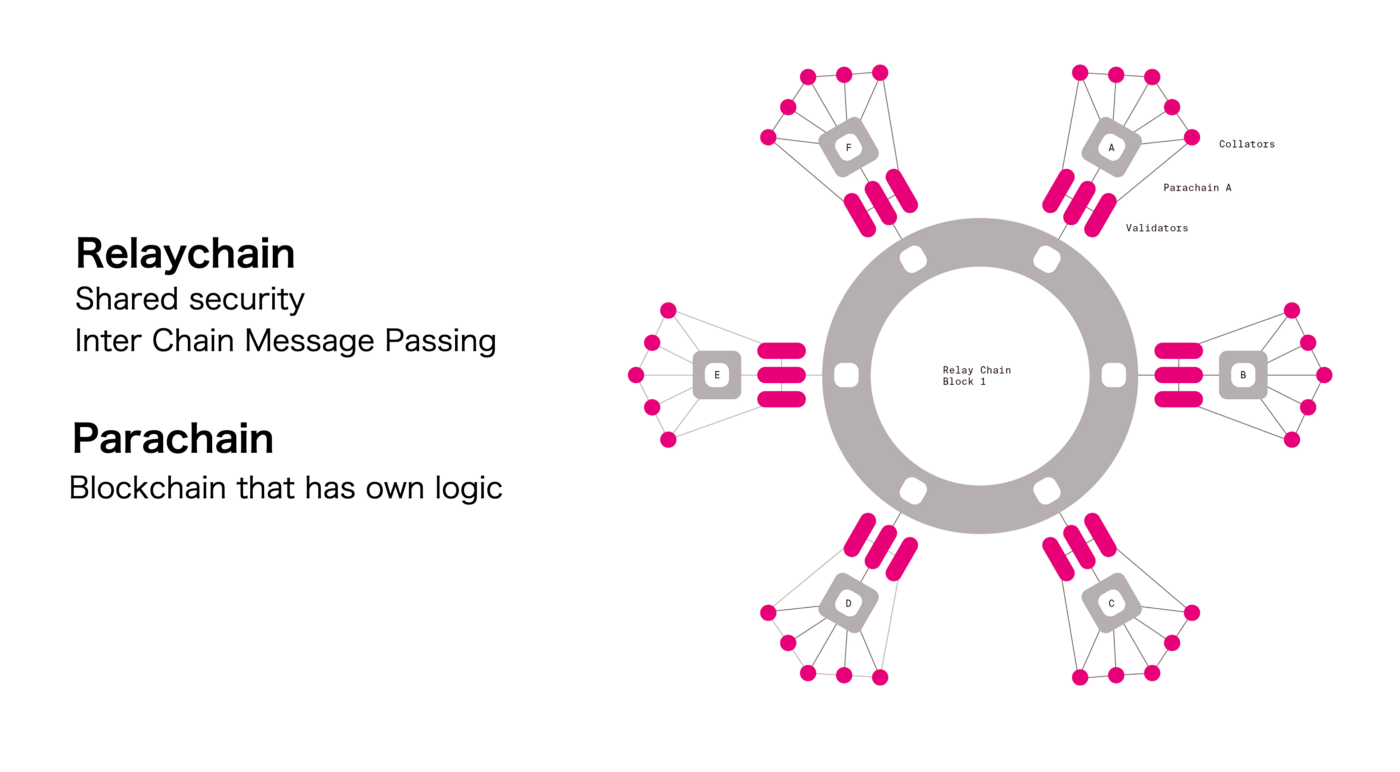
An overview of the Polkadot blockchain. | Credit: Elliptic
Meanwhile, Kusama, launched in 2019 as Polkadot’s wild cousin, played a pivotal role in this period. Often called a canary network, Kusama allowed developers to “build fast and break things” in a lower-stakes environment. Many of Polkadot’s features (governance changes, new upgrades) were first trialed on Kusama before going to Polkadot.
For example, the new governance model (OpenGov) and even scalability tests like the 2024 “Spammening” (massive stress test) were run on Kusama (more on these later). Kusama’s success demonstrated Polkadot’s tech in action and gave confidence for Polkadot’s mainnet launch
Some highlights of Polkadot’s network launch and early growth (2019–2021):
Kusama (2019):Polkadot’s canary network went live, providing an invaluable proving ground for technology and governance before mainnet. Kusama allowed thousands of builders to test ideas in a real environment, ensuring Polkadot would be secure and stable for enterprise-grade use.
Polkadot Genesis (2020): The Polkadot Relay Chain launched on May 26, 2020. Initially restricted (controlled by Web3 Foundation via Sudo) for safety, it progressively opened up: NPoS staking by June 2020, community governance by July 2020, and token transfers by August 2020. By Q3 2020, Polkadot was a fully decentralized network controlled by DOT stakeholders.
Parachains live (2021): Following over a year of testing, Polkadot held on-chain auctions for parachain slots. By December 2021, the first parachains (such as Acala, Moonbeam, etc.) were connected, enabling Polkadot’s promised parallel multi-chain functionality. This allowed Polkadot to support multiple specialized blockchains operating simultaneously under its umbrella.
Polkadot Architecture: Parachains, Relay Chain, XCMP and Shared Security
Polkadot was designed from the beginning as a multi-chain network rather than a single chain. At the center is the Relay Chain, a lean chain focused only on security, consensus, and coordination. Connected to it are parachains, which are independent blockchains that run in parallel and inherit the Relay Chain’s security.
Relay Chain: Coordinates the network, validates parachain blocks, and finalizes state. By staking DOT, validators secure all parachains together under one umbrella.
Parachains: Specialized chains (for DeFi, identity, gaming, etc.) that run in parallel. Collator nodes collect transactions, and Relay Chain validators finalize them. Even small chains benefit from Polkadot’s full validator set.
XCMP (cross-chain message passing): Built-in protocol for parachains to exchange tokens or data directly and securely. A DeFi parachain, for example, can send assets to a gaming parachain without relying on risky third-party bridges.
Shared security and scalability: All parachains share Polkadot’s validator set, avoiding duplication of security. Parallel processing allows the network to scale with each new parachain. Stress tests on Kusama showed 143,000 TPS at 23% load, pointing to over 600,000 TPS potential.
As Sedacca put it:
“Parachains give institutions custom blockchains with shared security. XCM enables safe cross-chain communication. Staking innovations provide economic security without losing efficiency.”
“For institutions, the big questions are resilience, scale, and security. Polkadot was built to answer yes to all of them.”
Is Polkadot 2.0 Complete?
Polkadot 2.0 was first announced in mid-2023, when Gavin Wood outlined a new roadmap focusing on scalability, flexibility, and long-term sustainability.
As of September 2025, Polkadot 2.0 is not yet fully complete, though important parts are already live. The upgrade is centered on three pillars:
Agile Coretime, which introduces a flexible marketplace for parachain resources;
Asynchronous Backing, which boosts throughput by letting parachains submit blocks more efficiently; and
Elastic Scaling, designed to increase parallel processing. Some features, like improvements to XCM and aspects of Elastic Scaling, have already been deployed through runtime upgrades.
Others, including the full Coretime marketplace, remain under development and community governance.
Polkadot’s Governance: OpenGov, Treasury, and On-Chain Upgrades
Polkadot’s governance ensures the network can evolve without hard forks, with decisions made by token holders directly on-chain.
Governance v1 (2020–2023): Included a Council, Technical Committee, and referenda. Crucially, Polkadot could upgrade itself via on-chain voting, avoiding disruptive forks.
OpenGov (Governance v2, 2023): Removed the Council and moved to a fully referendum-driven model. Any DOT holder can propose changes. Proposals are divided into “tracks” (e.g., small spending vs. major protocol change) with appropriate thresholds. Multiple proposals can run in parallel, and DOT holders can delegate votes to experts per track. This shift marked the full handover of control to the community.
Treasury: Funded by 15% of DOT inflation and 80% of fees, the treasury supports ecosystem development, public goods, and events. Proposals are voted on by the community, and unused funds are partially burned each spend period to encourage use.
On-chain upgrades: New runtime logic is deployed seamlessly once approved by governance. This has enabled major features like parachains and OpenGov itself, proving Polkadot can adapt quickly.
Polkadot’s governance model. | Credit: Polkadot
As Sedacca explained:
“Polkadot’s governance model is about resilience and adaptability. For institutions, this means predictability.”
“You can see every proposal, every vote, and every upgrade in real time, giving confidence the network evolves in an open environment.”
Use Cases of Polkadot
Cross-chain interoperability: Enables seamless data and asset transfer between blockchains, breaking down silos and allowing multi-chain smart contracts and token movements.
Decentralized finance (DeFi): Supports cross-chain DEXs, lending, and synthetic assets. Projects like Acala and Parallel Finance are building DeFi hubs on Polkadot.
NFTs and gaming: Facilitates interoperable NFT markets and gaming ecosystems with scalable, low-cost infrastructure. Unique Network is an example.
Enterprise solutions: Custom parachains enable supply chain tracking, payments, and digital identity, balancing privacy, compliance, and interoperability.
Governance and DAOs: Advanced on-chain governance allows DAOs, treasuries, and adaptive community decision-making directly at the protocol level.
Web3 Infrastructure: Provides identity, storage, and bridges connecting Web2 and Web3, making it a foundation for decentralized internet applications.
Shared security: The Relay Chain secures all parachains, lowering entry barriers and boosting trust for projects and users alike.
Why Cross-Chain Matters to Institutions: Polkadot Interoperability
For institutions, blockchain adoption cannot thrive in isolated silos. Banks, asset managers, and enterprises increasingly rely on multiple networks, such as public blockchains for liquidity, private chains for compliance, and specialized ledgers for settlement.
Polkadot’s interoperability allows these systems to connect seamlessly, enabling secure transfers of data and assets across ecosystems.
This cross-chain capability is crucial for building multi-asset financial infrastructure where tokenized securities, stablecoins, and even CBDCs can interact within the same framework.
It also provides a balance between transparency and privacy: private chains can operate alongside public ones, sharing only the proofs or information required for regulatory compliance.
By offering shared security through its Relay Chain, Polkadot reduces systemic risks and delivers a trusted foundation for mission-critical applications.
Just as importantly, it future-proofs institutional strategies by avoiding lock-in to a single network, giving organizations the flexibility to evolve with the broader Web3 landscape.
Polkadot and Wall Street: What’s Driving Institutional Interest
Wall Street’s interest in blockchain is shifting from speculation to infrastructure, and Polkadot is emerging as a serious contender. Its appeal lies in interoperability, such as linking private, public, and specialized chains, while providing shared security and institutional-grade risk management.
Recent moves show this interest is real. Polkadot launched Polkadot Capital Group, an institutional arm led by Dave Sedacca, aimed at bridging traditional finance with Web3.
Its focus includes real-world asset tokenization, staking, and capital markets infrastructure—areas banks and asset managers are already exploring.
In Europe, firms like 21Shares have issued regulated ETPs tied to Polkadot, giving investors compliant exposure.
Additionally, parachains like Centrifuge (which focuses on tokenizing real-world invoices and assets) have been bridging to Polkadot. The idea of on-chain finance that interacts with off-chain assets is something institutions are actively exploring, and Polkadot is positioning itself as a home for that.
Polkadot Capital Group: Mandate, Offerings, and Who It Serves
Polkadot Capital Group (PCG), launched in August 2025, represents the point where Polkadot deliberately built a bridge between its Web3 ecosystem and traditional capital markets. Instead of focusing on retail speculation, this division was designed as Polkadot’s institutional-facing arm, helping asset managers, banks, exchanges, and venture firms understand and use the network.
Mandate and Mission
PCG is described as the “capital markets-focused division of Polkadot”. Its role is to connect traditional finance with Polkadot’s infrastructure at a time when regulatory clarity in the U.S. has improved and demand from institutional players is increasing. Leadership frames its mission simply: to help institutions understand and access opportunities across the Polkadot ecosystem.
In the words of Dave Sedacca, PCG’s leader:
“When the Polkadot white paper was written in 2016, the aim was not simply to create another blockchain. It was to build a secure, flexible foundation where very different communities, from startups to institutions – could interact on equal footing. The more recent interest from traditional finance is a natural extension of that vision. What we’re seeing now is that institutions recognize the need for programmable, interoperable infrastructure to bridge markets with confidence that they’re stepping into a transparent and resilient ecosystem. That’s where Polkadot’s design and on-chain governance give us a real edge.”
In practical terms, this means:
Translating Polkadot’s technical capabilities into familiar financial language.
Demonstrating how blockchain infrastructure can serve compliance-heavy industries.
Acting as a neutral educational resource to build trust.
Offerings and Services
Polkadot Capital Group offers a suite of services tailored to different segments of the financial sector.
Insights & research: Data-driven reports on staking yields, parachain activity, and adoption metrics – helping analysts evaluate Polkadot like any other market.
Educational resources: Workshops and guides that explain Polkadot’s throughput, shared security, and governance using analogies familiar to finance (e.g., clearinghouses or settlement layers).
Ecosystem engagement: Acting as a concierge to connect institutions with relevant parachains and service providers. For instance, a bank exploring tokenized assets could be introduced to parachain teams building compliance-ready solutions.
Use case showcases: Providing detailed examples of real-world applications, such as how bonds could be issued on a Polkadot parachain and settled using stablecoins.
Product guidance: Helping exchanges, custodians, and funds integrate DOT or parachain assets. PCG also forges strategic partnerships with brokers and asset managers to co-develop institutional-grade products.
Sedacca emphasized the unique positioning:
“Institutions that are engaging with Polkadot Capital Group and other ecosystem partners recognize the infrastructure here is different. This isn’t just another smart contract chain; Polkadot was built for scale, for shared security, for real-world applications. That’s why we’re quietly running 50 million transactions a month and proving that speed and decentralization can be synonymous.”
Who It Serves
PCG’s mandate explicitly lists:
Asset managers and allocators (hedge funds, pension funds, sovereign wealth funds).
Banks and exchanges exploring tokenized settlement or new asset classes.
OTC desks and brokers looking to trade or custody DOT and parachain tokens.
Venture capital firms scouting Polkadot startups.
“Traditional finance wants data, education, and the confidence that this isn’t just hype. That’s where Polkadot Capital Group comes in – making sure these conversations are happening in boardrooms, with asset managers, gatekeepers, and across capital markets. After ten years of building, the time is now to bridge Web3 with traditional finance,” Sedacca emphasized.
By centralizing knowledge and support, PCG lowers barriers for institutions to enter the Polkadot ecosystem. For example:
A pension fund might seek DOT staking exposure as a yield-generating product.
A bank could explore inter-bank settlement using a Polkadot parachain.
An exchange may want best practices for listing parachain-native assets.
A VC firm might look for introductions to promising parachain projects.
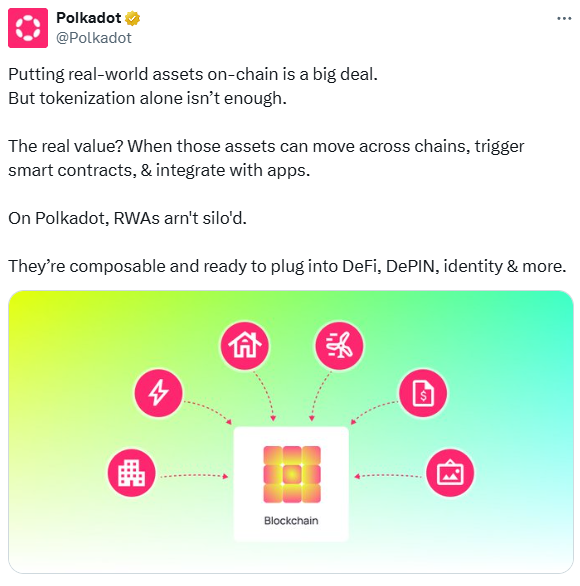
How Polkadot Makes Real-World Assets Work On-Chain
Real-world assets (RWA), such as bonds, real estate, invoices, or even commodities, are gaining traction in blockchain. Polkadot’s design makes it especially strong for RWA use cases.
Polkadot’s X post on RWA. | Credit: Polkadot X profile
Custom chains for compliance: Parachains can embed rules like KYC checks or transfer restrictions, aligning on-chain tokens with legal requirements.
Tokenization and settlement: Assets like Treasury bills could be issued on one parachain, while payments happen with stablecoins on another, enabling fast, 24/7 settlement.
Ecosystem examples: Projects such as Centrifuge tokenize invoices and mortgages, already demonstrating Polkadot’s potential to link real-world lending with DeFi liquidity.
Asset hub: A common-good parachain for simple token issuance makes it easier for smaller issuers to tokenize assets without running a full chain.
Trust and transparency: Governance ensures upgrades or fixes can be rolled out smoothly, while expert bodies like the Fellowship safeguard urgent technical changes.
Polkadot Leadership: Gavin Wood’s Return to Parity Technologies and Strategic Roadmap
On Aug. 13, 2025 Wood announced he would resume his role as CEO at Parity Technologies and has emphasized that Polkadot’s long-term success depends on more than just technology, it’s about vision. With Gavin Wood returning to guide strategy and Dave Sedacca leading Polkadot Capital Group, the Polkadot roadmap reflects both technical innovation and institutional engagement.
At its heart, Polkadot continues to build toward a future where individuals and institutions alike operate on decentralized rails. As Sedacca explained:
“Polkadot’s vision has always been clear: owning your data and controlling your identity.”
Over the next five years, this vision ties directly to financial infrastructure moving fully on-chain. Sedacca highlighted how this could affect everyday users:
“In the next five years, we envision financial rails moving fully on-chain, where users manage bank accounts in their own wallets and pay for services without going back to a bank.”
This future rests on Polkadot’s model of shared infrastructure. Rather than each project building a blockchain from scratch, Sedacca emphasized the importance of using proven foundations:
“Countless single-purpose blockchains spin up centralized first, but that model can’t scale. The better path is to partner with proven infrastructure. Enter Polkadot: battle-tested and ready.”
Looking further ahead, Polkadot is preparing to launch its Join-Accumulate Machine (JAM), designed to expand beyond smart contract limits and deliver internet-scale computing. Sedacca positioned JAM as the next leap:
“Imagine the next phase of the internet – not just cloud, but a decentralized operating system for compute, storage, and data.”
“JAM will power billions of transactions a month across industries, the same way today’s operating systems quietly power almost everything we do today.”
“And underpinning all of this will be a human dimension. With Dr. Gavin Wood back as Parity CEO, Polkadot is also doubling down on Proof of Personhood because of the growing need to distinguish real humans from AI agents. These are not side projects but core to how we see Web3 maturing: technology that serves real people, builds trust, and makes the world more empowering and delightful. In five years, that blend of advanced infrastructure and human-centered design will define Polkadot’s place in the broader blockchain and financial landscape,” noted Sedacca.
Why Polkadot’s Story Isn’t Just About DOT’s Chart
For many market watchers, Polkadot’s success is tied to its price ticker. DOT’s chart swings with sentiment, like any other token, but focusing solely on price misses the bigger story.
Polkadot was never designed as a speculative asset first; it was designed as an interoperability protocol to connect blockchains, secure parachains, and serve as infrastructure for the next phase of Web3.
Behind the price action, Polkadot has made steady progress: parachain auctions that expanded its ecosystem, cross-chain messaging that unlocked interoperability, and governance reforms that put decision-making fully on-chain.
More recently, institutional-facing initiatives such as real-world asset tokenization and Polkadot Capital Group signal a push beyond retail speculation into the structures of global finance.
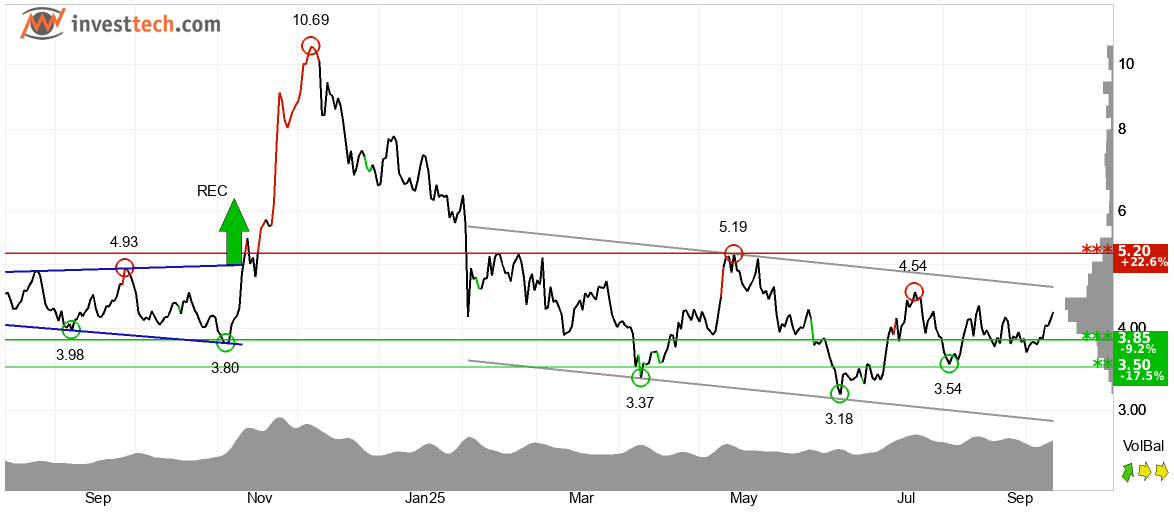
DOT’s Technical Analysis
DOT is currently trading within a medium- to long-term falling trend channel, reflecting that investors have gradually sold at lower levels, signaling an overall negative trajectory.
DOT technical analysis. | Credit: Giuseppe Fabio Ciccomascolo/InvestTech
However, in the short term, the token has broken above a resistance level, giving a positive signal for the near-term trading range. Key technical levels to watch are support around $3.85 and resistance near $5.20.
Notably, volume peaks and troughs have aligned closely with price tops and bottoms. This correlation suggests that selling pressure may be weakening, which could serve as an early indication of a potential trend reversal.
Bottlenecks to Polkadot’s Institutional Adoption
Polkadot is positioning itself as a bridge between Wall Street and Web3, but several obstacles could slow down its institutional momentum.
Regulatory uncertainty: Lack of clear global rules around securities and custody keeps institutions cautious.
Limited track record: Few large-scale, real-world tokenization projects exist yet on Polkadot; without case studies, adoption remains experimental.
Custody and infrastructure gaps: Institutions need insured custody, audits, and smooth integration with legacy systems—still developing in Polkadot’s ecosystem.
Institutional inertia: Banks and asset managers move slowly due to risk committees, compliance hurdles, and legacy processes.
Polkadot’s Future Outlook: What Developments to Watch
If the past nine years were about building Polkadot’s foundation, the next few years are about scaling and adoption.
Here are the key scenarios to watch in 2025 and beyond:
RWA marketplaces: Expect tokenized securities, interbank settlement parachains, or even government bond issuance on Polkadot. Partnerships led by Polkadot Capital Group could be critical milestones.
User adoption: Tools like Polkadot Hub and Polkadot App may make DOT more user-friendly, with potential for a flagship consumer app (social, gaming, or payments) to bring millions of users by 2027.
Governance evolution: OpenGov may adjust as adoption grows. Metrics like voter turnout and the rise of independent dev teams beyond Parity will show how decentralized governance has become.
Tokenomics adjustments: Proposals could refine DOT’s economics (inflation, fees, or supply caps) to ensure sustainable growth and validator security.
As Gavin Wood noted upon his return to lead Parity Technologies, the engineering firm helping to build Polkadot’s infrastructure, the focus is now on accelerating growth and the measure of success will be real-world impact, not just technical milestones.
Conclusion
Polkadot’s nine-year evolution shows that its story was never just about the price of DOT, but about building the foundations of a new financial and technological order.
What began as a white paper vision of interoperability has matured into an ecosystem capable of connecting blockchains, securing real-world assets, and attracting Wall Street’s attention.
The next phase will test whether Polkadot can translate technical innovation into sustained institutional adoption. Regulation, trust, and large-scale case studies will matter as much as throughput or governance models.
If it succeeds, Polkadot won’t simply be remembered for creating another digital asset—it will be seen as the protocol that helped bridge traditional finance and Web3, turning a bold vision into institutional reality.
Polkadot is a blockchain network created in 2016 by Dr. Gavin Wood to connect many specialized blockchains into one secure, interoperable system. It enables different chains to work together, scale through parachains, and upgrade without forks. The vision is to form the foundation of a decentralized Web3.
What makes Polkadot different from Ethereum or Bitcoin?
Unlike single-chain networks, Polkadot uses a Relay Chain plus many parachains running in parallel. This allows high throughput, secure cross-chain messaging, and customization for different use cases. It was designed for interoperability and governance from day one.
What is Polkadot Capital Group and why does it matter?
Launched in August 2025, Polkadot Capital Group connects traditional finance with the Polkadot ecosystem. It offers research, education, and partnerships for banks, asset managers, and exchanges. Its creation signals Polkadot’s shift toward institutional adoption.
How does Polkadot upgrade without forks?
Upgrades are decided through on-chain governance where DOT holders vote on proposals. Once approved, new runtime code is deployed automatically across the network. This makes improvements seamless and transparent without chain splits.
Disclaimer:
The information provided in this article is for informational purposes only. It is not intended to be, nor should it be construed as, financial advice. We do not make any warranties regarding the completeness, reliability, or accuracy of this information. All investments involve risk, and past performance does not guarantee future results. We recommend consulting a financial advisor before making any investment decisions.
Giuseppe Ciccomascolo began his career as an investigative journalist in Italy, where he contributed to both local and national newspapers, focusing on various financial sectors.
Upon relocating to London, he worked as an analyst for Fitch's CapitalStructure and later as a Senior Reporter for Alliance News. In 2017, Giuseppe transitioned to covering cryptocurrency-related news, producing documentaries and articles on Bitcoin and other emerging digital currencies. He also played a pivotal role in establishing the academy for a cryptocurrency exchange website. Crypto remained his primary area of interest throughout his tenure as a writer for ThirdFloor.


 Easy