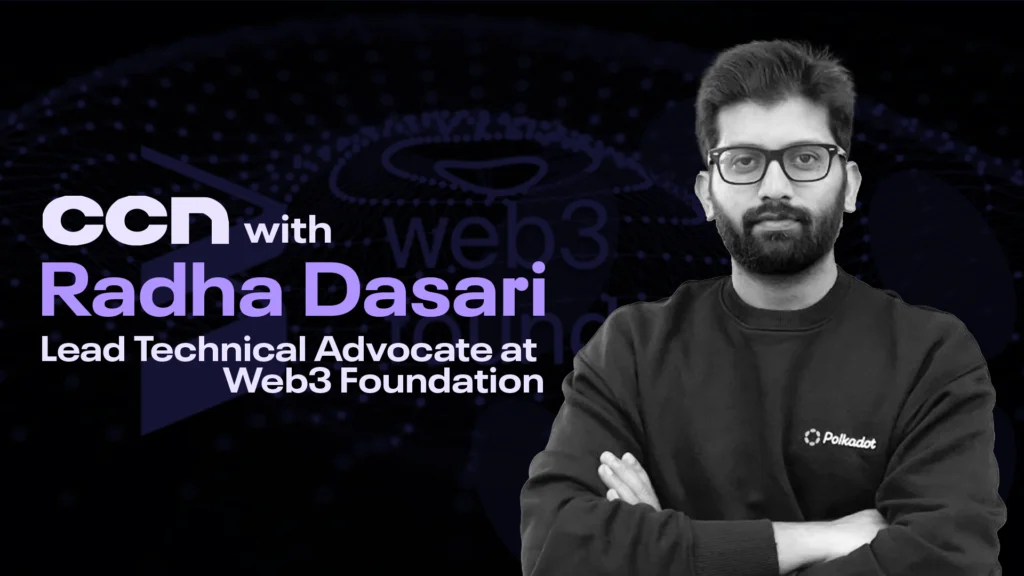
Radha Dasari, Lead Technical Advocate at the Web3 Foundation | Source: CCN
Share
Key Takeaways
Deepfakes have reached a point where even experts struggle to tell real from fake.
Web3 Foundation’s Radha Dasari believes features like content credentials are key to fixing the problem.
Dasari sees Polkadot’s Proof of Personhood framework as crucial for fighting bots on platforms like X.
We live in an online age of uncertainty where the truth and fabrication are increasingly blurred.
Deepfakes, AI-generated bots, and data misuse have created a world of uncertainty for anyone browsing social media or operating online.
To unpack these issues, CCN spoke with Radha Dasari, Lead Technical Advocate at the Web3 Foundation, the organization that helped launch Polkadot.
Dasari and his team are on a mission to figure out how technology can provide an “anchor for truth” in an increasingly complicated digital world.
In this special CCN interview, Dasari discusses Denmark’s landmark proposal to give people copyright control over deepfakes, why proof of personhood is key to fighting bots on platforms like X, and how decentralized social media could give users ownership of their online lives.
Try Our Recommended Crypto Exchanges
Sponsored
Disclosure
We sometimes use affiliate links in our content, when clicking on those we might receive a commission at no extra cost to you. By using this website you agree to our terms and conditions and privacy policy.
Dasari’s early roots in computer vision shaped his concerns about deepfakes over a decade ago.
“I did my PhD in computer vision. Basically, I started grad school in 2012 when the first deep learning paper got published.
“Since then, I’ve seen the field evolve from something where you had to put your brain to come up with techniques, to a black box where you feed in data and just get answers.”
Four years ago, he pivoted into blockchain, driven by a desire for an “anchor for truth” in an increasingly synthetic digital landscape.
“I was worried about how vulnerable we are to fakes even back then. Today’s technology has surpassed my imagination. I didn’t think it would come this quick.”
Denmark’s Landmark Bill on Deepfakes
As deepfakes become increasingly sophisticated, the question of personal consent and legal control has intensified.
Denmark’s proposed legislation aims to give individuals copyright control over deepfakes of their face or voice.
Dasari emphasized how deeply this issue resonates beyond video manipulation.
“Using your data without consent, I think this has been a broader problem. It’s not just your facial image, but a lot of the personal data that we use online, a lot of public information, a lot of companies crawl through that data and then train their models,” he told CCN.
“What Denmark has proposed makes sense because I wouldn’t want someone to reuse my public data to create something that I haven’t consented to.”
This perspective, Dasari believes, relates to the emerging role of content credentials, a framework designers hope could empower individuals to set their own usage rights.
“This got me thinking, if there is a way in which we could set a content credential that says, hey, you can use this for training purposes or no, you shouldn’t be using it for training purposes,” Dasari explained.
At the Web3 Foundation, Dasari said they were exploring ways this could become a reality for the creator economy, which remains under threat financially and artistically.
“At the Web3 Foundation, we’re trying to see how to make this seamless,” he said. “For creator economy, there could be a way in which I can say, ‘yes, you can use for training,’ but there’ll be some form of micro payment that rewards me as a royalty for the usage of my data.”
“So it’s very much possible with the frameworks that we have right now to be able to create a solution that addresses the issue.”
Polkadot’s Proof of Personhood Could Kill Bots
One of Polkadot’s most ambitious initiatives is proof of personhood, a privacy-preserving way to verify human identity online.
The Web3 Foundation has been working closely with the project to advance this vision.
“Proof of personhood is mainly for spam prevention, it ensures resources are limited to people rather than bots,” Dasari explained.
Polkadot’s initiative becomes extremely important on places like X, where AI-generated bots have become rampant.
“There is a need for an authentic social media where the content is authentic and the people are authentic,” Dasari said. “Proof of personhood and content credentials are going to play a huge role.”
Instead of relying on clunky CAPTCHAs or paid verification models, Polkadot’s PoP would provide a lightweight way for platforms to differentiate humans from bots.
Users wouldn’t need to reveal their identity, just cryptographically prove they are a real person.
“X wouldn’t want to ask each time, ‘Hey, solve this CAPTCHA to post a tweet.’ If a proof of personhood standard becomes widely adopted, it could be exposed through an API that X could use,” Dasari explained.
“Then you could build new features, like allowing only verified humans to reply to posts. That would very quickly change the experience on social media,” he added.
Unlike Sam Altman’s WorldCoin, which relies on iris-scanning hardware, Polkadot’s approach focuses on scalable, decentralized, internet-based methods.
“Anyone with internet should be able to prove they’re human with the resources available,” he said.
“We have seen like biometric solutions across like different countries as well. Yes, it can work very well, but onboarding 7 billion people onto it is a huge challenge.”
Decentralized Social Media
Dasari believes the real breakthrough lies in rethinking social media itself.
Current platforms, he argued, are broken by design, extracting revenue by centralizing and monetizing user data.
“Every time you go to a specific social media app, you’re giving consent for them to process your private data somehow,” he said.
“All the revenue that Facebook or TikTok or these are earning, it’s purely through the user data, either the data that user is posting or either the data they’re inferring from the user behavior somehow.”
Projects like Frequency, a Polkadot parachain, are experimenting with decentralized social graphs that allow users to own and carry their networks across platforms.
“These connections that we are making in the real life, they need not be siloed on a specific app like LinkedIn or Facebook or Instagram,” Dasari explained.
“You’re recreating your network each time you’re going to these different apps. And that’s where fundamentally social media is broken. It hasn’t changed much since Facebook launched.”
Dasari believes social media needs a new model that mirrors real-world relationships but is secured cryptographically and not owned by any single corporation.
“We’d like to see a decentralized social networking protocol that is trying to have these people connections embedded in a cryptographic graph, which could be put on a decentralized solution, right? We don’t want to have this data sitting on a central server again,” he said.
Kurt Robson is a London-based reporter at CCN, specialising in the fast-moving worlds of crypto and emerging technology. He began his career covering local news in Cornwall after graduating from Falmouth University with First Class Honours in Journalism. There, he cut his teeth on everything from council meetings to missing swans.
He quickly rose through the ranks to become a frontline journalist at several of the UK’s leading national newspapers. Over the years, he has interviewed musicians and celebrities, reported from courtrooms and crime scenes, and secured multiple front-page exclusives.
Following the upheaval of the COVID-19 pandemic, Kurt shifted his focus to technology journalism—just ahead of the AI boom. With a natural curiosity and a trained eye for emerging trends, he has found a new rhythm in reporting on innovation.
At CCN, Kurt's work focuses on the cutting edge of crypto, blockchain, AI, and the evolving digital world. Drawing on his background in people-first reporting and his deep interest in disruptive tech, Kurt delivers stories that are insightful, entertaining, and human-centric.