South Korea Pulls $657M From Tesla: Here’s Why 30% of Investors Choose Crypto | Credit: Hameem Sarwar /CCN
Share
Key Takeaways
Tesla’s choice to exit most of its Bitcoin holdings at a low point cost it billions in potential gains.
Regulatory mandates by KoFIU transformed South Korea’s crypto landscape, boosting trust among retail investors.
Millennials and Gen Z are now driving adoption, placing smaller bets but shaping market momentum.
Macro factors and evolving policy will continue to dictate who wins or regrets in the next wave of crypto activity.
As of mid-2025, the landscape of cryptocurrency adoption is shifting fast.
South Korea has emerged as one of the world’s most active crypto markets, with more than 30% of the population holding digital assets.
Retail adoption is rising fast, led by millennials and Gen Z who see crypto as an alternative to traditional investments.
Tesla cautioned in 2022 when it sold 75% of its Bitcoin (BTC) holdings during a market downturn, missing out on potential billions in gains.
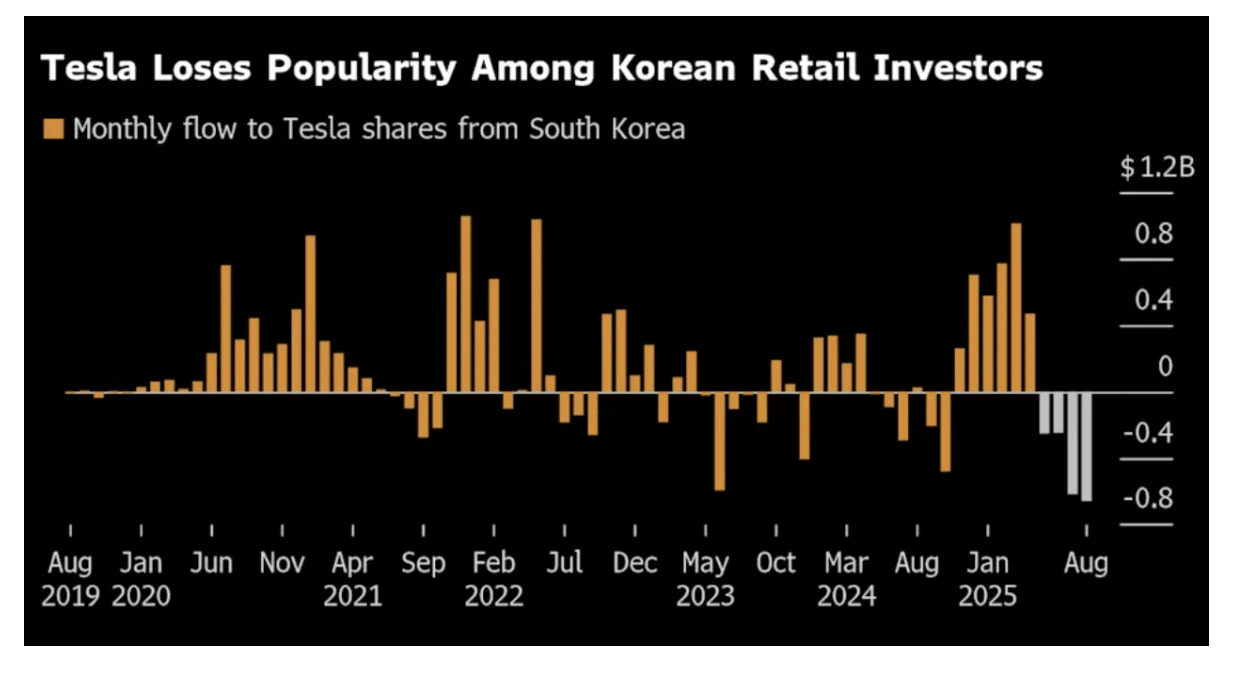
As of September 2025, Korean investors are also shifting strategy. They are pulling $657 million out of Tesla in August and redirecting more than $12 billion this year into crypto-linked equities, signaling a clear preference for digital assets over U.S. tech stocks.Together, these moves highlight rapid changes in South Korea in the perception of crypto.
Monthly flow | Source: Bloomberg
This article explores what’s driving this retail boom, what crypto investors’ decisions reveal, and where both risks and opportunities lie for both individuals and institutions.
South Korea’s Crypto Boom Explained
South Korea has long been known for its high-tech infrastructure, keen retail investor base, and cultural leanings toward early adoption.
Try Our Recommended Crypto Exchanges
Sponsored
Disclosure
We sometimes use affiliate links in our content, when clicking on those we might receive a commission at no extra cost to you. By using this website you agree to our terms and conditions and privacy policy.
In 2024, their total holdings exceeded 102.6 trillion Korean won (roughly USD $70-75 billion depending on exchange rates then), up from 58 trillion won just a month earlier.
Furthermore, as of mid-2025, approximately 32% of the population (over 16.5 million) uses crypto in the country, surpassing stock investors and fueled by regulatory trust and global market highs.
By the end of 2025, this figure could reach 20 million.
Several factors have fueled this boom:
Regulatory clarity: The Virtual Asset User Protection Act forced VASPs to segregate client funds, meet security standards, and comply with anti-money laundering (AML) rules, a shift that restored public confidence.
Retail investor momentum: Younger generations, especially Millennials and Gen Z, are increasingly distrustful of low-yielding traditional savings vehicles amid inflation and see crypto both as a speculative upside and a hedge.
Global political and economic ripple effects: U.S. election outcomes, shifts in regulation overseas, crypto market cycles have, in multiple reports, shifted risk appetite in Korea.
These factors worked alongside a sweeping regulatory clean-up that reshaped the market and rebuilt investor trust.
How Regulation Reshaped South Korea’s Crypto Market
According to scholarly research, South Korea’s crypto landscape changed dramatically after the government tightened oversight through amendments to the Specific Financial Information Act.
VASPs were required to report to the Korea Financial Intelligence Unit (KoFIU), to secure partnerships with banks for real-name verified accounts, and obtain the Information Security Management System (ISMS) certification.
These requirements, outlined under Article 7 of the Act, were designed to enforce AML standards and improve transparency across the industry.
The law granted a six-month transitional grace period, ending on 24 September 2021, after which any exchange operating without KoFIU registration faced criminal penalties under Article 17.
The impact was immediate: of nearly 60 crypto exchanges in operation before the deadline, only five, Upbit, Bithumb, Coinone, Korbit, and later Gopax, met the new standards and kept offering KRW fiat deposit and withdrawal services. Smaller platforms either shut down or pivoted to crypto-only models.
Further measures included the implementation of the Travel Rule (Article 6) in March 2022, which required exchanges to collect and share sender and recipient information for transactions above a threshold.
The collapse of Terra-Luna in May 2022 compounded the shake-up, driving down trading volumes through 2023 before a gradual recovery began in 2024.
As confidence slowly returned, a new wave of investors, especially Millennials and Gen Z, began to dominate trading activity, shaping South Korea’s current crypto boom.
Millennials & Gen Z: Shaping South Korea’s Crypto Market
Unlike some markets where institutional actors lead adoption curves in South Korea, the current impetus is essentially from retail. Millennials and Gen Z are:
More digitally native, already comfortable with fintech, mobile wallets, games, and online trading.
They are facing economic pressure, including low interest rates, inflation, and wage stagnation, which are all pushing them toward assets with higher risk/reward.
More exposed to social media and overseas signals: they see crypto showcased as growth, as a deflationary or inflationary hedge, as an opportunity.
While detailed demographic breakdowns are not yet available, surveys and industry commentary indicate that younger households are disproportionately likely to hold smaller crypto portfolios.
Also, many are first-time investors, often allocating modest percentages of their savings to digital assets rather than entirely shifting away from traditional investments.
Tesla’s $936 Bitcoin Sell-Off: What It Means
While retail in South Korea ramps up, big corporate players have been more cautious. Tesla provides a case study in timing, risk management, and opportunity cost.
In early 2021, Tesla invested about USD $1.5 billion in Bitcoin (BTC).
In mid-2022, during a severe downturn in crypto markets, Tesla sold around 75% of its Bitcoin holdings (about USD $936 million worth) at prices near USD $20,000 per coin.
After months/years of cryptocurrency recovering strongly, Tesla’s remaining Bitcoin holdings (plus what it retains or reinvests) are valued at approx USD $1.24 billion (as of its recent earnings reports).
The missed opportunity is substantial: some estimates put what Tesla could have profited by holding onto that 75% at USD $3.5-4+ billion or more, depending on current Bitcoin pricing.
So What Does Tesla’s Move Show?
It highlights how corporate decisions around crypto are about price charts and a delicate balance of financial strategy, market psychology, and timing.
Tesla’s actions reveal three key lessons for any company considering digital assets:
Liquidity over speculation: The decision to sell was reportedly motivated by a need for cash/liquidity in a challenging macroeconomic environment: inflation, rising rates, and business pressures (supply chain, production). For firms, there’s always tension between maximizing return vs preserving cash / balancing risk.
The cost of risk-aversion: Acting too conservatively (selling early) can avoid losses but can also mean missing outsized gains when an asset class rebounds. Tesla’s case is now often cited in that light.
Timing matters: Assets with high volatility magnify both the upside and the downside. For companies making public treasury decisions, timing (or mistiming) can shift billions.
The bigger picture: crypto’s promise comes with real risks that affect not just corporations but millions of retail participants. Understanding those risks is essential to navigating the market in 2025.
Retail Pivot: Koreans Shift Cash from Tesla to Crypto Stocks
Tesla’s retreat from Bitcoin raised questions about timing and risk. Korean retail investors are taking a different approach. In August 2025, they sold $657 million worth of Tesla shares, marking their largest monthly pullback in years, and redirected more than $12 billion this year into U.S.-listed crypto-linked companies.
Bought more than US$12 billion in U.S.-listed crypto firms (such as Bitmine, Circle, and Coinbase) in 2025.
In August 2025 alone, they bought roughly $426 million worth of Bitmine, $226 million of Circle, and $183 million of Coinbase shares.
These investors also put about $282 million in a 2x Ethereum ETF, showing interest in leveraged crypto exposures.
The share of crypto-linked stocks among Koreans’ top overseas picks rose from 8.5% in Jan to 36.5% in June, then slightly dropped to 31.4% in July.
This shift in South Korea’s retail investment behavior shows how global capital flows are evolving. Once strong supporters of Tesla and its vision, many of these investors are now turning their attention to the fast-moving crypto market.
The change reflects a deliberate bet on digital assets as the next wave of technological growth rather than a simple reaction to Tesla’s recent struggles.
Challenges and Risks of Crypto Adoption in 2025
With the rise in adoption, both in South Korea and globally, it’s not all upside down. Several serious risks and headwinds:
Regulatory risk/policy uncertainty: South Korea has progressed with rules like the Virtual Asset User Protection Act, but many regulatory details are still evolving: tax policy delays, rules for stablecoins, overseas crypto exchanges, user protections. Abrupt policy changes could hurt markets or investor confidence.
Volatility: Crypto assets continue to swing widely. Price drops can wipe out gains quickly, hitting first-time investors the hardest.
Security and fraud risks: Hacks, phishing, and rug pulls remain a threat. Exchanges and decentralized platforms (DeFi) are improving, but vulnerabilities still exist.
Market structure issues: Smaller coins often lack liquidity, creating slippage and pricing gaps. Retail users have fewer hedging tools compared to institutions.
Social and behavioral risks: Herd behavior on social media can lead to panic buying or selling, causing losses for inexperienced participants.
These challenges underline the need for both retail investors and corporations to approach crypto with clear strategies and risk awareness. The next phase will depend on how participants adapt to a maturing market and shifting regulations.
South Korea now stands as one of the most closely watched test cases for large-scale crypto adoption. What happens next in this market could influence regulatory thinking and investor behavior across the continent and internationally.
Retail participants and corporations must adapt to a landscape that is becoming more regulated and more competitive. The following are some important elements to consider:
Maturing regulation: Expect more detailed rules on taxation, stablecoins, and cross-border flows. Regulators are working to protect investors while preventing capital flight, with the Bank of Korea and financial authorities actively debating new frameworks.
Institutional returns (or regrets): Tesla’s $936 million Bitcoin exit is a cautionary tale. Its early sell-off shows how corporate risk-aversion can mean missing billions in potential gains. Other companies will likely revisit crypto exposure but with tighter governance and pre-set exit strategies.
Greater retail-institutional overlap: Growing retail participation is pushing infrastructure forward, with more custodians, wallets, Exchange-Traded Fund (ETFs), and derivatives coming to market for individual investors, blurring the line between corporate and retail adoption.
Technological and product innovation:Layer-2 solutions, staking, cross-chain tools, and NFTs with utility will make crypto use cases more practical and keep users engaged beyond simple speculation.
Global drivers stay in control: Policy rates, cross-border rules, and geopolitics will keep steering market sentiment.
Conclusion
The rise in crypto adoption among South Koreans is rooted in years of regulatory cleansing and infrastructure building. The Specific Financial Information Act and KoFIU mandates forced exchanges to formalize or close. Those changes and macroeconomic pressures created a safer environment for widespread retail investment.
Yet Tesla’s decision to sell 75% of its Bitcoin in mid-2022 remains a stark reminder: for corporations, poor timing turned potential gains into lost opportunity, forcing companies to rethink their strategy.
As regulation tightens, markets stabilize, and more people come in, the cost of playing it too safe becomes clearer.
Looking ahead, crypto in South Korea and global corporate treasuries must balance risk and reward. Success will favor those who build strong governance, embrace innovation, and stay nimble. The story isn’t over; it’s entering its most defining phase.
What role do Korean banks play in crypto adoption today?
Major banks partner with exchanges to offer real-name verified accounts, which are mandatory for fiat deposits and withdrawals.
Has South Korea considered a central bank digital currency (CBDC)?
Yes. The Bank of Korea is running CBDC pilot programs, testing wholesale and retail use cases to study efficiency and privacy.
Are Korean pension funds investing in crypto yet?
Not directly. Most pension funds remain cautious, but some have exposure through blockchain ETFs and tech-heavy indexes.
How has Terra-Luna’s collapse shaped policy since 2022?
It triggered calls for stricter stablecoin oversight and investor protection measures that continue to guide regulation in 2025.
Disclaimer:
The information provided in this article is for informational purposes only. It is not intended to be, nor should it be construed as, financial advice. We do not make any warranties regarding the completeness, reliability, or accuracy of this information. All investments involve risk, and past performance does not guarantee future results. We recommend consulting a financial advisor before making any investment decisions.
Dr. Lorena Nessi is an award-winning journalist and media technology expert with 15 years of experience in digital culture and communication. Based in Oxfordshire, UK, she combines academic insight with hands-on media practice.
She holds a PhD in Communication, Sociology, and Digital Cultures, and an MA in Globalization, Identity, and Technology.
Lorena has taught at Fairleigh Dickinson University, Nottingham Trent University, and the University of Oxford. She is a former producer for the BBC in London, with additional experience creating television content in Mexico and Japan.
Her research focuses on digital cultures, social media, technology, capitalism, and the societal impact of blockchain innovation.
She has written extensively on digital media and emerging technologies, with her work featured in both academic and media platforms. Her Web3 expertise explores how blockchain technologies shape culture, economics, and decentralized systems.
Outside of work, Lorena enjoys reading science fiction, playing strategic board games, traveling, and chasing adventures that get her heart racing. A perfect day ends with a relaxing spa and a good family meal.


 Easy
Easy