USR stablecoin crashed 70% after a $24M exploit. Learn how unbacked tokens were minted, why it lost its peg, and what it means for DeFi security. | Credit: CCN.com
Share
Key Takeaways
An attacker gained access to a privileged key, allowing him to mint 80 million unbacked USR tokens and drain funds.
The protocol worked exactly as intended, exposing flawed assumptions around trust and security.
The stablecoin crashed to $0.047 before partially recovering, highlighting how quickly confidence can evaporate.
Resolv Labs stated that reserves were largely unaffected, though market trust took a major hit.
On Mar. 22, the decentralized finance (DeFi) ecosystem was shaken once again as Resolv Labs’ USR stablecoin suffered a devastating exploit that wiped out tens of millions in value and triggered a dramatic loss of market confidence.
Within hours, the stablecoin, designed to maintain a steady peg, collapsed by over 95%, falling as low as $0.047 before partially recovering. The attacker walked away with approximately $24 million in ETH and other assets, exposing not just a vulnerability, but a deeper structural flaw in the protocol’s design.
The incident has quickly become one of the most discussed security failures of 2026, not because of a complex smart contract bug, but because the system behaved exactly as it was designed to.
This raises critical questions about trust assumptions, risk management, and the evolving security standards of DeFi.
How the Resolv Labs USR Stablecoin Exploit Happened
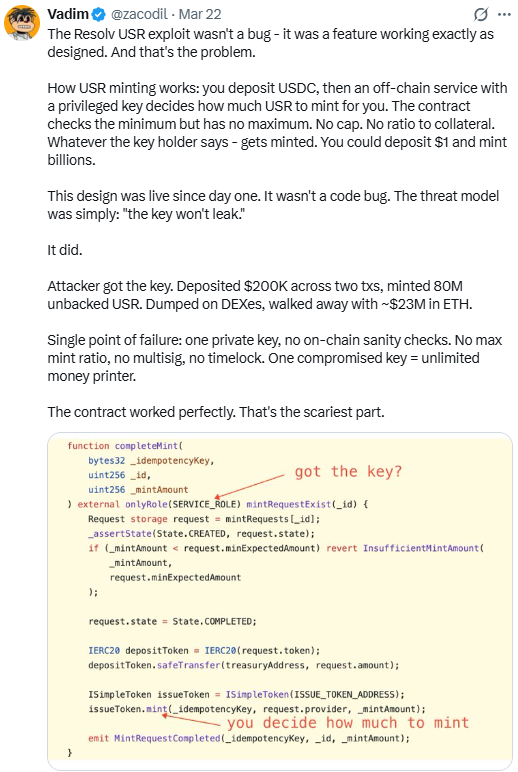
According to initial reports and on-chain analysis, the exploit was enabled by the compromise of a privileged private key tied to USR’s minting mechanism. This key allowed an off-chain service to determine how many USR tokens could be minted when users deposited collateral, typically USDC.
The attacker leveraged this mechanism in a straightforward but devastating way:
Deposited approximately $200,000 in USDC across two transactions.
Used the compromised key to mint around 80 million unbacked USR tokens.
Extracted roughly $24 million in ETH and other assets.
How the exploit occurred. | Credit: Vadim X profile
Because the system lacked upper bounds or on-chain verification of minting ratios, the attacker effectively turned the protocol into a “money printer.”
This wasn’t a traditional hack involving code manipulation or reentrancy. Instead, the attacker exploited trust assumptions embedded in the protocol’s architecture.
Why the USR Stablecoin Lost Its Peg and Crashed Over 95%
Stablecoins rely heavily on market confidence. Once that confidence is shaken, depegging can happen rapidly, and that’s exactly what unfolded.
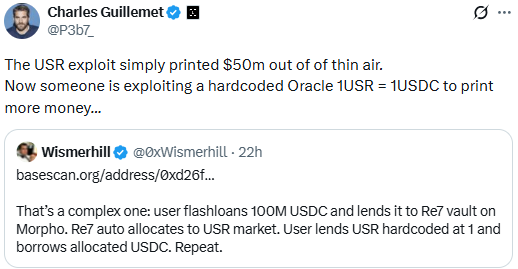
How the users took the news. | Credit: Charles Guillemet X profile
Following the exploit:
USR plunged over 95%, reaching a low of $0.047.
Panic selling intensified as liquidity pools were drained.
Arbitrage opportunities accelerated the collapse.
The token later recovered to around $0.26, but remained far below its peg.
This price action reflects a familiar pattern in DeFi crises: once a stablecoin loses credibility, recovery becomes extremely difficult, even if underlying collateral remains intact.
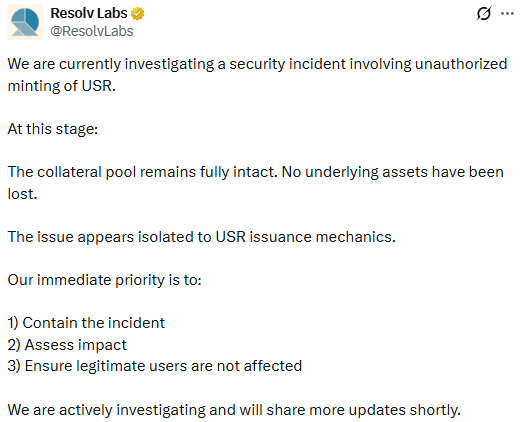
Resolv Labs Response: Protocol Halt, Token Burn, and User Redemptions
Announced plans to begin redemptions for pre-incident holders starting Mar. 23.
Resolve Labs responded promptly to the issue. | Credit: Resolve Labs X profile
The team emphasized that losses were “minimal” relative to total collateral, suggesting that the exploit primarily affected market dynamics rather than underlying reserves.
However, the distinction between technical solvency and market trust is crucial. Even if reserves remain intact, the perception of insecurity can be enough to destabilize a stablecoin.
USR Exploit Explained: Why It Was a Design Flaw, Not a Bug
One of the most striking aspects of this incident is that it was not caused by a coding error. As several analysts pointed out, the system functioned exactly as intended.
This means that whoever controls the key effectively controls the entire monetary supply.
As one observer noted, the protocol’s threat model boiled down to a single assumption: “The key won’t leak.”
In decentralized systems, this is a dangerously fragile premise.
DeFi Security Risks: The Danger of Centralized Control Mechanisms
The USR exploit highlights a recurring contradiction in DeFi: many protocols claim decentralization while relying on centralized components.
In this case, the system depended on:
A single private key
No multisig protections
No timelocks
No on-chain validation mechanisms
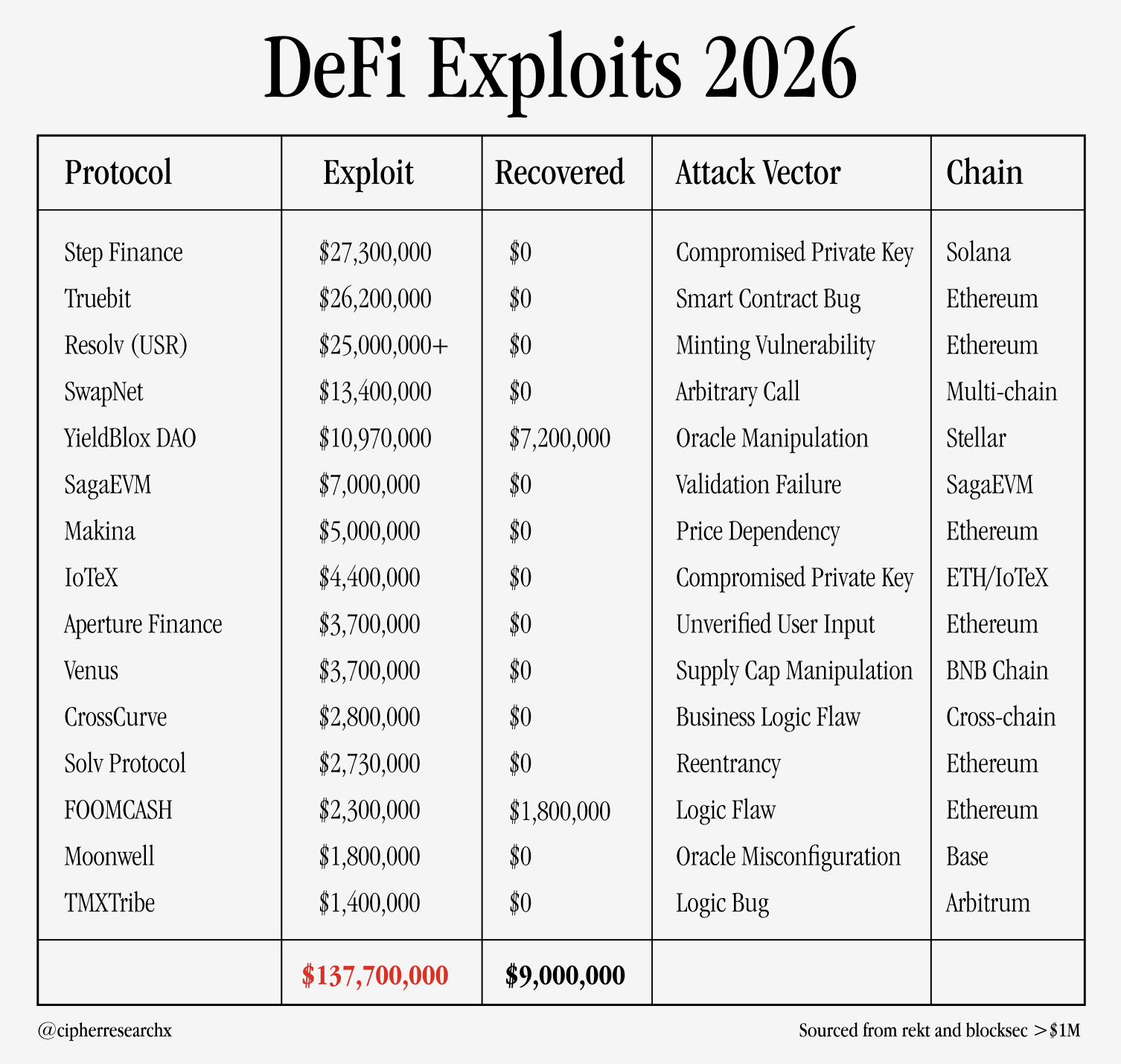
All DeFi exploits in 2026 so far. | Credit: Cipher Research
This created a classic single point of failure, a concept well understood in traditional cybersecurity, but still frequently overlooked in DeFi design.
When attackers compromised the key, they gained unrestricted minting power. The blockchain faithfully executed the instructions, because from its perspective, nothing was wrong.
What the USR Hack Means for the Future of DeFi Protocol Security
This incident is not isolated. It contributes to a growing pattern of exploits that have already resulted in over $137 million stolen across DeFi protocols this year.
More importantly, it underscores several systemic issues:
1. Misaligned Risk and Reward
DeFi users are often taking outsized risks for relatively low yields. When protocols offer returns in the 2-4% range, comparable to traditional finance, the justification for taking smart contract and governance risks becomes weaker.
2. Overreliance on Off-Chain Components
The use of off-chain services to control critical functions introduces trust dependencies that contradict the ethos of decentralization. These components are often opaque and difficult to audit.
What level of transparency is necessary for users to trust these systems?
Should protocols prioritize fully on-chain verification over flexibility?
The USR case illustrates that stability is not just about collateral, it’s about design integrity and trust minimization.
Key Lessons for DeFi Developers and Protocol Builders
For developers and protocol designers, this exploit offers several key takeaways:
Eliminate single points of failure: Critical functions should never rely on a single key. Multisig wallets, distributed control, and hardware security modules can reduce risk.
Enforce on-chain constraints: Protocols should implement strict rules for minting, including caps and collateral ratios that cannot be overridden off-chain.
Design for adversarial conditions: Assume that keys will be compromised and systems will be attacked. Build safeguards accordingly.
Increase transparency: Users need clear visibility into how systems operate, especially when these involve off-chain components.
What DeFi Users Should Learn from the USR Stablecoin Crash
For DeFi participants, the incident is a reminder to look beyond yield and evaluate risk more critically:
Understand how a protocol mints and manages tokens.
Assess whether control mechanisms are decentralized.
Be wary of systems that rely on trust rather than code.
Diversify exposure to reduce impact from single failures.
In many cases, people don’t notice the most dangerous risks: they simply overlook them.
Can Resolv Labs Recover? What’s Next for USR Stablecoin
Resolv Labs now faces a difficult challenge: restoring trust.
While the team has acted quickly to stabilize the situation and protect collateral, rebuilding confidence will require more than technical fixes. It will likely involve:
Possibly rebranding or restructuring the protocol.
Whether USR can regain its peg and user base remains uncertain.
The USR stablecoin exploit is a stark reminder that in DeFi, design choices can be just as dangerous as coding errors. The protocol didn’t fail because of a bug, it failed because of a flawed assumption about trust.
As the industry matures, incidents like this will continue to shape best practices and standards.
The challenge for builders is to create systems that are not only innovative, but also resilient against real-world threats.
For users, the lesson is equally clear: in a permissionless financial system, due diligence is not optional: it is essential.
The promise of DeFi remains compelling. But as this event shows, achieving that promise requires more than decentralization in name: it requires decentralization in practice.
The USR stablecoin exploit refers to a $24 million attack on Resolv Labs where a hacker used a compromised privileged private key to mint unbacked USR tokens and sell them on decentralized exchanges, causing the token to collapse in value.
Why did the USR stablecoin crash?
USR crashed because millions of unbacked tokens were suddenly minted and dumped on the market. This created massive selling pressure and caused the stablecoin to lose its peg, dropping over 95% at its lowest point.
Was the Resolv Labs exploit caused by a smart contract bug?
No, the exploit was not due to a coding bug. The system worked as designed. The issue was a flawed architecture that relied on a single privileged key without proper safeguards like minting caps or on-chain checks.
How much was stolen in the USR exploit?
The attacker extracted approximately $24 million worth of ETH and other assets after minting and dumping around 80 million unbacked USR tokens.
Disclaimer:
The information provided in this article is for informational purposes only. It is not intended to be, nor should it be construed as, financial advice. We do not make any warranties regarding the completeness, reliability, or accuracy of this information. All investments involve risk, and past performance does not guarantee future results. We recommend consulting a financial advisor before making any investment decisions.
Giuseppe Ciccomascolo began his career as an investigative journalist in Italy, where he contributed to both local and national newspapers, focusing on various financial sectors.
Upon relocating to London, he worked as an analyst for Fitch's CapitalStructure and later as a Senior Reporter for Alliance News. In 2017, Giuseppe transitioned to covering cryptocurrency-related news, producing documentaries and articles on Bitcoin and other emerging digital currencies. He also played a pivotal role in establishing the academy for a cryptocurrency exchange website. Crypto remained his primary area of interest throughout his tenure as a writer for ThirdFloor.


 Easy
Easy