Home / Analysis / Crypto / Explainers / Top Investing Coach Denise Shull Explains Why Crypto Investors Panic and How to Think Clearly in Volatile Markets
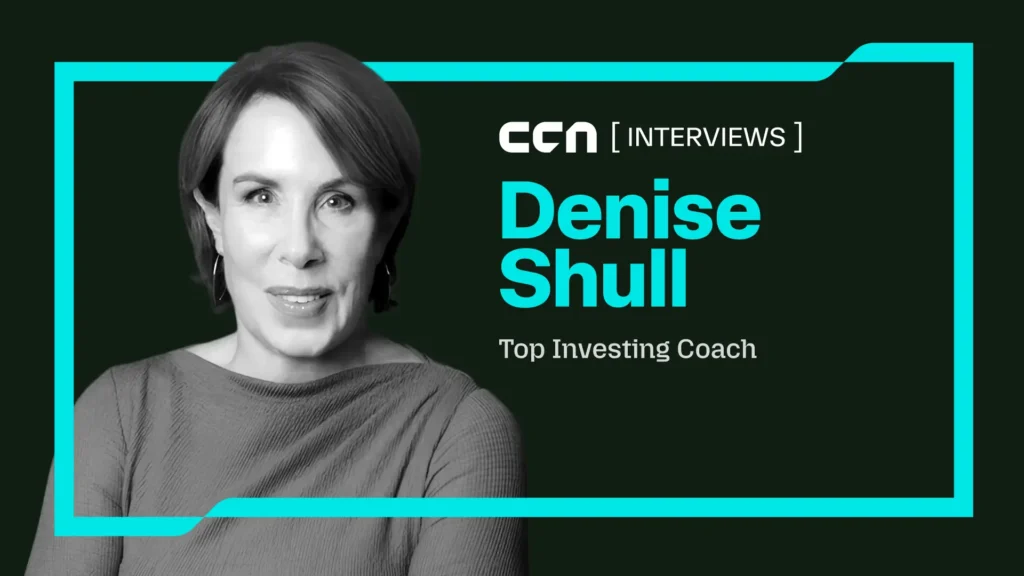
Top investing coach Denise Shull explains the psychology behind crypto investor panic, market volatility, and how emotions shape trading decisions. | Credit: CCN.com
Share
Key Takeaways
Denise Shull, who applies neuroeconomics and modern psychoanalysis and who inspired Billions’ Wendy Rhoades, argues that emotions play a role in how the brain processes risk.
According to Shull, investors constantly predict whether something is “good or bad for them,” and that prediction shows up as a feeling rather than a purely rational thought.
Neuroscience shows people cannot make decisions without emotion, meaning investors must learn to recognize their feelings rather than suppress them.
Rapid changes, new players, and evolving structures make it harder for investors to understand the “poker game” behind price movements.
Editor’s Note
In nearly two decades as a journalist, I’ve interviewed world leaders, CEOs, and top investors. Yet my conversations with Denise Shull remain among the most profound and personally transformative I’ve ever had.
As Chief Content Officer of CCN.com’s parent company, I’m helping transform one of the original crypto news websites into the Crypto Citizens Network — a community built around people who are building lives, not just portfolios, in crypto.
And if there is one thing I want fellow Citizens to gain from this Network, it’s access to the kind of wisdom Denise has shared with me over the years.
Because understanding markets matters.
But understanding how your own mind works in markets matters even more.
When crypto markets turn violent, the advice tends to sound familiar: stay calm, trust the data, and take emotion out of the equation.
According to Denise Shull, who uses neuroeconomics and modern psychoanalysis, who inspired Billions’ Wendy Rhoades, that is exactly where many investors go wrong.
Shull, an internationally recognized expert in market psychology who has worked with hedge fund managers, traders, and investors across asset classes, says in an exclusive interview with Crypto Citizens Network (CCN) that the standard view of risk and decision-making is deeply flawed. In her telling, emotion is not the problem in markets. It is part of the process. The real mistake is failing to understand what those emotions mean and then acting on them too quickly.
“It looks like emotion is the problem. It’s not,” Shull said. “It’s the decision to act.”
That perspective is especially relevant in crypto, where sharp drawdowns, rapid rebounds, and constant volatility can push investors into decisions they later regret. In periods of panic, Shull argues, what people call rational behavior is often just a story they tell themselves after the fact.
One clear example occurred in October 2025, when a crypto market crash became one of the largest liquidation events in the industry’s history. On Oct. 10-11, more than $19 billion in leveraged positions were wiped out within 24 hours, triggering a rapid sell-off across major cryptocurrencies.
Bitcoin and Ethereum fell sharply while many altcoins posted double-digit losses as automated liquidations cascaded across exchanges. The collapse was driven by a combination of factors: a macro shock from a sudden U.S. tariff announcement on Chinese technology imports, extremely high leverage in crypto derivatives markets, and thin liquidity that amplified forced liquidations.
Within minutes, billions of dollars in positions were liquidated, exposing structural weaknesses in crypto market infrastructure and highlighting how geopolitical news, leverage, and exchange mechanisms can rapidly trigger systemic volatility in digital asset markets that every citizen investor must learn to navigate.
Brain Makes Market Decisions Through Feeling, Not Pure Logic
At the center of Shull’s framework is the idea that human beings do not first analyze, then decide, then act in a neat and rational sequence. Instead, the brain is constantly making predictions below the level of conscious thought, which show up as feelings.
“We’re always predicting if something’s good or bad for us based on everything that we’ve ever experienced,” she said. “And that information is delivered in a feeling, not through our head.”
That matters because investors often assume they are responding objectively to the market when they are actually responding to a personal prediction about what a market move means for them.
In a crypto selloff, for example, an investor may tell themselves they are “buying the dip” based on experience and conviction. But Shull says another force is often present: fear of missing out, fear of regret, and fear of feeling stupid if the market bounces without them.
“What gets people is that, ‘I will feel bad about myself. I’ll feel stupid,” she said.
For Shull, that is a crucial distinction. The pressure many investors feel in a downturn is not always about the asset itself. Often, it is about identity, self-image, and the emotional significance of being right or wrong.
Why ‘Take The Emotion out of It’ Does Not Work
One of the most striking parts of Shull’s thinking is her rejection of one of finance’s favorite clichés.
“You cannot make a decision without emotion,” she said.
Rather than seeing emotion as interference, she argues that emotion is necessary for judgment. Shull pointed to neuroscience research showing that when people lose access to their subjective feeling states, they struggle to make even simple decisions.
“If you could [take the emotion out], you could not do anything,” she said. “You can’t decide the darn thing out of the vending machine.”
That is why she believes investors need to stop trying to suppress emotion and instead learn to identify it clearly. The key is not to become emotionless, but to understand which feelings are about the market and which are about personal fear, ego, or memory.
“The way to get more of what you want is to know what you feel so that you have a choice,” Shull said.
She says that choice becomes possible only when investors are honest with themselves. In moments of stress, the desire for prices to rebound can be so loud that it drowns out a more useful internal signal — what the investor actually thinks is going to happen next.
That is why one of Shull’s most practical mental prompts is deceptively simple: “What do I want to happen? What do I really think is going to happen?”
“This is the moment that requires some courage, because you have to be honest,” she said.
Why Big Crypto Losses Trigger Grief and How Investors Should Respond
For Shull, a major market loss is not simply a financial event. Psychologically, it can resemble bereavement.
“It’s like the death of your closest friend or the death of your spouse or your child. Something’s died,” she said.
That is how she describes the internal impact of losing a large amount of money, especially when the loss changes a person’s view of their future. In those moments, she says, investors should not rush to recover emotionally or financially by immediately jumping back into the market. The first step is to acknowledge the loss for what it is.
“You have got to grieve,” she said. “If you don’t, you will try too hard to make it back too quickly.”
That warning is especially relevant in crypto, where fast recoveries can tempt burned investors into trying to win everything back at once. Shull believes that skipping the emotional processing stage often leads to revenge trading, overconfidence, or desperation disguised as conviction.
Instead, she recommends something much more basic: write down what you feel, identify the emotional stage you are in, and separate what the market is telling you from what your fear is telling you.
“There’s nothing wrong with any emotion,” she said. “Your job is to understand them.”
Best Traders Are Not Emotionless — They Are Honest
Shull’s work with professional traders has convinced her that success in markets does not come from emotional control as most people imagine. It comes from recognizing feelings early, putting them into words, and refusing to let them silently turn into impulsive trades.
“When you don’t recognize the emotion, you absolutely act on it,” she said. “The noise of desire and the noise of fear are too loud.”
That is one reason she tells clients to build emotional vocabulary. Naming feelings like panic, frustration, fear, regret, or confidence can reduce the odds that they are expressed through poor buying or selling decisions.
“Being able to put your feelings into words, just that is helpful,” she said. “The chances that you put the feelings into your fingers when buying and selling things go down.”
For Shull, the ideal trader is not someone who feels less. It is someone who can tolerate discomfort long enough to listen more carefully to what is underneath it. That includes learning to distinguish between the emotional need to feel better and the real judgment call the market requires.
Pattern Recognition, Courage, and the Reality of Crypto
Asked what separates traders who can handle volatility from those who panic, Shull points to experience, confidence, and understanding what kind of game a market really is.
“It’s understanding the market for what it really is, which is a poker game when the value of the cards changes,” she said.
In that sense, markets are social. They are about anticipating what other participants are likely to do next. But crypto makes that especially difficult, Shull noted, because the players, incentives, and market structure are still changing quickly.
That uncertainty is part of why she has remained cautious at various moments, even as a long-term crypto believer. When price action does not align with the broader narrative, she says the mismatch itself becomes a signal worth paying attention to for any citizen trying to understand what the market is really saying.
Still, her broader conclusion is not pessimistic. Human beings, she argues, are actually built to recognize patterns in social systems. What most investors lack is not instinct, but the ability to hear it clearly through the noise of fear and desire.
“Age and wisdom amount to pattern recognition and the courage to act,” Shull said.
In euphoric markets and fearful ones alike, that may be the real edge, not removing emotion, but understanding it before it decides for you: a lesson every crypto citizen eventually learns through experience.
CONTINUE WITH DENISE SHULL
Denise Shull’s work — including her Intro to the Trader Brain course and periodic coaching groups — is available at therethinkgroup.net.
Disclaimer:
The information provided in this article is for informational purposes only. It is not intended to be, nor should it be construed as, financial advice. We do not make any warranties regarding the completeness, reliability, or accuracy of this information. All investments involve risk, and past performance does not guarantee future results. We recommend consulting a financial advisor before making any investment decisions.