Bitcoin remains absent from clear treatment in U.S. Basel III proposals, leaving banks uncertain on capital rules and risk weighting. | Credit: CCN.com
Share
Key Takeaways
U.S. regulators like Fed, FDIC, and OCC do not clearly define how Bitcoin exposures should be treated.
Existing “other assets” or residual categories could technically include Bitcoin.
However, without explicit guidance, banks lack clarity on capital treatment and risk weighting.
Banks may default to conservative treatment or avoid the space entirely.
The global banking system is in the middle of one of its most consequential regulatory updates in decades: the implementation of the Basel III “endgame” reforms. These rules aim to standardize how banks calculate risk, hold capital, and manage exposures across jurisdictions.
Yet amid this sweeping overhaul, one of the fastest-growing asset classes, Bitcoin, has been conspicuously absent from explicit treatment in key U.S. proposals.
This omission is not merely academic. It raises fundamental questions about how banks should treat Bitcoin-related activities, from direct holdings to custody and lending, and whether regulatory ambiguity could slow institutional adoption.
A recent comment letter submitted by The Bitcoin Bond Company highlights this issue, arguing that regulators have failed to clearly define how Bitcoin exposures fit into the capital framework. The result is a growing disconnect between evolving financial reality and regulatory clarity.
Why Bitcoin Is Missing From the Basel III Endgame Capital Rules
At the heart of the issue is a simple but critical observation: the March 2026 Notices of Proposed Rulemaking (NPRMs) issued by U.S. banking agencies do not explicitly address Bitcoin or broader crypto exposures in a meaningful way.
This silence does not necessarily mean that Bitcoin-related exposures fall outside the regulatory framework. In fact, existing capital rules already include broad “residual” or “other assets” categories that could theoretically capture such exposures.
However, as the comment letter emphasizes, relying on generic categories is not the same as providing clear regulatory guidance.
The fiat system should stop sabotaging itself, Rochard says. | Credit: Pierre Rochard X profile
The distinction matters. Banks need to know not just whether Bitcoin exposures are permitted, but how they are treated, what risk weights apply, how capital must be held, and which risk frameworks govern different types of activity.
Without that clarity, institutions are left to interpret the rules themselves, often conservatively. That creates friction for adoption and discourages innovation.
Basel SCO60 Crypto Rules Explained: Why They Matter for Bitcoin
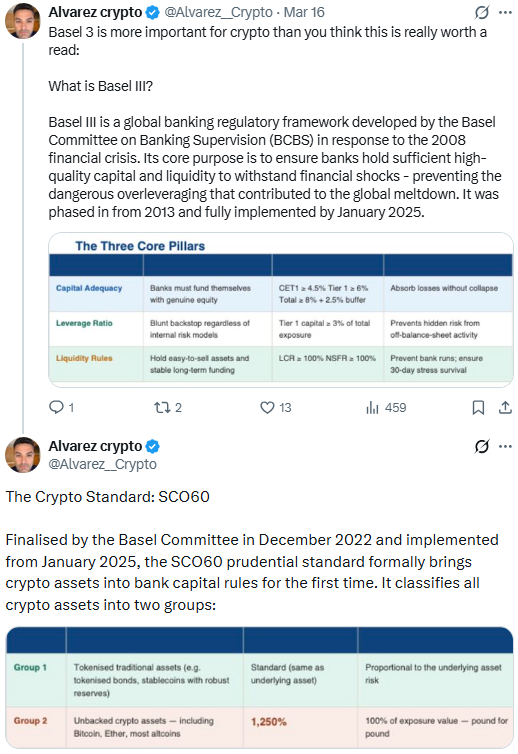
Complicating matters further is the existence of Basel’s cryptoasset standard, known as SCO60. Introduced by the Basel Committee on Banking Supervision, SCO60 establishes a framework for classifying cryptoassets and assigning capital requirements based on their risk characteristics.
Importantly, SCO60 distinguishes between different types of exposures, such as tokenized traditional assets versus unbacked cryptoassets like Bitcoin, and assigns significantly higher capital charges to the latter. It also separates risk into distinct channels, including credit risk, market risk, operational risk, and counterparty risk.
Experts hail the relevance of Basel III for crypto. | Credit: Alvarez Crypto X profile
However, SCO60 is not automatically binding in the U.S. American regulators can choose to adopt it fully, partially, or not at all. The problem, as highlighted in the letter, is that the current NPRMs do not clearly state which path they intend to take.
This creates a form of regulatory limbo. Banks do not know whether to prepare for SCO60-style treatment, rely on existing domestic categories, or expect some hybrid approach.
Why “Technology Neutral” Banking Rules Fail to Address Bitcoin Risk
U.S. regulators have often emphasized that capital rules are “technology neutral,” meaning they apply equally regardless of whether an asset is tokenized or traditional. In theory, this principle should allow Bitcoin-related activities to fit within existing frameworks.
In practice, however, technology neutrality has limits.
Bitcoin exposures are not monolithic. They span a wide range of activities, each with distinct risk profiles:
Direct spot holdings involve market risk and volatility.
Custody and safekeeping raise operational and fiduciary concerns.
Derivatives and counterparty exposures involve complex valuation and CVA (credit valuation adjustment) considerations.
Treating all of these under a single “other assets” bucket obscures these differences and risks miscalibrating capital requirements.
As the comment letter argues, regulators should identify the specific “exposure channel” for each type of activity rather than treating “Bitcoin-related exposures” as a single undifferentiated category.
Legal Risks of Unclear Bitcoin Capital Rules Under US Administrative Law
U.S. rulemaking requires agencies to provide a clear explanation of the rules they propose, including the rationale and evidentiary basis for their decisions. Courts have consistently held that agencies cannot rely on post hoc justifications or leave key elements unspecified.
What to expect this week? | Credit: Virtual Baconn X profile
The comment letter points to landmark cases such as State Farm and Chenery, which establish that agencies must connect their policy choices to the administrative record. If regulators intend to change or clarify how Bitcoin exposures are treated, they must explicitly say so and explain why.
Failure to do so could expose final rules to legal challenges, particularly if banks argue that they were not given adequate notice of how the framework would apply.
Regulatory Uncertainty Around Bitcoin Capital Treatment Is The Real Problem
One of the most important insights from the letter is that this is not fundamentally a debate about Bitcoin itself. Rather, it is a “notice-and-framework” problem.
The question is not whether Bitcoin exposures are permissible or whether they belong inside or outside the capital framework. Instead, the issue is whether regulators have clearly identified:
Which framework applies to each type of exposure.
Whether any changes are being introduced in the NPRMs.
What evidence supports those choices.
Without this information, stakeholders cannot meaningfully evaluate the proposal or provide informed feedback. This undermines the purpose of the notice-and-comment process.
Data Gaps in Basel III: Are Bitcoin Risks Being Properly Measured?
Another concern raised in the letter is the lack of clear data underpinning the proposed calibrations.
The NPRMs rely on various datasets, including special data collections and FR Y-14Q operational risk data, to determine capital requirements. However, it is unclear whether these datasets actually include meaningful crypto-related exposures.
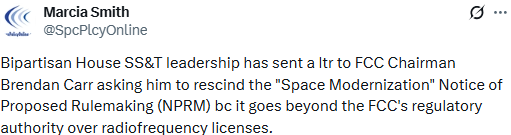
Debate continues among lawmakers. | Credit: Marcia Smith X profile
If they do not, then applying those calibrations to Bitcoin activities could be inappropriate. For example:
Operational risk models based on traditional banking services may not capture the unique risks of digital asset custody.
In short, without explicit evidence that the data includes crypto-related activity, regulators risk applying generic calibrations to a fundamentally different asset class.
What Existing US Crypto Banking Guidance Says and What It Doesn’t
Recent supervisory actions suggest that regulators are aware of the need for clarity, but have not yet gone far enough.
For instance:
A July 2025 interagency statement on crypto-asset safekeeping emphasized that it does not create new supervisory expectations.
The Federal Reserve and FDIC have withdrawn earlier crypto-related guidance, signaling a shift toward integrating digital assets into existing frameworks.
A March 2026 FAQ on tokenized securities reaffirmed the principle of technology neutrality.
While these steps provide some direction, they stop short of addressing the core issue: how Bitcoin exposures should be treated within the capital framework.
Supervisory materials can inform interpretation, but they cannot substitute for explicit rulemaking. As the letter notes, they do not “silently create Pillar 1 capital categories.”
How Unclear Bitcoin Capital Rules Impact Bank Adoption and Innovation
The lack of clarity has real-world consequences for banks considering Bitcoin-related activities.
1. Conservative Capital Treatment
In the absence of clear rules, banks are likely to assume the most conservative interpretation. This could mean assigning high risk weights or avoiding certain activities altogether.
2. Uneven Playing Field
Different institutions may interpret the rules differently, leading to inconsistent treatment across the industry. This undermines the goal of standardized capital requirements.
3. Delayed Innovation
Uncertainty discourages investment in infrastructure such as custody platforms, trading desks, and lending products. Banks are unlikely to commit resources without regulatory certainty.
4. Competitive Disadvantage
Non-bank entities, which are not subject to the same capital rules, may gain an advantage in offering Bitcoin-related services.
What Regulators Must Clarify About Bitcoin Under Basel III
The comment letter offers a pragmatic path forward. Rather than overhauling the entire framework, regulators can address the issue through targeted clarifications.
Specifically, they should:
State whether the NPRMs change or clarify Bitcoin treatment or simply maintain existing categories.
Identify which categories apply to different exposure types (e.g., spot holdings, custody, lending).
Clarify whether SCO60 will be adopted, in whole or in part.
Provide the evidentiary basis for any chosen treatment.
Explain where guidance will appear, whether in rule text, preamble, or interagency FAQs.
These steps would not require a new regulatory regime. Instead, they would ensure that existing rules are applied transparently and consistently.
Why Clear Bitcoin Capital Rules Are Critical for Institutional Adoption
The Basel III endgame represents a pivotal moment for global banking regulation. As digital assets continue to gain traction, integrating them into the capital framework is no longer optional: it is essential.
Bitcoin’s omission from explicit treatment in the current U.S. proposals does not mean it has been excluded from the system. But it does mean that banks are left navigating uncertainty at a time when clarity is most needed.
Regulators have an opportunity to fix this, not by rewriting the rules, but by clearly stating how they apply. Doing so would strengthen the integrity of the regulatory process, support informed decision-making, and pave the way for responsible adoption of Bitcoin within the banking system.
Until then, the question is not whether Bitcoin belongs in the capital framework. It is whether the framework is ready to accommodate it with the clarity and precision that modern finance demands.
Basel III is a global regulatory framework that sets rules for how banks manage risk and how much capital they must hold. It was developed after the 2008 financial crisis to make banks safer and more resilient. The current “Basel III endgame” updates how risks are calculated, making it highly relevant for any new asset class, including Bitcoin.
What is the issue with Bitcoin in the latest Basel III updates?
The problem is not that Bitcoin is banned or excluded; it’s that regulators have not clearly explained how Bitcoin-related activities should be treated under the new capital rules. This lack of clarity creates uncertainty for banks.
Does this mean banks can’t hold or offer Bitcoin services?
No. Banks can still engage in Bitcoin-related activities where permitted. However, unclear capital treatment means banks may be cautious, since they don’t know how much capital they’ll need to hold against those activities.
What does “technology neutral” mean in this context?
“Technology neutral” means regulators aim to apply the same rules regardless of whether an asset is digital or traditional. But critics argue this approach doesn’t fully work for Bitcoin because its risk profile differs significantly across use cases.
Disclaimer:
The information provided in this article is for informational purposes only. It is not intended to be, nor should it be construed as, financial advice. We do not make any warranties regarding the completeness, reliability, or accuracy of this information. All investments involve risk, and past performance does not guarantee future results. We recommend consulting a financial advisor before making any investment decisions.
Giuseppe Ciccomascolo began his career as an investigative journalist in Italy, where he contributed to both local and national newspapers, focusing on various financial sectors.
Upon relocating to London, he worked as an analyst for Fitch's CapitalStructure and later as a Senior Reporter for Alliance News. In 2017, Giuseppe transitioned to covering cryptocurrency-related news, producing documentaries and articles on Bitcoin and other emerging digital currencies. He also played a pivotal role in establishing the academy for a cryptocurrency exchange website. Crypto remained his primary area of interest throughout his tenure as a writer for ThirdFloor.


 Easy
Easy