What 'Non-KYC Bitcoin' Really Means — And What People Get Wrong About Anonymous BTC
Share
Key Takeaways
Non-KYC Bitcoin refers to buying, keeping, or moving BTC without ever providing personal identification to regulated platforms.
Since every transaction on Bitcoin is forever available on a public blockchain that anybody can examine, the token is deliberately pseudonymous.
Record illicit crypto volumes in 2025, along with aggressive mixer takedowns, have caused an increase in non-KYC conversations heading into 2026.
Advanced forensic tools now detect most mixer flows with high confidence, making traditional privacy tools far riskier than before.
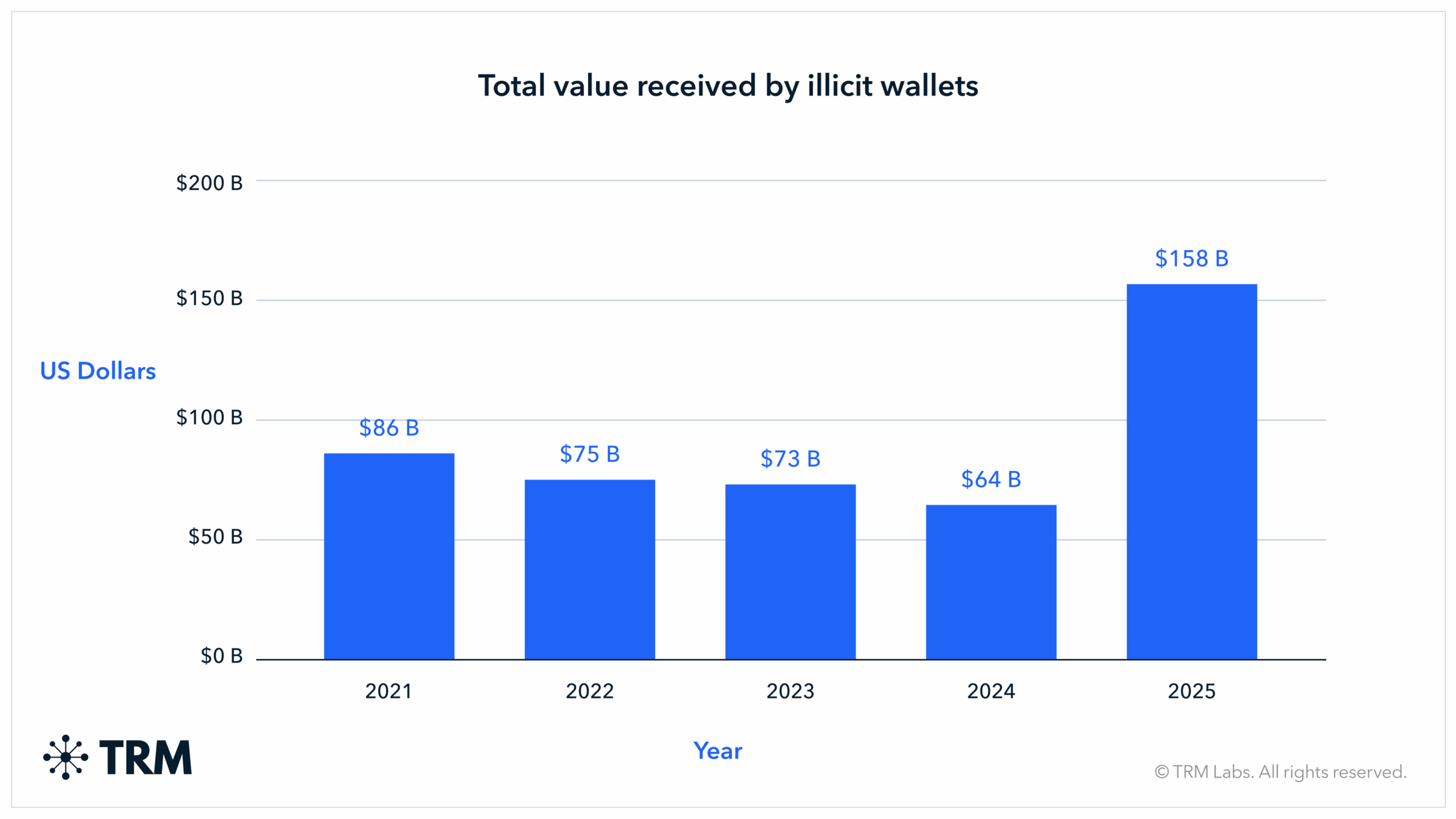
As 2025 came to an end, a dose of forensic reality hit the crypto space. According to newly disclosed data, illicit crypto volumes shattered records, reaching $158B according to the TRM Labs 2026 Crypto Crime Report and at least $154B according to Chainalysis’ 2026 Crypto Crime Report. Given that high-tech schemes are pushing numbers to record highs, it’s no surprise that the privacy discourse has shifted once again.
Suddenly, from OG Bitcoiners to new stackers are asking the same thing: Does skipping Know-Your-Customer (KYC) actually keep your money safe from prying eyes? The short answer: it creates a clean on-ramp and gives you real separation from identity-linked services, but it does not turn Bitcoin into anonymous money.
This article explores what stays behind non-KYC Bitcoin, why it gained popularity, and the main misconceptions that still cause problems for experienced crypto users.
Total value received by illicit wallets | Credit: TRM
What Non-KYC Bitcoin Really Means
Typically, when purchasing BTC on a popular crypto exchange, you will be asked to submit your government ID, proof of address, and, in some cases, a facial scan, to access trading. Non-KYC Bitcoin avoids these barriers, allowing users to connect with the network that aligns with Satoshi Nakamoto’s original vision: a peer-to-peer electronic cash system. Non-KYC Bitcoin allows you to have control over the private keys in a non-custodial wallet, which means no third party has access to your funds or knows your identity. This setup avoids the “KYC gate” that links real-world identity to on-chain addresses. However, the privacy veil drastically thins the moment those coins later engage with a KYC-compliant service, for example, when selling for fiat.
Bitcoin Is Pseudonymous, Not Anonymous
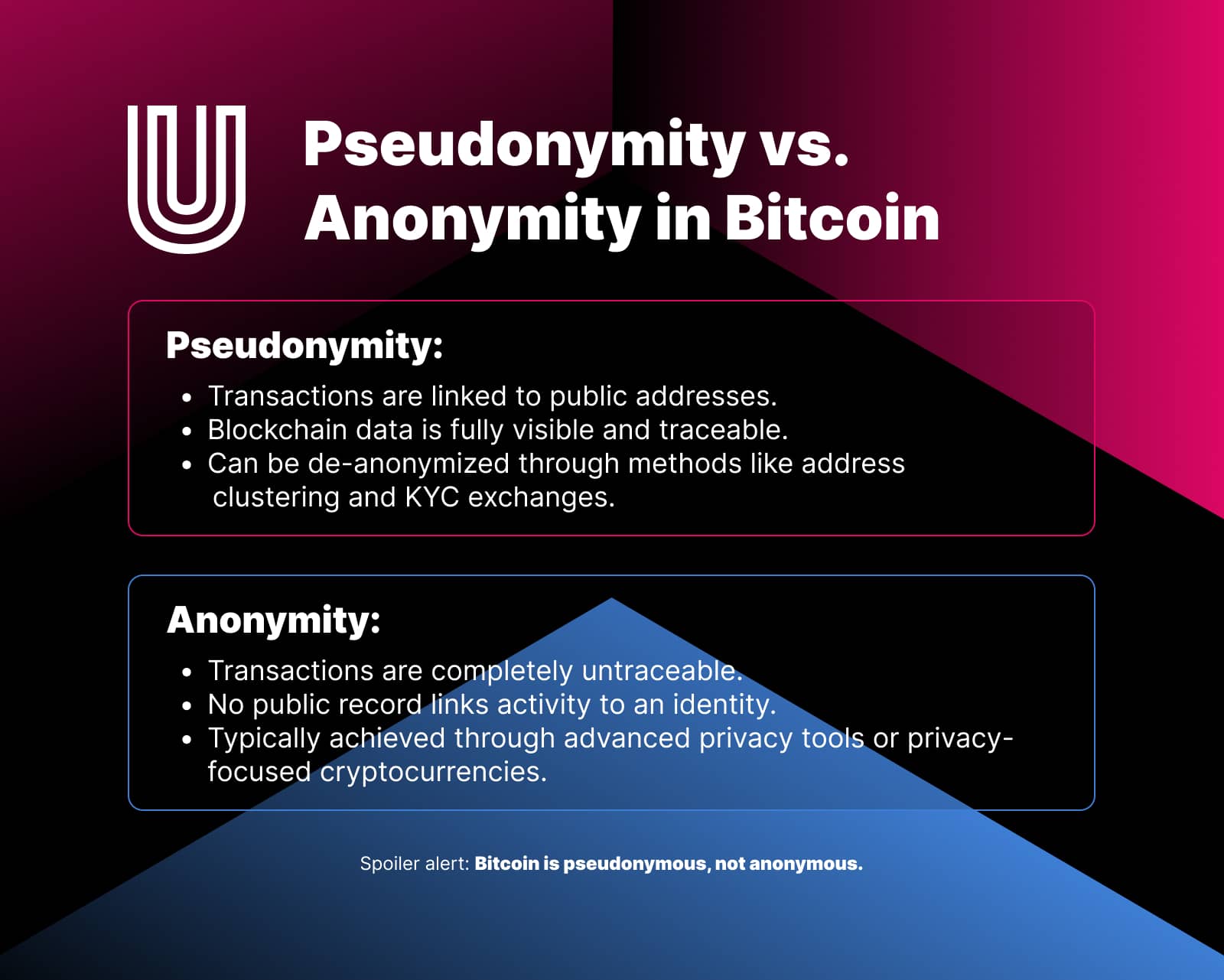
But can one truly remain invisible? Although non-KYC Bitcoin adds an extra layer of security against ID checks, it does not make Bitcoin anonymous.
Bitcoin’s whitepaper never promised anonymity – it promised cash without banks in the middle. On a public ledger, every transaction is recorded permanently. Addresses are not secret identities, but merely strings that appear randomly. To link the dots, forensic teams use common-input clustering, change-address heuristics, timing patterns, and off-chain KYC record data. What appears to be private at first glance is frequently not when law enforcement or exchanges check into it.
Pseudonymity versus true anonymity in Bitcoin | Credit: Ulam.io
Why Non-KYC Bitcoin Commands Attention in 2026
Here’s why the topic is heating up right now. Illicit inflows increased by 145-162% in 2025 to $158B (TRM Labs) or $154B (Chainalysis), mostly due to sanctions evasion and stablecoin-heavy schemes. The clean market expanded even more quickly, as evidenced by the fact that criminal activity actually decreased as a percentage of overall on-chain volume to just 1.2% (TRM).
Regulators responded firmly. Long-running mixers such as Cryptomixer and anonymous swap site eXch.cx have been shut down in the European Union. CARF’s global tax-reporting guidelines went online. Inflows to high-risk no-KYC services increased by more than 200% (TRM Labs), although forensic tools improved at a similar rate. While compliance teams applauded improved detection, privacy advocates criticised surveillance creep. Every day holders start to fear that their “clean” non-KYC tokens could be noticed later. That tension is exactly why the topic is prevalent in early 2026.
The Decline of Mixers and Other Privacy Tools
Centralized mixers got dismantled one after another. Decentralized ones like early Tornado Cash faced sanctions (partially eased in March 2025 after court pushback) but stayed active. Mixer-related activity fell 37% year-over-year in 2025 (TRM Labs). Criminals pivoted to DeFi bridges and high-volume no-KYC DEX swaps instead.
Forensic advances like amount persistence, multi-variable behavioral scoring, and cross-platform clustering, turned yesterday’s silver bullet into today’s liability. Garima Singh’s 2025 forensic deep-dive, “The Definitive Death of Cryptocurrency Mixers”, lays out the numbers: criminal success rates dropped to 20-30%, detection above 80%, and convictions approaching 100% when mixers appear in investigated cases.
Real Risks of Relying on Non-KYC Bitcoin
Non-KYC Bitcoin provides an advantage in terms of privacy, but it does not eliminate all risks. In fact, some new ones may emerge if you are not vigilant.
Clean sats can pick up taint if they later mingle with flagged funds.
Large off-ramps on regulated platforms often trigger manual reviews.
Deliberate KYC avoidance can itself be treated as structuring in some countries.
Rules can shift and retroactively affect how exchanges treat legacy flows.
The December 2025 MDPI parametric study on cryptocurrency money laundering techniques nails the core trade-off: the more privacy you chase, the more technical skill and planning you need and even then, perfect anonymity remains out of reach.
What Privacy-Conscious Crypto Users Can Do
Privacy-conscious crypto users may generate a fresh address for every receive. Use hardware wallets and coin control to keep UTXOs separate. Document your acquisition story for taxes without broadcasting it.
Operational security should never be regarded as flawless, but it could be layered (VPN + Tor + careful timing). Above all, rather than eliminating connectivity, privacy on Bitcoin aims to minimize it.
It is Bitcoin obtained or moved without any identity verification on regulated platforms.
Why is non-KYC BTC more expensive?
You are paying a “privacy premium” for avoiding the data collection of major exchanges.
Can mixers still hide non-KYC BTC effectively?
Forensic tools now detect most mixer flows at high confidence, making them far riskier than in previous years.
Should everyday users avoid non-KYC Bitcoin?
Not at all. But they must practice strong operational security and understand the traceability limits to stay out of unintended trouble.
Disclaimer:
The information provided in this article is for informational purposes only. It is not intended to be, nor should it be construed as, financial advice. We do not make any warranties regarding the completeness, reliability, or accuracy of this information. All investments involve risk, and past performance does not guarantee future results. We recommend consulting a financial advisor before making any investment decisions.
Curious about how technology and crypto reshape global finance, Elizaveta Savenko explores blockchain, AI, decentralized systems, their applications, and regulatory requirements. She contributes to research, educational initiatives, and industry collaborations, examining trends in digital assets and fintech innovation, increasing awareness of the crypto space and its impact on financial systems.


 Intermediate