The bill, tabled by House Financial Services Committee Chairman French Hill and Bryan Steil, Chairman of the Digital Assets, Financial Technology, and Artificial Intelligence Subcommittee, establishes a regulatory framework for U.S.-based payment stablecoins.
The Stablecoin Act aims to introduce clear guidelines for issuers seeking licenses to create stablecoins.
Among its provisions, the bill sets reserve requirements and mandates regular audits to ensure compliance.
Issuers with over $10 billion in stablecoin issuance would be subject to the Federal Reserve’s regulatory framework, alongside the Office of the Comptroller of the Currency’s framework for nonbank issuers.
Under the proposed regulations, payment stablecoin issuers like Tether (USDT) and USD Coin (USDC) would need to maintain reserves at a 1:1 ratio, using only highly liquid and safe assets.
The new legislation builds on the “Clarity for Payment Stablecoins Act,” which passed with bipartisan support in 2023.
Stablecoin Regulation Gaining Momentum
The Stablecoin Act was introduced just one week after Senator Bill Hagerty introduced the “GENIUS Act.”
The GENIUS Act, which also focuses on stablecoin payments, calls for sweeping regulations that would require stablecoin issuers to back their coins with U.S. dollars, Treasury bills, Federal Reserve notes, and other similar assets.
The GENIUS Act also mandates that stablecoin issuers submit audit reports, a requirement that Tether has historically avoided.
The Threat to Tether’s Unchecked Power
The proposed regulations could curtail Tether’s unchecked market power. This follows Tether’s recent exit from the European Union due to the EU’s Markets in Crypto Assets (MiCA) regulation.
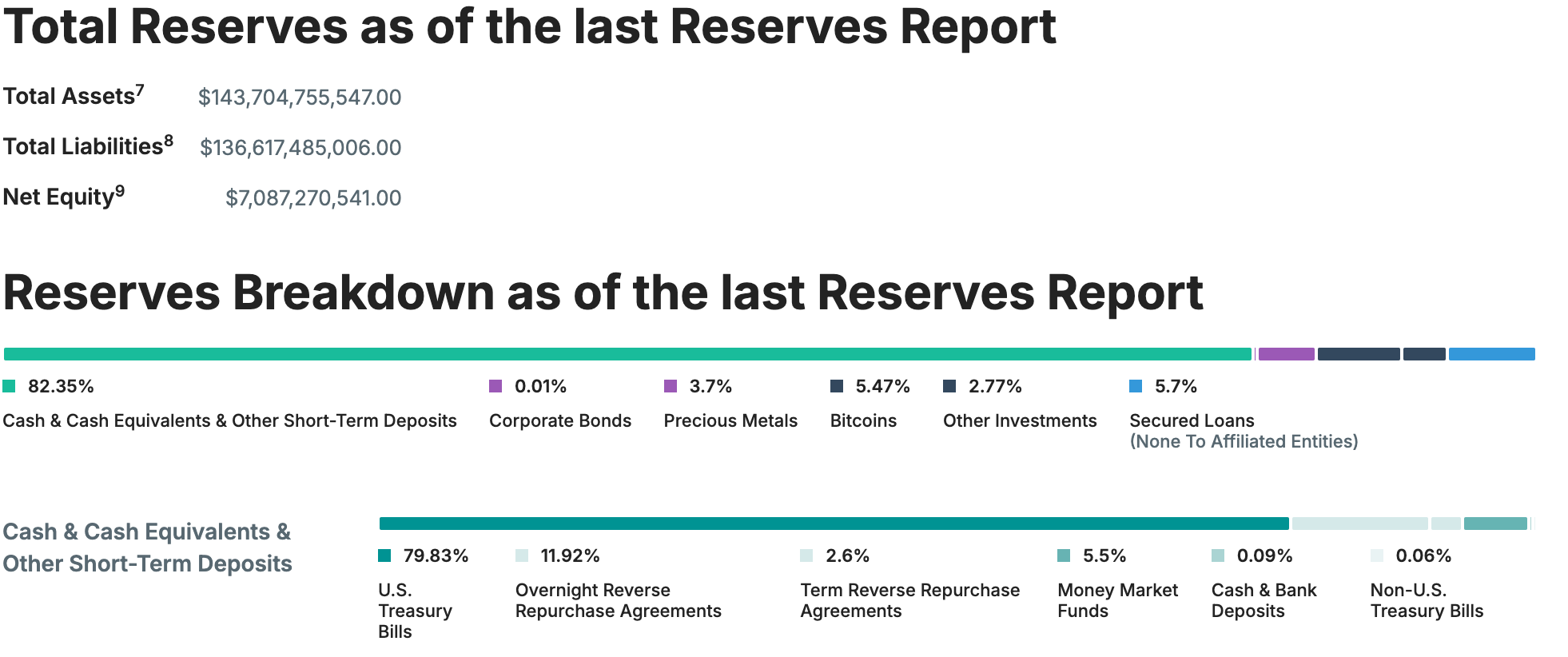
Tether has faced criticism over its lack of transparency regarding reserves.
Tether reserve report. Source: Tether
While the company claims to hold a significant portion of its reserves in U.S. Treasury bonds, cash, and equivalents, it has also admitted to holding some reserves in Bitcoin and collateralized loans.
Tether’s audits come from its chosen auditing partner, BDO Italia. None of the Big Four accounting firms, let alone the top 100, refuse to get anywhere near it.
Despite multiple assurances, Tether has never undergone a third-party audit from a reputable auditor.
As a result, Tether’s dominance could be threatened by competitors like Circle’s USDC, which is more compliant with existing regulations.
Should the U.S. push for stronger regulations succeed, USDC could see a rise in market share, challenging Tether’s long-standing reign.
While Tether may struggle to meet the proposed requirements, USDC is fully aligned with all current regulations.
Prashant Jha is a seasoned crypto journalist based in Delhi, India, with a Bachelor’s Degree in Computer Science Engineering. Passionate about the evolving world of blockchain and cryptocurrencies, he has been a dedicated voice in the industry since 2018. Prashant’s expertise lies in regulatory reporting, where he unravels complex legal and financial developments with clarity and precision. Before joining CCN in 2024, he honed his craft at Cointelegraph, establishing himself as a trusted name in crypto journalism.
His coverage spans major industry events, including the high-profile collapses of FTX, Three Arrows Capital (3AC), and LUNA, offering readers insightful analyses of their regulatory and market implications. Prashant’s technical background enables him to bridge the gap between intricate blockchain technology and its real-world applications, making his work accessible to novices and experts.
Beyond his professional pursuits, Prashant is an avid music enthusiast, often exploring diverse genres to unwind. A sports lover, he has a particular passion for cricket and frequently engages in discussions about the game. His multifaceted interests and sharp journalistic instincts make him a valuable contributor to CCN, where he continues shaping the crypto landscape's narrative.