Polkadot’s proposed pUSD stablecoin aims to succeed where aUSD failed. | Credit: Hameem Sarwar/CCN.com
Share
Key Takeaways
Polkadot’s first native stablecoin, aUSD, imploded in 2022 after a smart contract misconfiguration allowed 1.2 billion tokens to be minted without collateral.
The proposed pUSD revives the idea of a Polkadot-native stablecoin, using DOT as over-collateralized backing under the same Honzon protocol.
While pUSD uses the same protocol stack as aUSD, it adds tighter governance, clearer oversight, and stronger community involvement.
A phased rollout, open communication, and integration across dApps, AMMs, and Polkadot Treasury use cases will be key to real-world adoption.
Stablecoins are among the most critical building blocks for DeFi ecosystems.
For Polkadot, the introduction of pUSD has reignited hope and skepticism, especially in light of the failures of its predecessor, aUSD.
Let’s unpack pUSD, how it differs (or doesn’t) from aUSD, what risks it must address, and whether it can avoid the pitfalls that undermined aUSD.
Try Our Recommended Crypto Exchanges
Sponsored
Disclosure
We sometimes use affiliate links in our content, when clicking on those we might receive a commission at no extra cost to you. By using this website you agree to our terms and conditions and privacy policy.
To understand pUSD, it’s essential to revisit aUSD (“Acala USD”).
What aUSD was: aUSD was a stablecoin launched by the Polkadot parachain Acala. It was built using the Honzon protocol. Users could mint aUSD by locking collateral (e.g. DOT or other assets) in debt positions. It was intended to provide a Polkadot-native stablecoin.
The failure event: In August 2022, a major exploit occurred. A misconfiguration in one of Acala’s liquidity pools (the iBTC/aUSD pool) allowed attackers to mint over 1.2 billion aUSD without sufficient collateral. The stablecoin depegged drastically, losing nearly all of its value.
Underlying Causes:
Technical flaw and smart contract misconfiguration: The bug that improperly allowed an attacker to mint tokens.
Governance, oversight, and risk management gaps: Concerns about how quickly problems were addressed, and how transparent and robust the governance was.
Trust damage: The exploit shook confidence in Acala, Honzon protocols, and native stablecoins in Polkadot. Many in the community felt burned.
What is Polkadot’s pUSD?
Polkadot’s proposed pUSD is a new stablecoin initiative, laid out in RFC-155 by Bryan Chen, that aims to learn from aUSD’s collapse and offer a safer, more trusted option:
Collateralization: pUSD is planned to be over-collateralized, using DOT (Polkadot’s native token) as the primary backing. That means users lock up DOT to mint pUSD.
Protocol and framework: It will deploy on Polkadot’s Asset Hub using the Honzon protocol, the same fundamental protocol stack that aUSD used.
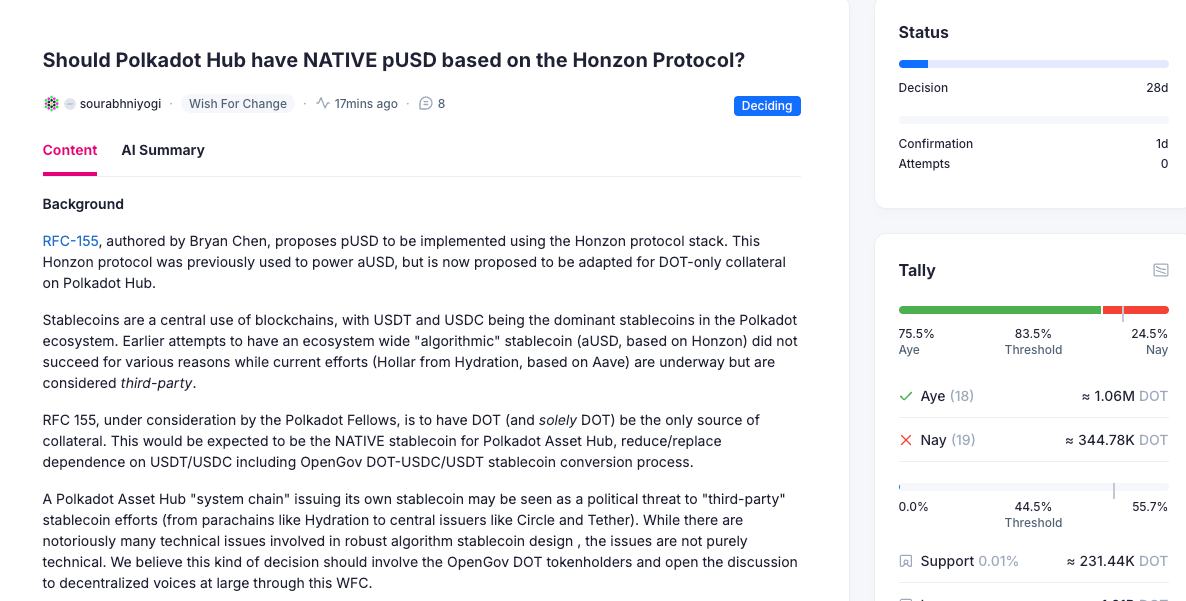
Governance and community involvement: The proposal has strong community support so far. Voting is underway in Polkadot’s OpenGov track (“Wish for Change”). Over 75% of the vote has already been cast in favor. However, the threshold for approval is higher (around 80-85%), so there’s still a gap.
Should Polkadot Hub have native pUSD based on the Honzon Protocol? | Credit: Mexc
Polkadot’s Motivation:
To reduce reliance on centralized stablecoins like USDT and USDC.
To boost DeFi liquidity and native tooling in the Polkadot ecosystem.
Potential integration of pUSD with Polkadot’s Treasury and reward systems, possibly reducing DOT inflation pressures.
Key Differences Between pUSD and aUSD
The failure of aUSD in 2022 exposed vulnerabilities in stablecoin design within the Polkadot ecosystem. pUSD is being developed with those lessons in mind.
While both aim to provide a decentralized, ecosystem-native stablecoin, their approaches and safeguards differ significantly.
Aspect
aUSD (Acala)
pUSD (Proposed)
Failure / risk event
Exploit and misconfiguration led to uncontrolled minting of billions of aUSD
Not launched yet; design aims to prevent over-minting
Collateral model
Mixed crypto collateral, but controls were bypassed during exploit
Fully collateralized by DOT with over-collateralized debt positions
Governance & control
Emergency governance paused modules and intervened after exploit
On-chain governance with safeguards; concerns about rushed changes remain
Recovery / response
Burned error-minted tokens and applied emergency measures, but trust never recovered
No live test yet; effectiveness of response mechanisms unproven
Collateral concentration
Multiple assets, but still vulnerable due to design flaws
Single collateral (DOT), simpler but concentrated risk in DOT’s volatility
Adoption / ecosystem role
Native to Acala but adoption collapsed after peg loss
Proposed as Polkadot’s native stablecoin to reduce reliance on USDT/USDC
Major Risks and Challenges for pUSD
pUSD isn’t guaranteed success. Several known risks must be addressed:
Single-collateral risk (DOT-only backing): Relying on DOT alone means that if the DOT price drops sharply, many vaults (collateralized debt positions) could be liquidated, which leads to selling pressure on DOT, possibly amplifying the price drop. This risk is severe if volatility spikes.
Legacy and trust issues from aUSD and Acala: Many in the community distrust Acala or how aUSD was managed, even if the exploit was due to a liquidity-pool misconfiguration rather than an inherent flaw in Honzon. The association with past failures is a reputational risk.
Governance and risk management: Who is responsible for monitoring contracts, managing emergencies, ensuring reliable oracles, and responding when things go wrong? In the aUSD situation, questions about the speed and effectiveness of responses were raised. pUSD will need strong, clearly defined governance and oversight structures.
Technical debt and protocolic weaknesses: Since Honzon was already used, any unresolved bugs or edge cases remain a concern. Even if the protocol was not directly at fault in the aUSD exploit, its components (liquidity pools, oracles, collateral logic) must be carefully audited.
Maintaining the peg during stress: Mechanisms like liquidation thresholds, stability fees, buffer collateralization ratios, or savings features must be designed to handle large market moves. If users expect mass liquidation or loss of peg, they may withdraw or avoid using pUSD, which can lead to a bank-run-style depeg.
What Needs to Go Right: Design And Mitigation Strategies
To succeed, pUSD must incorporate lessons from aUSD and other stablecoin failures. Some best practices and mitigation tactics include:
Diversify collateral: Even if starting with DOT, plan for additional collateral assets in the future (e.g., other cryptocurrencies, tokenised real-world assets, or possibly stablecoins) to reduce the risk of single-asset dependency.
Robust auditing and formal verification: All critical smart contracts, especially those managing minting, liquidations, oracles, must be audited and ideally formally verified. Liquidity pools and reward mechanisms should be stress-tested.
Clear governance structure: The roles and responsibilities for decision-making, emergency operations, upgrades, and bug fixes must be well-defined. Transparency is essential, both on the chain and in communication with the community.
Insurance / safety mechanisms: Either via a reserve fund, insurance, or similar mechanism to respond to unforeseen exploit or depeg events; possibly also insurance or backstop funded by fees.
Have strong liquidation logic to manage risk without triggering hyper-sell pressure.
Stability fees to disincentivize excess risk or encourage paying back debt in high collateral value scenarios.
However, that’s not all. Community support and engagement are also vital for this project:
Community engagement and trust building: Addressing concerns about past failures openly; possibly excluding or limiting the involvement of individuals or entities whose actions were heavily criticized; ensuring governance transparency; and opening feedback loops.
Gradual rollout and monitoring: Launching in phases with a limited total supply or to simulate or limit specific risk parameters, monitoring usage, and maintaining pegs in different market environments is safer.
Why pUSD Still Has Promise
Despite the concerns, there are several reasons to believe pUSD might succeed where aUSD faltered:
Strong Community Support: The voting so far shows significant backing. This demonstrates demand for a Polkadot-native stablecoin.
Policy & Ecosystem Alignment: Using a native stablecoin could reduce reliance on external stablecoins (USDT, USDC), potentially lower friction, reduce external risk, and keep more value within the Polkadot ecosystem.
Better Incentive Structures Proposed: Features like a savings option (letting users lock pUSD and earn yield via fees) promote stability and alignment of incentives.
Experience & Lessons Learned: The aUSD failure has made people more cautious, more demanding of audits, governance, and risk controls. This potentially means that mistakes may be less likely to repeat if community pressure and scrutiny are high.
Can pUSD Really Avoid aUSD’s Fate?
The idea of pUSD, a DOT-backed stablecoin for the Polkadot ecosystem, comes with both high expectations and cautionary shadows. The collapse of aUSD in 2022 exposed how fragile stablecoin mechanisms can be when governance, minting controls, and liquidity depth are not airtight.
pUSD positions itself as a safer alternative: fully collateralized by DOT, governed through Polkadot’s on-chain mechanisms, and designed to reduce reliance on external assets like USDT and USDC.
Yet, the fate of aUSD shows that design promises are not enough, including execution, transparency, and community trust will ultimately decide whether pUSD thrives or unravels.
pUSD: Strengths, Weaknesses, and Implications
Strengths
Weaknesses / Risks
Implications
Backed entirely by DOT (liquid L1 asset)
Heavy reliance on DOT’s price and liquidity
Stability tied to DOT’s market cycles; risk if DOT crashes
On-chain governance and transparency
Governance capture or rushed changes possible
Requires strong checks and balances to maintain trust
Potential to unify liquidity across Polkadot
Early-stage adoption may mean shallow liquidity
May struggle with peg defense until deeper pools exist
Lessons learned from aUSD’s collapse
Technical design still untested in live markets
Improved design, but true resilience proven only under stress
Over-collateralization planned
Collateral concentration (no diversification yet)
Safer than under-collateralized models, but lacks risk spread
So why pUSD’s fate is still uncertain?
pUSD can avoid aUSD’s downfall because the Polkadot team designed it with stricter mint controls, clearer governance safeguards, and a single, transparent collateral source.
However, no mechanism is foolproof: if DOT suffers a steep drawdown, if liquidity proves too thin, or if governance missteps occur under stress, pUSD could face the same spiral of lost confidence that doomed aUSD.
The difference this time will not be in promises but in whether those safeguards work under pressure.
Beyond Technical and Governance Risks, pUSD Faces External Factors
Besides technical and governance risks, pUSD must navigate external factors:
Regulation: Stablecoins often come under regulatory scrutiny. How will regulators in various jurisdictions view Polkadot’s stablecoin? Will there be pressure to comply with KYC, reserves, audits, etc.?
Competition: Other stablecoins and native designs (for example, HOLLAR in the Polkadot and Substrate ecosystem) might compete. If another design offers better collateral diversification or a governance model, pUSD may lose out.
Market conditions and volatility: Crypto markets are volatile. A stablecoin that depends on a volatile asset (DOT) must ensure its collateralization and liquidation logic can handle crashes without cascading failures.
Ecosystem integration: For pUSD to be useful, it needs adoption of dApps, lending protocols, AMMs, bridges, treasury usage, etc. If the ecosystem doesn’t integrate it deeply, it may remain marginal.
Conclusion
The failure of aUSD shows that stablecoins, even those built with good protocols, are only as strong as their weakest components: security, governance, risk control, and trust. The technical exploit in aUSD was a wake-up call.
pUSD is promising in many respects: clear over-collateralization, community demand, alignment of incentives in the Polkadot ecosystem, and proposals for yield or savings options. These are positive steps.
However, the similarities (the same protocol framework, the same ecosystem, overlapping teams, or reputational associations) mean that stakeholders will accept nothing less than rigorous oversight, strong governance, diversified collateral over time, and transparent, audited code.
Suppose Polkadot and its community carefully learn the lessons of aUSD, design for resilience, and foster trust through transparency. In that case, pUSD has a decent chance of becoming a stable, native, and functional stablecoin for the network. If not, the legacy of aUSD will loom large, and failure could be catastrophic, not just for the stablecoin itself, but for Polkadot’s reputation in DeFi.
What exactly is pUSD, and how does it differ from aUSD?
pUSD is the proposed Polkadot-native stablecoin outlined in RFC-155. Like aUSD, it’s built with the Honzon protocol and is designed to be over-collateralized (i.e. users lock DOT to mint it). The difference lies in risk controls, governance improvements, and lessons learned from aUSD’s collapse. Unlike aUSD, which used multiple collateral types, pUSD’s initial design is DOT-only (though there is room for expansion). Also, the community is pushing for greater transparency, stronger oversight, and modular rollout to avoid repeating past mistakes.
Why did aUSD fail, and what lessons does that failure teach for pUSD?
aUSD failed primarily because of a vulnerability in one specific liquidity pool (iBTC/aUSD) that allowed an attacker to mint over 1.2 billion aUSD without adequate collateral, causing a depeg. Key contributing factors included smart contract misconfiguration, gaps in risk monitoring, slow response, and erosion of trust.
Is using only DOT as collateral too risky?
It’s one of the most significant risks. With a DOT-only backing, a sharp drop in DOT’s price can trigger mass liquidations, further depressing DOT and cascading into pUSD instability. That’s why collateral diversification is considered necessary once pUSD is proven. Using multiple asset types or tokenized real-world assets could spread risk, though each new collateral type also brings technical and governance challenges.
What governance structures are proposed to mitigate centralization or failure risk?
pUSD’s plan includes transparent, on-chain governance via Polkadot’s OpenGov model. Decisions on upgrades, emergency intervention, or parameter changes would require community voting. The proposal also emphasizes clearly delineated roles (who handles oracles, who handles emergency soft forks, etc.). One goal is to avoid the opacity that dogged aUSD; regular audits, on-chain proposals, and public review periods are intended to bolster accountability.
Disclaimer:
The information provided in this article is for informational purposes only. It is not intended to be, nor should it be construed as, financial advice. We do not make any warranties regarding the completeness, reliability, or accuracy of this information. All investments involve risk, and past performance does not guarantee future results. We recommend consulting a financial advisor before making any investment decisions.
Giuseppe Ciccomascolo began his career as an investigative journalist in Italy, where he contributed to both local and national newspapers, focusing on various financial sectors.
Upon relocating to London, he worked as an analyst for Fitch's CapitalStructure and later as a Senior Reporter for Alliance News. In 2017, Giuseppe transitioned to covering cryptocurrency-related news, producing documentaries and articles on Bitcoin and other emerging digital currencies. He also played a pivotal role in establishing the academy for a cryptocurrency exchange website. Crypto remained his primary area of interest throughout his tenure as a writer for ThirdFloor.


 Easy
Easy