Is Pi Network Dead in 2026? What Pioneers Need to Know
Share
Key Takeaways
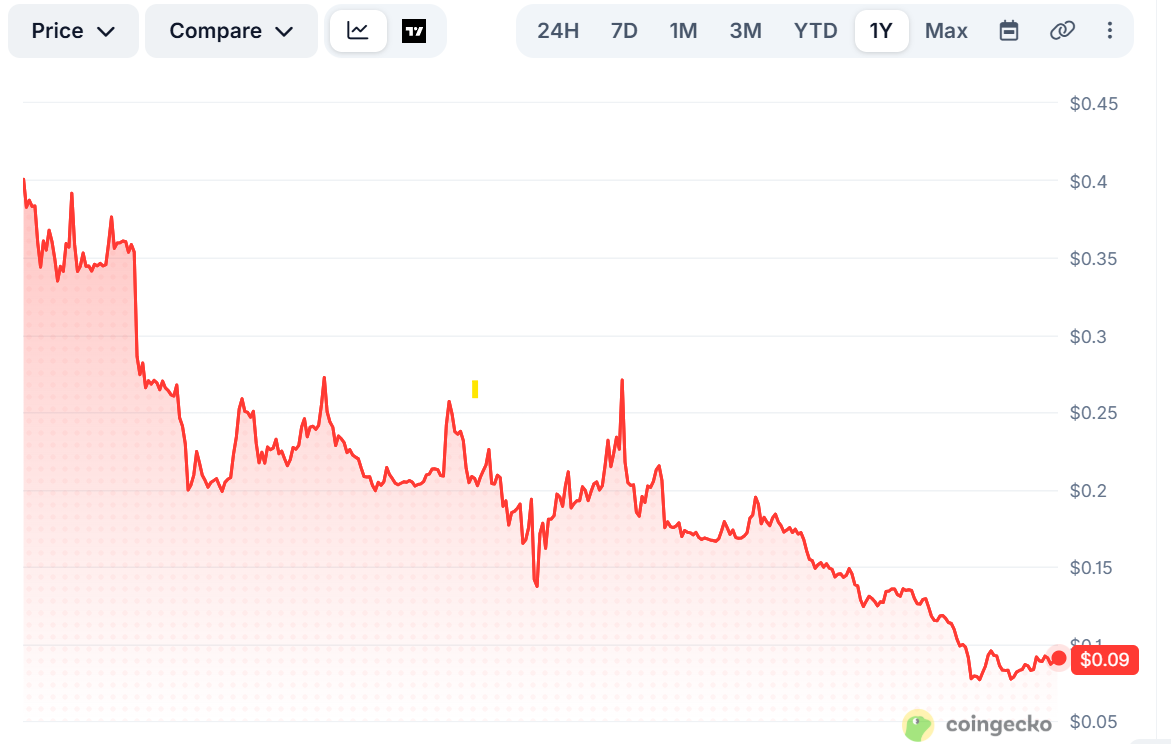
PI trades near $0.09, roughly 97% below its February 2025 peak near $3, despite the network remaining operational.
Pi Network says 16 million Pioneers had migrated to Mainnet by January 2026, while its Android app has surpassed 100 million downloads.
The biggest questions are no longer whether Pi has a functioning blockchain, but whether real usage and demand can grow quickly enough to absorb the expanding circulating supply.
Pi Network is not dead in the literal sense in 2026. Its blockchain is running; millions of users have migrated to Mainnet; PI trades on several exchanges; and development continued through August.
But anyone looking only at the PI price could reach a very different conclusion.
PI trades around $0.09, compared with an all-time high near $3 shortly after Open Network launched in February 2025. That represents a drawdown of roughly 97%.
PI price collapse post-mainnet launch. | Source: CoinGecko
CoinGecko currently places PI’s market capitalization near $1 billion, with approximately 11 billion PI in circulation. That is still a substantial market value, but the collapse from its post-launch high illustrates how dramatically expectations have reset since Mainnet trading began.
Try Our Recommended Crypto Exchanges
Sponsored
Disclosure
We sometimes use affiliate links in our content, when clicking on those we might receive a commission at no extra cost to you. By using this website you agree to our terms and conditions and privacy policy.
The clearest argument against calling Pi Network dead is simple: the project actually reached the milestone Pioneers had waited years for.
Pi’s Open Network launched on Feb. 20, 2025, removing the firewall around Mainnet and allowing external connectivity. Before launch, Pi Network reported more than 10 million Mainnet migrations and more than 100 Mainnet or Mainnet-ready applications.
Migration continued afterward. By the end of 2025, Pi said 17.5 million Pioneers had fully passed KYC, and 15.8 million had migrated. In January 2026, the project reported that Mainnet migrations had passed 16 million.
That does not prove those users are actively spending PI, but it shows the network has moved well beyond the closed mining phase that defined most of its history.
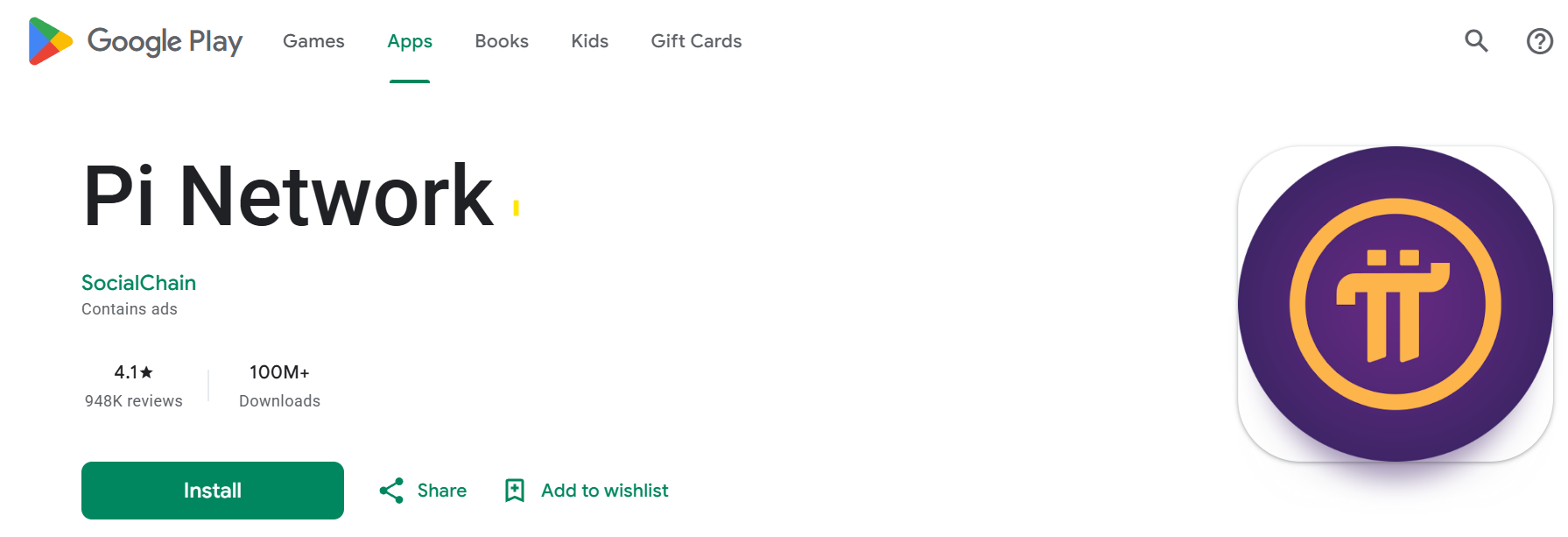
Mobile distribution remains difficult to ignore. Google Play shows the Pi Network app with 100 million-plus downloads and roughly 948,000 reviews, while Pi Browser has passed 50 million Android downloads.
PI Network downloads on Google Play Store. | Source: play.google.com
Downloads, however, are not the same thing as active blockchain users.
Pi does not currently publish a standardized historical series showing monthly active users, daily active addresses, or monthly Mainnet transaction volumes. That makes it difficult to independently measure how much of its enormous registered community is regularly using PI rather than simply holding or occasionally opening the app.
PI Has More Exchange Access, but Binance Is Still Missing
Exchange access has improved since Open Network.
OKX opened PI/USDT trading alongside the February 2025 Mainnet launch, while Kraken added PI trading on March 13, 2026. CoinGecko also tracks markets on exchanges including Gate and Bitget.
That matters because exchange availability affects liquidity, accessibility, and price discovery. However, a Binance listing alone would not solve Pi’s larger economic challenge: new supply needs enough demand to absorb it.
Token Unlocks Remain a Major Test
Pi Network has a maximum supply of 100 billion PI. Its tokenomics allocate 65% to community mining rewards, 20% to the Core Team, 10% to foundation reserves, and 5% to liquidity.
Only a fraction of that maximum is currently circulating.
Independent explorer PiScan estimated in June that roughly 1.7 billion PI could become claimable over the following 12 months, with near-term unlocks averaging more than 4 million PI per day.
Unlocks do not automatically mean those tokens will be sold. Some holders may continue to lock or hold their PI. But increasing liquid supply can create pressure when demand is weak, making adoption increasingly important as migrations continue.
That supply dynamic helps explain why ecosystem growth matters more in 2026 than another headline user number.
Pi Network also continued shipping infrastructure updates during 2026.
The project scheduled Protocol v25 for July 22, adding cryptographic capabilities including BN254 and Poseidon support. Mainnet node operators were subsequently required to complete the Protocol v26 upgrade by Aug. 11 to remain connected.
Pi has also been testing its Launchpad and expanding App Studio functionality. Its August Pi2Day recap said more than 2.56 million Pioneers started its Ecosystem Quest, providing at least one measurable sign that a substantial audience continues interacting with new ecosystem features.
The project’s public GitHub organization contains dozens of repositories, with developer materials receiving updates during 2026.
In addition, Pi Network rolled out Protocol v26, marking one of the network’s final major protocol upgrades before Protocol 27.
🔥BREAKING: Pi Network Begins Protocol v26 Upgrade
Pi Network is rolling out Protocol v26, one of the final major upgrades before Protocol 27, which is planned as the network’s final scheduled protocol upgrade.
The update is designed to strengthen protection against smart contract attacks, improve state management, expand cross-chain functionality, and introduce cryptographic upgrades.
Protocol 27 is expected in the second half of 2026 and is described as the network’s final planned upgrade in its current development period.
For the Pi community, v26 therefore represents more than a technical update. It signals that Pi Network’s core infrastructure is nearing completion ahead of the anticipated Protocol 27 milestone.
It has a functioning Open Mainnet, approximately 16 million migrated users, 100 million-plus Android downloads, active exchange markets, and continued protocol development.
But the 97% price collapse cannot be dismissed either.
For Pioneers, 2026 is therefore less about whether Pi Network exists and more about whether it can convert its enormous community into measurable economic activity.
The figures worth watching are not social followers or total downloads, but active Mainnet users, payment activity, application usage, exchange liquidity, and whether demand grows quickly enough to absorb new PI entering circulation.
Pi Network survived the transition to Open Mainnet. The unanswered question is whether its utility can now catch up with the scale of the community built around it.
Dr. Guneet Kaur is a senior editor at CCN.com and a Science Fellow at Exponential Science. She is a fintech and blockchain expert with extensive experience in digital finance education, blockchain ecosystems, and cryptocurrency markets. She has worked with global media such as Cointelegraph, as well as education and blockchain platforms, to design and lead strategic content and learning initiatives. As an educator and assessor for top-tier executive programs, she bridges real-world fintech trends with academic insight.
Dr. Kaur is also a published researcher and peer reviewer across fintech and data science journals, including Financial Innovation Journal and International Journal of Big Data Intelligence and Applications. Her work spans data-driven analysis, Web3 innovation, and technical content development. With a strong foundation in both industry and academia, she translates complex financial technologies into practical applications, empowering learners, professionals, and institutions across the rapidly evolving digital finance landscape.


 Easy