Binance Insolvency Rumors Explained: What On-Chain Data Really Shows
Share
Key Takeaways
Insolvency allegations on X are contradicted by on-chain data showing Binance’s reserves remain over-collateralized.
The rumours primarily derive from a record $19 billion liquidation event in 2025, which was caused by macroeconomic shocks rather than an internal liquidity issue at Binance.
Binance offers the public to independently confirm that its digital assets match user liabilities at a 1:1 ratio by using cryptographic Proof-of-Reserves (PoR).
Unlike platforms like FTX and Celsius, Binance has a fee-based business model and an SAFU insurance fund to protect long-term solvency in case of market stress.
As of February 2026, speculations of Binance’s possible bankruptcy were circulating on social media, provoking discussions and calls for withdrawals.
These allegations are related to the major October 10, 2025, market crash known as “10/10,” during which billions of dollars’ worth of leveraged positions disappeared in a matter of hours. On-chain analytics and Binance executives, however, provide a distinct picture of stability and transparency on this matter.
The article explores the rumours of Binance’s insolvency that are going around on X, compares them with facts that can be verified, and investigates how the 10/10 crash caused them.
What Are the Binance Insolvency Rumors?
Firstly, what is “insolvency”? Insolvency refers to a scenario when an individual or business is unable to meet its debt obligations to lenders as they come due. Since transparency is frequently protected by complex on-chain structures in the high-stakes crypto space, the term “insolvency” acts as a catalyst for market volatility.
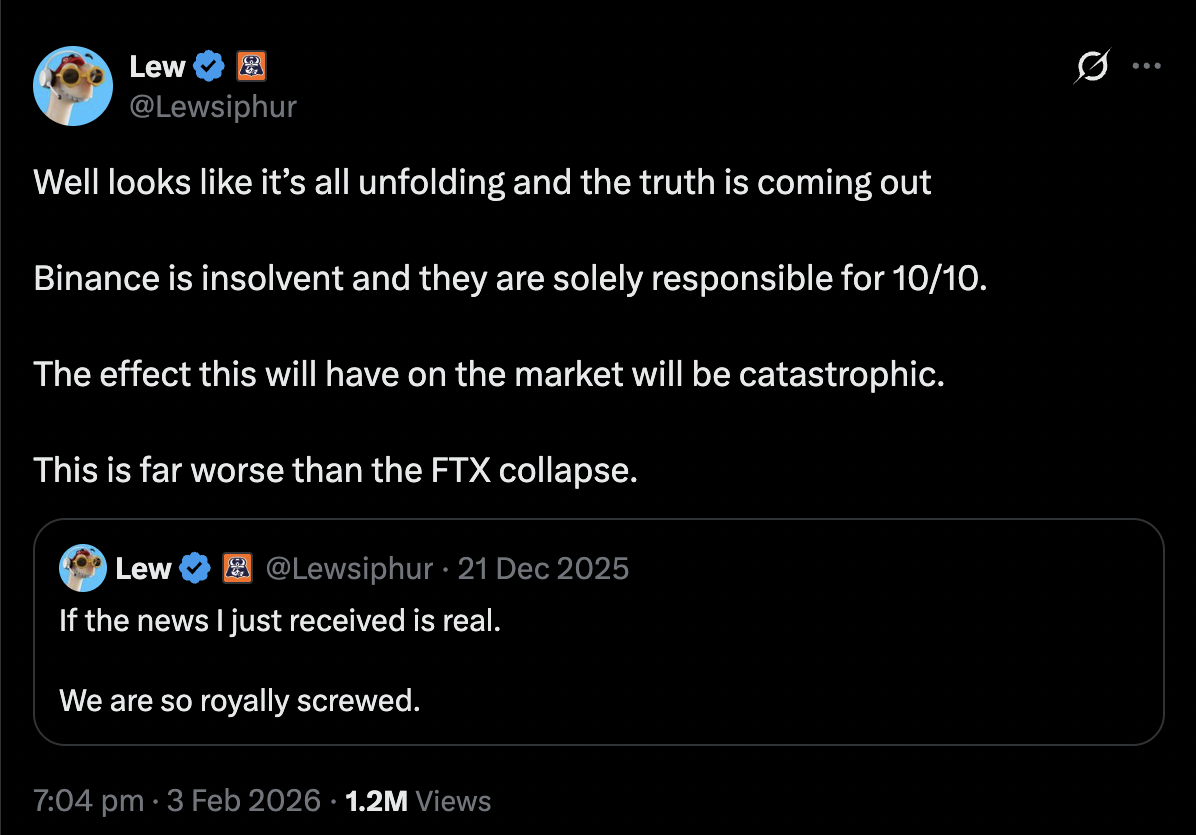
The current wave of rumors began in early February 2026 when X user Lewsiphur posted a stark warning: Binance was insolvent and solely responsible for the 10/10 crash, with impacts potentially worse than FTX’s 2022 downfall. The post went viral, prompting calls for mass withdrawals to “stress test” the platform. Coordinated accounts intensified the FUD, fuelled by high leverage risk and echoes of previous collapses.
Lewsiphur’s X post saying that Binance is insolvent | Credit: X
Additionally, unverified screenshots on X fueled rumors that Binance is insolvent and issued cease-and-desist orders to whistleblowers and was hiding a multibillion-dollar balance-sheet hole. The recent departures of high-ranking compliance officers further prompted speculation that internal concerns were escalating.
In response, Binance’s leadership has defined these events as either ordinary business restructuring or outright fabrication. Former CEO Changpeng Zhao (CZ) called accusations “far-fetched,” emphasizing Binance handled $14 billion in outflows during past stresses without issues – far beyond what traditional banks could manage. CZ also denied claims of market manipulation, clarifying fund movements were user-driven or for the Secure Asset Fund for Users (SAFU).
The FUD Campaigns Are REAL!
I received this DM this morning & was offered $20,000 to FUD @Binance, @CZ_Binance & to lie & say that I sold all my $ASTER
Posting this for awareness as I never actually thought FUD campaigns were a real thing
‘Shadow Bankruptcy’ Claims Spark Debate Around Exchange Liquidity
Rumors of a “shadow bankruptcy” involve the theory that an exchange is technically insolvent but is using new customer deposits to pay out existing withdrawals. This is essentially a Ponzi scheme structure.
Proponents of this theory on X point to occasional “maintenance” windows on Binance as evidence of liquidity “bottlenecks,” though no widespread evidence of halted withdrawals has been confirmed as of February 5, 2026.
On-Chain Data Counters Insolvency Fears
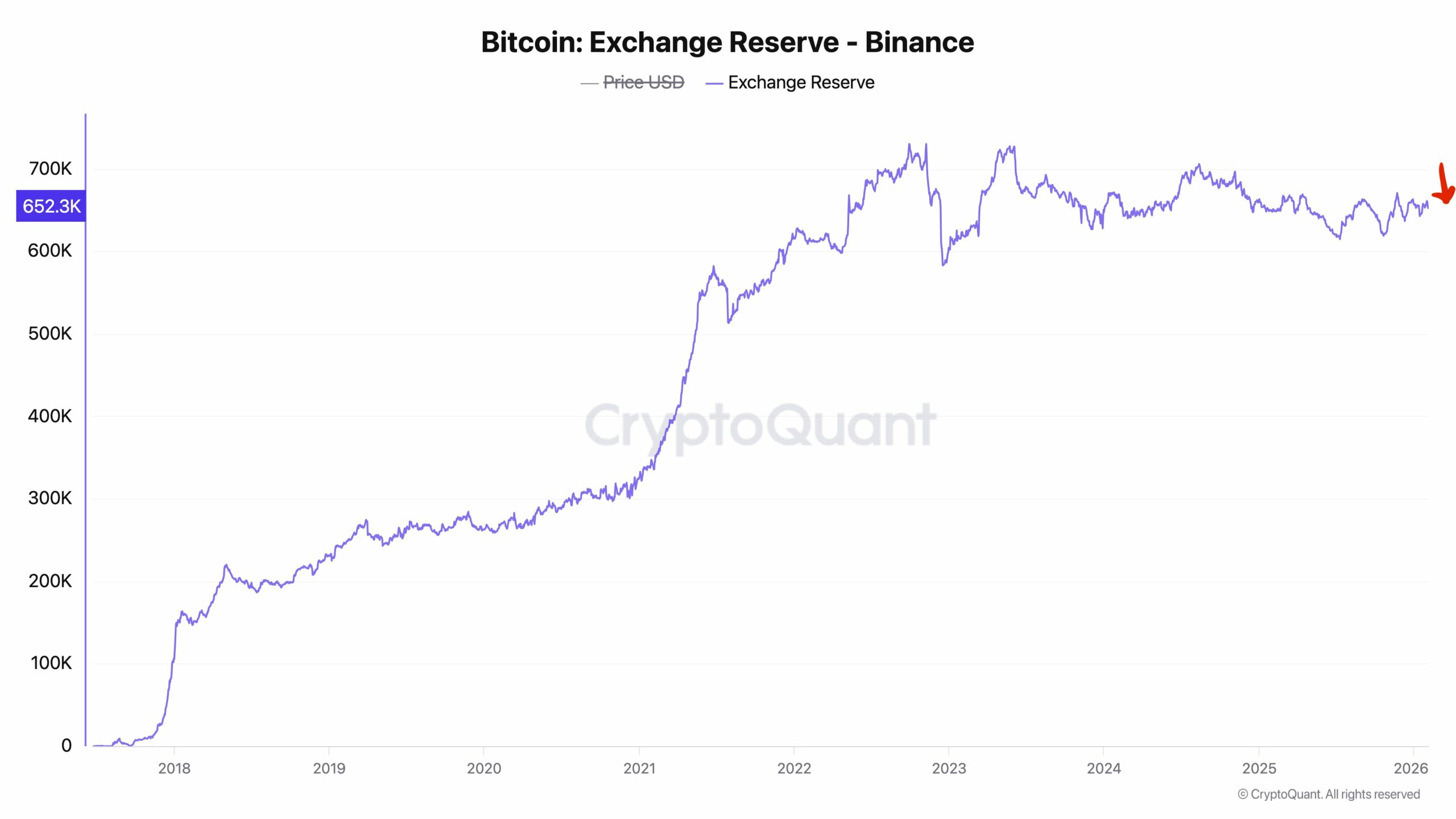
A clearer picture is offered by on-chain data from companies such as CryptoQuant and Nansen. Binance’s Bitcoin reserves hover steadily at around 659,000 BTC, with no signs of erosion despite the FUD. In fact, the exchange reported billions in net inflows over one-day, seven-day, and monthly periods.
These third-party data providers have shown that even during periods of high-volume withdrawals, sometimes exceeding $1 billion in 24 hours, Binance has processed transactions without delay. This suggests that the liquidity is present and accessible, contrary to the insolvency narrative.
CryptoQuant chart showing Binance’s Bitcoin exchange reserves over time | Credit: CryptoQuant
Since late 2022, Binance has used a technique known as Proof-of-Reserves (PoR), providing transparency on customer holdings. Binance publishes regular proof-of-reserve audits, a transparency system implemented post-FTX to ensure that assets exceed liabilities. Recent SAFU conversions included acquiring 1,315 BTC, bolstering user protection funds. Could a PoR report be faked?
Well, while it is possible to “window dress” a balance sheet, the continuous, real-time nature of on-chain tracking makes it nearly impossible to hide a multi-billion dollar deficit over a long period.
Comparing Binance to Historic Cases of Crypto Exchange Failure
To understand the risk, we must look at how previous exchanges actually failed. The most well-known examples are Mt. Gox, Celsius Network, and FTX.
Mt. Gox (2014):Failed following a large hack that remained unnoticed/unreported for years, resulting in a shortage of coins.
Celsius (2022): A lending platform that failed after accepting customer deposits, investing them in risky and illiquid DeFi protocols.
FTX (2022): Failed because it used customer funds to bail out its sister trading firm, Alameda Research, using its own illiquid token (FTT) as collateral.
Binance’s business model differs significantly from Celsius’s. As a spot and derivatives exchange, its primary revenue comes from trading fees, not from “yield farming” with customer assets. Unlike FTX, there is currently no evidence that Binance is using its native token, BNB, as collateral to support massive debt positions.
Why Binance Rumors Matter in the Bigger Picture
So, what’s the verdict? The question “Is Binance facing insolvency?” cannot be answered with a simple “yes” or “no”, as financial health is dynamic.
However, based on the facts available in February 2026, the rumours about X appear to be baseless. The exchange continues to process withdrawals, maintains a public Proof-of-Reserves, and has survived numerous “stress tests” involving billions of dollars in outflows.
These examples can serve as a reminder to investors of the need for due diligence: Verify, Don’t Trust. In the crypto space, the tools to verify a firm’s health are typically built into the technology. Relying on “X threads” without checking on-chain data is a recipe for unnecessary panic.
Why are many connecting the 10/10 crash to Binance?
Critics blame Binance for worsening the crash with high-leverage products such as USDe trading, which fuelled liquidations.
What is Binance's SAFU fund?
SAFU is Binance’s emergency insurance fund, holding about 1% of trading fees in reserves (valued over $1 billion) to cover user losses from hacks, glitches, or extreme events.
What is driving the “whistleblower” legal threats?
An investigation into the “cease-and-desist” screenshots revealed that they were digitally created. In reality, Binance has active $5 million bounty programs for legitimate whistleblowers who disclose internal corruption or security issues via official audit channels.
How does Proof-of-Reserve (PoR) prevent fraud?
Proof of Reserves uses cryptographic proofs, audits and on-chain tracking to verify that an exchange’s assets match its liabilities without revealing user data.
Disclaimer:
The information provided in this article is for informational purposes only. It is not intended to be, nor should it be construed as, financial advice. We do not make any warranties regarding the completeness, reliability, or accuracy of this information. All investments involve risk, and past performance does not guarantee future results. We recommend consulting a financial advisor before making any investment decisions.
Curious about how technology and crypto reshape global finance, Elizaveta Savenko explores blockchain, AI, decentralized systems, their applications, and regulatory requirements. She contributes to research, educational initiatives, and industry collaborations, examining trends in digital assets and fintech innovation, increasing awareness of the crypto space and its impact on financial systems.


 Easy
Easy