How to Trade Crypto Perpetual Futures on Kraken in the US: Step-by-Step Guide
Share
Key Takeaways
Kraken’s US perpetual futures trade on Bitnomial Exchange and clear through NinjaTrader Clearing under full CFTC oversight, a regulatory layer absent from most offshore perpetual futures platforms.
Funding rates settle once daily at 3:00 pm CT as a single cash adjustment, differing from the eight-hour settlement cycles common on offshore venues such as Binance and Bybit.
Only USD is accepted as collateral at launch, ruling out crypto-margined strategies where traders use their underlying holdings as position collateral.
Liquidation fees start at $10 for perpetual-only accounts but rise to $25 for a first event and $50 for each subsequent event if standard CME futures are held in the same account simultaneously.
Kraken has brought perpetual futures to US customers through Kraken Derivatives US, a CFTC-registered venue that gives American traders regulated access to a contract type that has been standard on offshore platforms for years but largely unavailable domestically through a compliant, overseen structure.
This guide covers how the product works, what it costs, and what traders need to understand before placing a position.
What Are Crypto Perpetual Futures?
A standard futures contract carries an expiration date. When that date arrives, the contract settles and the position closes, requiring traders who want to maintain directional exposure to roll into the next contract period. Rolling costs money and demands attention to timing, particularly around high-volatility periods when bid-ask spreads on expiring contracts widen.
Traditional vs. Perpetual futures comparison. | Source: XBTFX
Perpetual futures solve that problem by removing the expiration date entirely. A position opened today can remain open indefinitely without rolling, making perpetuals simpler to manage for traders who want continuous exposure to an asset’s price movement without monitoring contract calendars or managing rollover costs.
How Perpetuals Stay Anchored to Spot Price
Without an expiration date to pull the contract price back toward spot, perpetual futures rely on a funding rate mechanism to maintain price alignment. The funding rate is a periodic payment exchanged between traders holding long positions and traders holding short positions, and its direction depends on where the perpetual contract price is trading relative to the underlying spot price.
When the perpetual trades above spot, longs pay shorts. When it trades below spot, shorts pay longs. This creates a continuous self-correcting pressure: bullish sentiment that drives the perpetual price above spot makes holding long positions progressively more expensive, incentivizing short sellers to enter and pull the contract price back toward alignment.
How Kraken’s Perpetual Futures Work for US Traders
Kraken Derivatives US operates as a Futures Commission Merchant registered with the CFTC and a member of the National Futures Association. Brokerage services are provided by NinjaTrader Clearing, doing business as Kraken Derivatives US. Perpetual contracts are listed on Bitnomial Exchange, a CFTC-regulated designated contract market.
This structure matters because most perpetual futures volume globally runs through offshore venues operating outside US regulatory jurisdiction. Trading on a CFTC-regulated venue provides oversight, dispute mechanisms and consumer protections that offshore platforms do not offer. It does not eliminate the financial risk of leveraged trading, but it places the product inside a recognized regulatory perimeter.
Perpetual futures’ unique funding mechanism and lack of expiry have made the product popular offshore, where limited regulations apply.
Under my chairmanship, the @CFTC is bringing perpetuals onshore under a robust regulatory framework.
Sixteen perpetual futures contracts are available at launch, all quoted in USD. The full list covers Bitcoin, Ether, Solana, XRP, Cardano, Dogecoin, Chainlink, Avalanche, Litecoin, Polkadot, Stellar Lumens, Shiba Inu, AAVE, Hedera, Tezos and Bitcoin Cash.
Kraken Derivatives US may add or remove contracts based on liquidity, regulatory or risk considerations. Open positions in any contract that is delisted will be closed before removal, with best-effort advance notice provided where possible.
How the Funding Rate Works on Kraken
On most offshore perpetual futures platforms, funding payments are settled every eight hours, meaning costs accumulate and are debited three times per day. Kraken Derivatives US settles funding payments once daily at 3:00 pm CT as a single cash adjustment to the available account balance.
Traders should not interpret once-daily settlement as lower overall funding cost. The daily rate reflects the same underlying market forces. What changes is the timing of when the cost hits the account balance, which affects intraday margin calculations and the point at which a funding payment might draw down position margin if the available balance is insufficient.
The current funding rate and the predicted next rate are both visible on the order form before any trade is placed. Reviewing both figures before entering a position is important, particularly in strongly trending markets where funding rates can become a material cost that accelerates the approach to the liquidation threshold.
Step-By-Step Guide To Getting Started With Perpetual Futures on Kraken
Step 1: Unlock Futures Trading on Kraken Pro
Perpetual futures are available to any US customer who has already unlocked futures trading on Kraken Pro. The unlock process requires identity verification and acknowledgment of the risk disclosures mandated by the CFTC and NFA. Traders who have not yet unlocked futures should follow Kraken’s How to Unlock Futures Trading in the US guide before proceeding.
Step 2: Access the Perps Tab
Once futures trading is active, perpetual contracts appear in the market selector under the Perps tab alongside any existing CME futures contracts. No separate application, additional account, or extra unlock step is required. The same account and wallet used for CME futures provides access to perpetuals.
Step 3: Fund Your Account in USD
Only USD is accepted as collateral at launch. Crypto holdings cannot be used as margin. Traders whose strategies depend on holding an underlying asset as collateral while running a futures position against it will need to reconsider that approach until Kraken Derivatives US expands the list of accepted collateral types.
Step 4: Review Contract Details Before Placing a Trade
The order form displays the current funding rate, the predicted next funding rate, and a full order preview showing all applicable fees before a trade is confirmed. Reviewing the funding rate’s direction and magnitude, along with the total fee estimate, before committing to a position is a basic risk management step that the platform makes straightforward.
Step 5: Place Your Order
After reviewing all contract details and fees, confirm the trade through the order form. The position will appear in the account alongside any other open futures contracts.
Step 6: Monitor Margin Continuously
After entering a position, monitor the available account balance relative to the maintenance margin threshold continuously. Daily funding settlements at 3:00 pm CT can reduce the available balance, and if the available balance is insufficient to cover a funding payment, the shortfall is drawn directly from position margin, narrowing the buffer before a potential liquidation event.
Understanding Fees on Kraken Perpetual Futures
Each perpetual futures trade on Kraken Derivatives US incurs four fee components. An exchange fee collected by Bitnomial Exchange, an NFA fee set by the National Futures Association, a clearing fee covering transaction processing, and a flat per-contract commission fee.
All four components appear in the order preview window before a trade is confirmed. The funding rate is separate from these fees and can be positive or negative depending on market conditions, meaning it is sometimes a cost and sometimes a credit to the account.
Liquidation Fees and Why Account Structure Matters
A $10 liquidation fee applies if the account holds only perpetual futures positions. If any standard CME futures positions are held in the same account alongside perpetual futures, the fee structure changes for all liquidation events in that account: $25 for the first event and $50 for each subsequent event.
Traders who use Kraken for both CME and perpetual futures should factor in the asymmetric fee structure when managing their risk.
Risk Considerations Every US Trader Should Understand
Perpetual futures can offer greater flexibility than spot trading, but they also introduce additional risks that every trader should understand before using leverage. Funding costs, liquidation thresholds, and margin requirements can significantly affect performance, especially during periods of high market volatility.
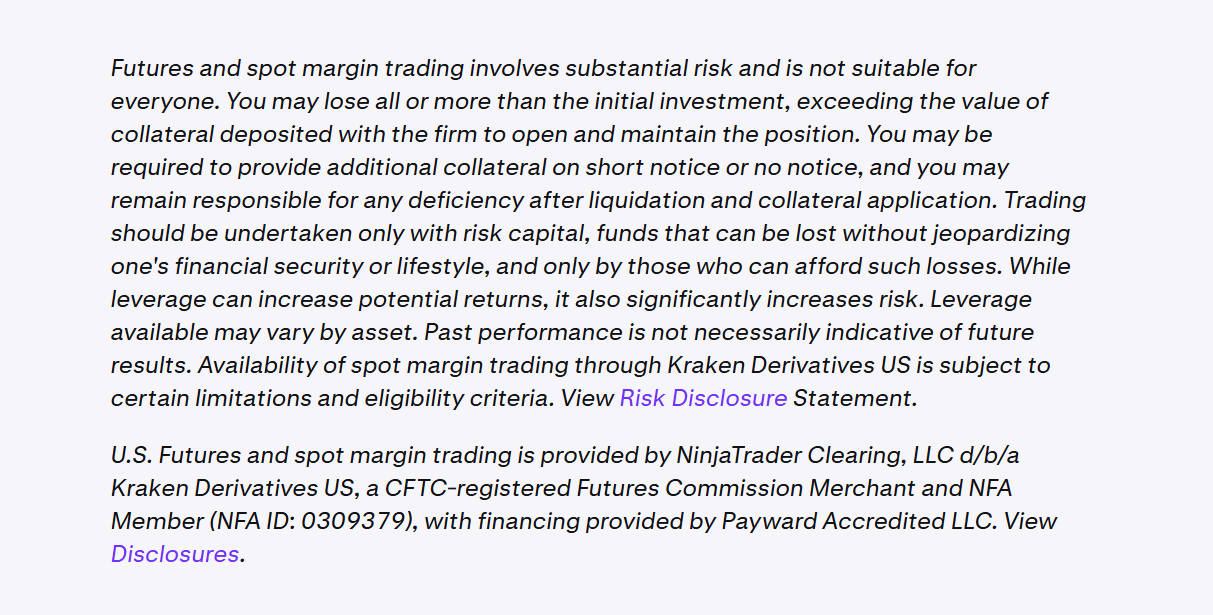
Kraken warns that futures and margin trading carry substantial risk, including the possibility of losing more than your initial investment, and are suitable only for traders who can afford significant losses.
Kraken’s risk disclosure statement on derivatives. | Source: Kraken
Leverage and Loss Amplification
Perpetual futures are leveraged instruments. Leverage amplifies both gains and losses relative to the collateral posted, meaning a position can move against a trader faster and more severely than an equivalent spot position. Traders new to leveraged products should understand this dynamic before placing any positions.
Funding Rate Risk in Trending Markets
Funding rates are not static. In strongly trending markets, rates can rise significantly and remain elevated across multiple daily settlement windows. A position that looked cost-effective to hold when opened can become expensive to maintain if the funding rate moves sharply in one direction. Monitoring the predicted next funding rate alongside the current rate gives traders early visibility into whether holding costs are likely to increase.
Liquidation Risk and Margin Monitoring
Liquidation occurs automatically if account equity drops below the maintenance margin threshold. Because daily funding settlements can draw down both the available balance and, if the balance is insufficient, the position margin itself, traders in elevated funding rate environments face accelerated liquidation risk that may not be immediately visible from the position’s profit and loss alone. Monitoring available balance separately from unrealized position performance is the correct approach.
Regulatory Protection and Its Limits
Trading on a CFTC-regulated venue provides regulatory oversight and access to dispute mechanisms that offshore platforms do not offer. That regulatory structure does not protect against trading losses, margin calls, or the financial consequences of liquidation. It provides recourse in cases of platform misconduct or operational failure, not protection against market risk.
Do I need a separate account to access perpetual futures on Kraken?
No. Perpetual futures are accessible through the same Kraken Pro account and wallet used for CME futures. Provided futures trading has already been unlocked on the account, perpetual contracts appear immediately in the Perps tab with no additional application required.
How does the daily 3:00 pm CT funding settlement affect my margin?
Funding payments accumulate throughout the trading day and are applied as a single cash adjustment at 3:00 pm CT. If the available account balance is insufficient to cover the payment at settlement time, the shortfall is drawn directly from position margin, which reduces the buffer before the maintenance margin threshold and can accelerate a potential liquidation.
What happens to my position if Kraken removes a perpetual contract?
Kraken Derivatives US will make best efforts to provide advance notice before any contract is delisted. Open positions in the delisted contract will be closed prior to removal. Traders should monitor official Kraken communications for delisting announcements.
Can perpetual futures and CME futures be held in the same account?
Yes, both contract types are accessible through the same account. Traders should be aware that holding any CME futures position alongside perpetual futures changes the liquidation fee structure for all events in that account from the $10 flat perpetual fee to $25 for the first liquidation and $50 for each subsequent event.
Disclaimer:
The information provided in this article is for informational purposes only. It is not intended to be, nor should it be construed as, financial advice. We do not make any warranties regarding the completeness, reliability, or accuracy of this information. All investments involve risk, and past performance does not guarantee future results. We recommend consulting a financial advisor before making any investment decisions.
Dr. Guneet Kaur is a senior editor at CCN.com and a Science Fellow at Exponential Science. She is a fintech and blockchain expert with extensive experience in digital finance education, blockchain ecosystems, and cryptocurrency markets. She has worked with global media such as Cointelegraph, as well as education and blockchain platforms, to design and lead strategic content and learning initiatives. As an educator and assessor for top-tier executive programs, she bridges real-world fintech trends with academic insight.
Dr. Kaur is also a published researcher and peer reviewer across fintech and data science journals, including Financial Innovation Journal and International Journal of Big Data Intelligence and Applications. Her work spans data-driven analysis, Web3 innovation, and technical content development. With a strong foundation in both industry and academia, she translates complex financial technologies into practical applications, empowering learners, professionals, and institutions across the rapidly evolving digital finance landscape.


 Easy
Easy