Home / Education / Crypto / Interview / Passport as Portfolio: Henley & Partners’ Dominic Volek on Why Crypto Wealth Is Rewriting the Rules of Global Mobility
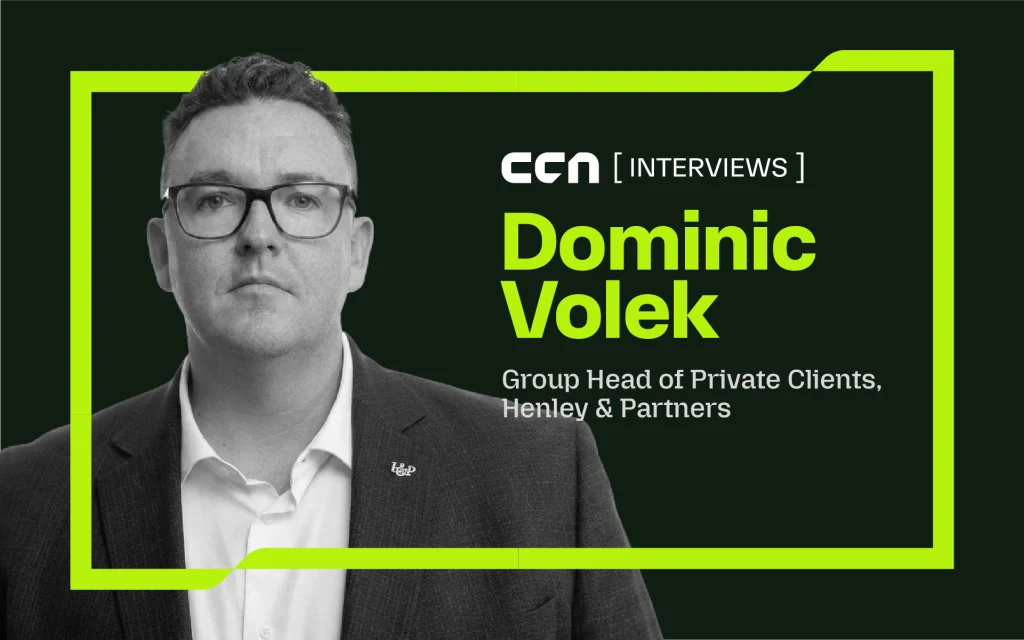
Henley & Partners’ Dominic Volek says crypto investors diversify passports like wallets, staying mobile, hedged across jurisdictions. | Credit: CCN.com
Share
The world’s fastest-growing wealth class holds borderless capital but lives inside borders. CCN’s Giuseppe Ciccomascolo sat down with Dominic Volek, Group Head of Private Clients at Henley & Partners, to explore how the investment migration industry is adapting, and where it is still falling short.
The shift is already visible in the numbers. Cryptocurrency millionaires have grown to 241,700 globally, a 40% increase in just one year. More of them are now asking a once-niche question: where should I live?
For Dominic Volek, that question sits at the heart of his practice. As Group Head of Private Clients at Henley & Partners, the firm widely credited with creating the concept of residence and citizenship planning in the 1990s, Volek spends his days advising the globally mobile, the ultra-wealthy and, increasingly, a new kind of client altogether: the crypto-native high-net-worth individual.
A Different Kind of Wealthy
Volek is careful to distinguish this cohort from the traditional wealth profile his firm has long served. Crypto-native investors are younger, more international and considerably more liquid, he says. Where conventional wealth tends to be built through operating businesses or property, assets that keep their owners rooted in a jurisdiction, digital wealth carries no such gravitational pull.
“Crypto-native high net worths are certainly less emotionally tied to any single jurisdiction,” Volek says, “and therefore usually more mobile.”
That mobility, he argues, makes the case for residence and citizenship planning almost self-evident to this group. Their capital is already borderless. The problem is that they, as individuals, are not.
“While their capital is borderless through digital assets and crypto, they as individuals are still limited based on what passport they hold, where they’re tax residents, or banking systems or regulatory regimes.”
Hedging Jurisdictional Risk
Where traditional clients approach mobility planning through the lens of family, education or lifestyle, crypto investors think in terms of optionality, decentralization and resilience, Volek explains. The language of portfolio theory, so fluent to anyone who has navigated volatile digital markets, translates directly into how they think about passports and residency.
“Anyone in the crypto space understands volatility very well,” he says. “The idea of hedging jurisdictional risk is quite intuitive to them.”
The framework Henley uses for this is what Volek calls a sovereign portfolio. Rather than a Plan B, it is a structured set of residences and citizenships across multiple jurisdictions, assembled in advance of any crisis.
He invokes Kennedy to make the point. ‘You don’t fix the roof when it’s raining,’ he says, quoting the old adage. ‘You fix the roof when the sun is shining. Put these things in place now so that if and when things change—and they will—you’re ready to act.’”
Today’s entrepreneurs maintain footprints in three, four, five jurisdictions, recognizing that concentration equals vulnerability. Regulations shift overnight. Technologies obsolete themselves. For Volek, that reality makes the sovereign portfolio not a luxury but a structural necessity.
Where the Industry Is Lagging
Not everything in the investment migration world has kept pace with the new wealth. Volek is candid about the gap.
“The investment migration industry at large is still a bit behind in terms of the adoption and acceptance of crypto wealth,” he says.
Most residency and citizenship by investment programs still demand proof of wealth in forms designed for a previous era: bank statements, audited accounts, property transaction records. When a client’s fortune exists primarily on-chain, that creates friction.
The documentation challenge is manageable in many cases. Proof of wallet ownership, transaction histories and clean exchange records can all be produced. The harder problem is the earliest layer of the money trail: explaining what fiat currency was used to make the initial investment into crypto, years or decades ago, and where that fiat came from.
A 2024 analysis of 75 global jurisdictions found that 76% now permit cryptocurrency use within defined regulatory boundaries, while only 23% maintain substantial restrictions. But permitting crypto use and accepting it as a direct medium of investment are very different things, and most programs still require conversion to fiat before any qualifying investment is made.
The Programs That Are Moving
There are exceptions, and Volek maps them carefully.
Italy‘s investor visa includes a 250,000 euro pathway into innovative startups, and some of those projects have been tokenized.
In the Caribbean, certain real estate developers and program partners will accept crypto directly into qualifying projects, even where governments themselves will not. El Salvador, famously, offers a Bitcoin-denominated citizenship program, though Volek notes it has not yet gained significant traction.
St. Kitts operates without personal income tax, capital gains tax or inheritance tax, and at $250,000 for an applicant and up to three dependents, remains one of the more accessible citizenship programs, particularly relevant to crypto entrepreneurs assembling portfolios across multiple jurisdictions.
The UAE may represent the most comprehensive strategy for attracting crypto wealth, with zero taxes on crypto trading, staking, mining or selling across all seven emirates, and the DMCC Crypto Centre now housing over 650 blockchain companies.
Volek is also preparing to add a new name to that list. Henley is working with the Maldives government on a residence by investment program set to launch within weeks.
“We’ve worked with over 15 different governments around the world,” he says. “There are actually about 60 countries globally that have attractive, well-run, legal residence and citizenship programs available.”
Compliance Is Not Optional
As programs become more sophisticated in their acceptance of digital wealth, they are also becoming more demanding. Volek describes an industry-wide move toward stronger AML screening and more rigorous source-of-funds verification.
Crypto origin of wealth is not automatically a red flag, he stresses. The key is documentation and clarity. Henley has successfully guided primarily crypto-sourced clients through programs in both Europe and the Caribbean. But the expectation from governments is rising.
The Decade Ahead
Volek expects the intersection of crypto wealth and global mobility to intensify considerably over the next ten years. More crypto-origin high-net-worth individuals will enter the market every year. Governments will apply more scrutiny. And competition among jurisdictions to attract credible digital wealth will sharpen.
Crypto is gaining traction as financial infrastructure for those pursuing self-directed mobility, and its expanding use in regulated investment migration programs marks a turning point in how digital wealth can support individual sovereignty.
The winners, in Volek’s view, will be the jurisdictions that combine innovation with trust, and that integrate investment migration into a credible, forward-looking digital asset framework.
For investors, the message is equally clear: Residence and citizenship planning is no longer a peripheral concern. It is, as Volek puts it, part of the wider wealth architecture itself.
As Volek has noted publicly, crypto millionaires are seeking jurisdictions that not only recognize digital assets but also provide residence and citizenship solutions aligned with their internationally mobile lifestyles, with investment migration programs offering a structured pathway to greater security and global access.
For clients approaching this process, his advice is consistent: document everything now, regularize any outstanding tax or compliance positions, and do not wait for a crisis to start building the portfolio.
Disclaimer:
The information provided in this article is for informational purposes only. It is not intended to be, nor should it be construed as, financial advice. We do not make any warranties regarding the completeness, reliability, or accuracy of this information. All investments involve risk, and past performance does not guarantee future results. We recommend consulting a financial advisor before making any investment decisions.
Giuseppe Ciccomascolo began his career as an investigative journalist in Italy, where he contributed to both local and national newspapers, focusing on various financial sectors.
Upon relocating to London, he worked as an analyst for Fitch's CapitalStructure and later as a Senior Reporter for Alliance News. In 2017, Giuseppe transitioned to covering cryptocurrency-related news, producing documentaries and articles on Bitcoin and other emerging digital currencies. He also played a pivotal role in establishing the academy for a cryptocurrency exchange website. Crypto remained his primary area of interest throughout his tenure as a writer for ThirdFloor.


 Easy
Easy