Fake “CLAW” tokens are linked to an OpenClaw phishing scam targeting crypto wallets. Learn how the attack works, risks involved, and how to stay safe. | Credit: CCN.com
Share
Key Takeaways
Fake CLAW tokens are widely circulating, exploiting OpenClaw’s name and hype to mislead users into interacting with malicious assets.
Phishing attacks are evolving beyond simple wallet signatures into full system compromise through malicious plugins and AI agent execution.
AI agent platforms introduce new risks, as compromised agents can access wallets, files, and sensitive credentials simultaneously.
User caution and verification are essential, as unverified tokens, tools, or addresses can quickly lead to irreversible financial losses.
The sudden emergence of “CLAW” tokens has left many crypto users asking a simple but critical question: are these tokens legitimate, or part of a broader scam?
The answer, based on multiple security reports and incident analyses, leans heavily toward caution. A recent wave of phishing attacks targeting users of OpenClaw, an AI-agent-based platform, has exposed a complex scheme involving fake tokens, malicious plugins, and wallet-draining malware.
While the token itself may appear tied to a legitimate ecosystem at first glance, the surrounding activity suggests a coordinated effort by attackers to exploit trust, branding confusion, and emerging AI infrastructure.
I suspect the attackers extracted information from GitHub and transmitted it on a large scale. pic.twitter.com/2DGwof8Zc6
OpenClaw is part of a new generation of AI-agent platforms designed to automate tasks such as data retrieval, execution of commands, and interaction with external tools. These agents can operate semi-autonomously, making decisions and executing workflows on behalf of users.
This level of capability also introduces a new attack surface.
Unlike traditional applications, OpenClaw agents can:
This makes them particularly attractive targets for attackers. Instead of tricking users into signing a malicious transaction, as seen in traditional phishing, attackers can now aim to compromise the agent itself, gaining deeper and more persistent access.
Are ‘CLAW’ Tokens Legit or Part of a Scam?
There is no widely verified, officially recognized “CLAW” token tied securely to the OpenClaw ecosystem at the time of reporting. Instead, several variants of CLAW-branded tokens have appeared, many of which are linked to scam activity.
Security researchers and incident reports highlight that attackers:
Created lookalike tokens using the CLAW name
Promoted them through compromised or spoofed social accounts
Leveraged confusion during branding or development transitions
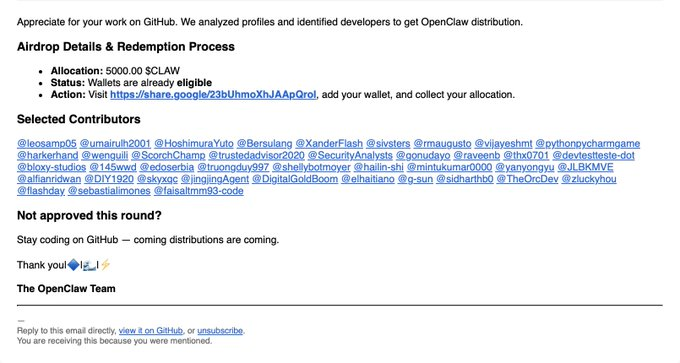
According to cyber security firm OX Security, the attackers set up fake GitHub profiles and posted messages in repositories they managed, tagging developers to draw attention. These posts claimed users had received $5,000 worth of “CLAW,” a token that doesn’t actually exist, in an effort to lure them to a spoofed website.
The scheme redirected users to a fake site designed to closely mimic OpenClaw’s official page, where they were prompted to connect their crypto wallets, a typical phishing method used to gain access to credentials or authorize malicious transactions.
X user @orcdev shared a screenshot of the phishing message, highlighting how attackers are impersonating OpenClaw to promote a fake “CLAW” token and lure developers into connecting their wallets.
Scam e-mail. | Credit: OrcDev X profile
OpenClaw creator Peter Steinberger cautioned users to ignore any emails promoting cryptocurrency offers linked to the project, stressing that such messages are fraudulent.
Folks, if you get crypto emails from websites claiming to be associated with openclaw, it's ALWAYS a scam.
We would never do that. The project is open source and non-commercial. Use the official website. Be sceptical of folks trying to build commercial wrappers on top of it.
He clarified that OpenClaw is an open-source, non-commercial initiative and would never send crypto-related promotions. Steinberger urged users to rely only on the official website and remain cautious of third parties attempting to commercialize or misuse the project’s name.
Why the Confusion Worked
The success of these fake tokens stems from a familiar but effective strategy:
In some cases, attackers even manipulated agents to initiate transactions or interact with fraudulent tokens.
Fake CLAW Tokens and Social Engineering Tactics
The phishing campaign did not rely on technical exploits alone. Social engineering played a central role.
Attackers:
Mimicked official project branding
Used similar wallet addresses or token names
Leveraged compromised or fake social media accounts
In some instances, attackers sent small transactions from lookalike addresses to users. This tactic, known as address poisoning, aims to trick users into copying the wrong wallet address during future transactions.
Combined with fake CLAW tokens, this created a layered deception:
Users believed they were interacting with a legitimate ecosystem
No, there is currently no widely verified official CLAW token tied to OpenClaw. Many tokens using the “CLAW” name appear to be unofficial or malicious, created to exploit user confusion.
What is the OpenClaw phishing attack and how does it work?
The OpenClaw phishing attack involves malicious plugins (“skills”) that trick users into executing harmful commands. Once installed, these can steal crypto wallet data, credentials, and system access, going beyond traditional phishing.
Why are AI agent platforms like OpenClaw vulnerable to attacks?
AI agent platforms can execute commands, access files, and interact with wallets, making them powerful, but also risky. If compromised, attackers can gain deep and persistent control, not just one-time access.
How can users protect themselves from fake tokens and wallet phishing?
Users can protect themselves from fake tokens and wallet phishing by taking a few essential precautions. It is important to always verify token contracts through official sources before interacting with them, as scammers often create convincing replicas. Users should also avoid installing unverified plugins or tools, which can compromise wallet security. For added protection, using hardware wallets and operating in isolated environments can significantly reduce the risk of unauthorized access.
Disclaimer:
The information provided in this article is for informational purposes only. It is not intended to be, nor should it be construed as, financial advice. We do not make any warranties regarding the completeness, reliability, or accuracy of this information. All investments involve risk, and past performance does not guarantee future results. We recommend consulting a financial advisor before making any investment decisions.
Giuseppe Ciccomascolo began his career as an investigative journalist in Italy, where he contributed to both local and national newspapers, focusing on various financial sectors.
Upon relocating to London, he worked as an analyst for Fitch's CapitalStructure and later as a Senior Reporter for Alliance News. In 2017, Giuseppe transitioned to covering cryptocurrency-related news, producing documentaries and articles on Bitcoin and other emerging digital currencies. He also played a pivotal role in establishing the academy for a cryptocurrency exchange website. Crypto remained his primary area of interest throughout his tenure as a writer for ThirdFloor.
Giuseppe Ciccomascolo began his career as an investigative journalist in Italy, where he contributed to both local and national newspapers, focusing on various financial sectors.
Upon relocating to London, he worked as an analyst for Fitch's CapitalStructure and later as a Senior Reporter for Alliance News. In 2017, Giuseppe transitioned to covering cryptocurrency-related news, producing documentaries and articles on Bitcoin and other emerging digital currencies. He also played a pivotal role in establishing the academy for a cryptocurrency exchange website. Crypto remained his primary area of interest throughout his tenure as a writer for ThirdFloor.


 Easy
Easy