This emission reduction immediately lowered future supply inflation. However, the team did not stop there.
Venice also introduced an aggressive buyback-and-burn mechanism. A portion of monthly protocol revenue is now used to purchase VVV tokens on the open market and permanently remove them from circulation.
As of early March, more than 33 million tokens (42.74% of the total supply) have already been burned.
Consequently, VVV has transitioned into what the team describes as a “deflationary capital asset, ensuring that sell pressure has declined.
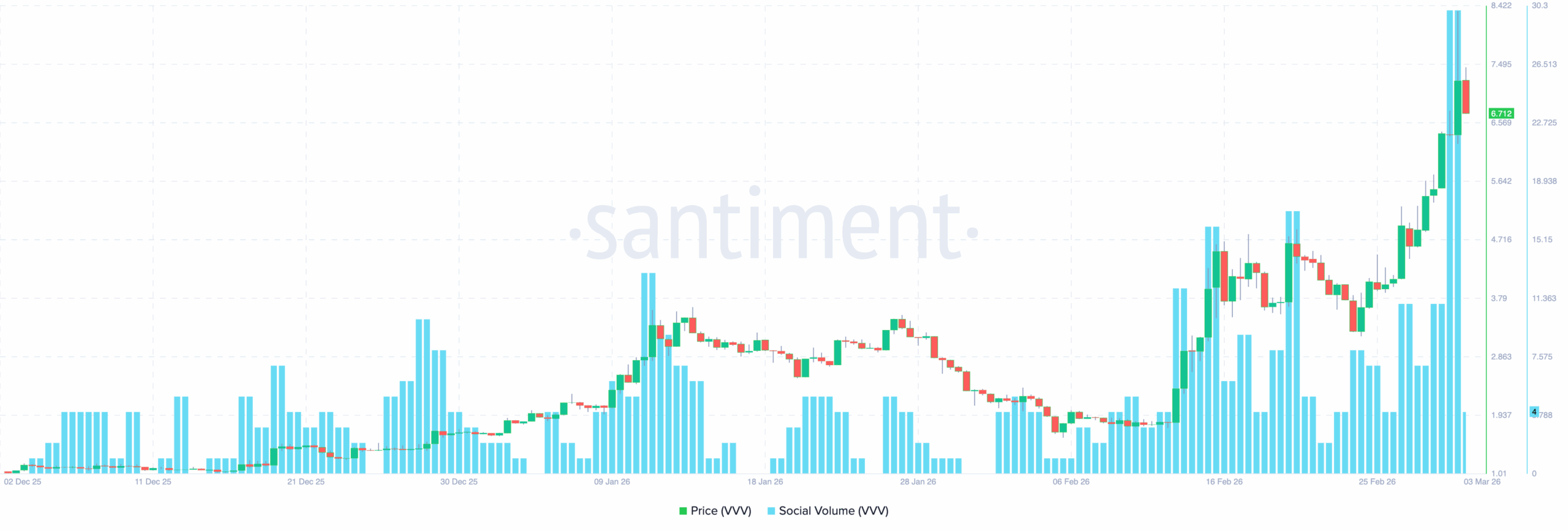
Amid these developments, social volume is simultaneously spiking to its highest levels on the chart.
Historically, when social activity rises alongside price in this way, it reflects strong retail attention.
As shown below, the move from early February into this breakout has been accompanied by progressively larger social spikes.
This alignment between the Venice Token price break and social volume growth confirms that the rally is being fueled by increasing crowd participation.
The integration is not symbolic. OpenClaw documentation now lists venice/llama-3.3-70b as the default model and venice/claude-opus-45 as the “best overall” choice.
This preferred status matters. It embeds Venice directly into developer workflows as thousands of builders now interact with Venice AI natively.
Also, since the VVV token must be staked to access the Venice API at zero marginal cost, usage growth directly reinforces token demand.
Therefore, the utility-driven demand adds a fundamental layer beneath price action.
Can VVV Price Hit $9 in March?
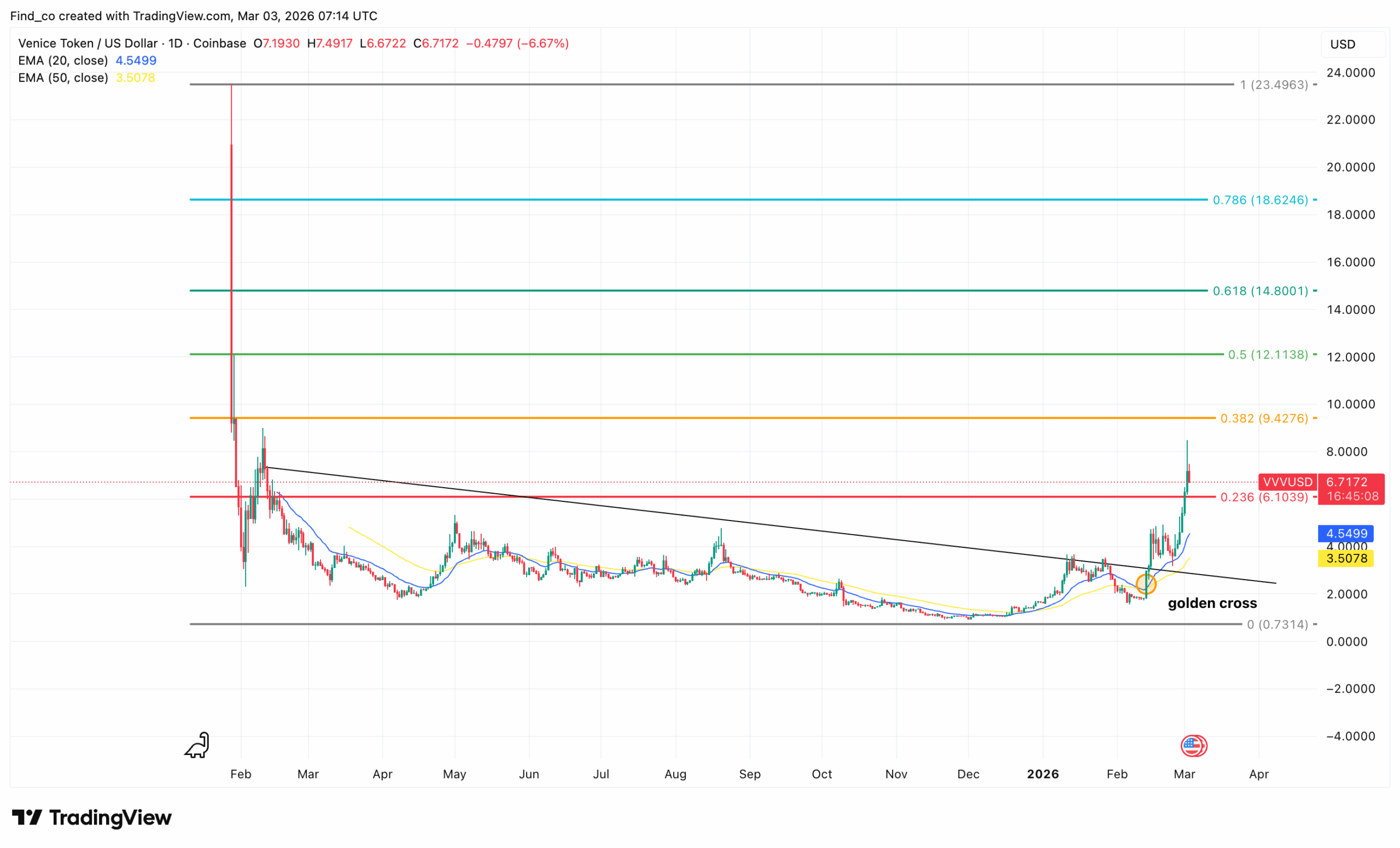
On the daily chart, VVV appears to be undergoing a major shift in its setup following a prolonged downtrend.
Following the post-launch collapse and nearly a year of decline, the altcoin held support near $0.70.
Meanwhile, the recent breakout has been clear, with the VVV token reclaiming both the 20 EMA (blue) and 50 EMA (yellow).
In the process, it also formed a golden cross, indicating that the distribution phase may be over.
At the time of writing, the Venice token price has surged into the 0.236 Fibonacci retracement around $6.10, which is acting as the first major resistance.
Therefore, the next significant resistance sits near the 0.382 retracement around $9.42.
If momentum sustains and VVV consolidates above the $5.00 region on any pullback, continuation toward that level becomes technically plausible.
On the contrary, failure to hold above the 20 EMA near $4.55 would signal that the breakout is losing strength. In that scenario, VVV’s price might decline below $4.
Disclaimer:
The information provided in this article is for informational purposes only. It is not intended to be, nor should it be construed as, financial advice. We do not make any warranties regarding the completeness, reliability, or accuracy of this information. All investments involve risk, and past performance does not guarantee future results. We recommend consulting a financial advisor before making any investment decisions.
Victor Olanrewaju is a crypto analyst and reporter at CCN with deep roots in on-chain research and technical analysis. His crypto journey began in 2017, but it was the 2020 Uniswap airdrop that sparked a full-time pivot into the space.
With a foundation in copywriting, Victor honed his craft creating high-converting content for leading crypto brokers — most notably an XRP price prediction that ranked #1 on Google during the 2021 bull run.
He later joined AMBCrypto in 2022, where he combined storytelling with technical and on-chain analysis to cover key market narratives.
In 2024, he expanded his expertise at BeInCrypto, collaborating with analysts and using tools like Glassnode, Santiment, and IntoTheBlock to break down Bitcoin and altcoin trends.
At CCN, Victor covers the top cryptocurrencies, memecoins, macro shifts, blending real-time insights with deep-dive metrics.
He holds a Bachelor’s degree in Physics from the University of Ibadan, equipping him to simplify complex data for a wide audience. Follow his work or connect on LinkedIn or X.