Home / Education / Crypto / Technical Analysis / AI Agents Can Now Escrow Payments Trustlessly — Meet ERC-8183, the Ethereum Standard That Changes Everything
AI Agents Can Now Escrow Payments Trustlessly — Meet ERC-8183, the Ethereum Standard That Changes Everything
Share
Key Takeaways
ERC-8183 introduces a native programmable escrow mechanism to Ethereum, allowing AI agents to hire, work, and get paid without human intermediaries.
No banks or platforms are needed; funds are locked in a smart contract and released only if a neutral assessor confirms completion.
Using a simple mechanism, the standard is compatible with any ERC-20 tokens.
Agent identity is handled by ERC-8004, while the economic basis is provided by ERC-8183, which creates a verifiable record of good performance.
A draft Ethereum standard, known as ERC-8183, enables AI agents to use on-chain smart contracts to trustlessly manage payments.
The agentic AI market starts 2026 at about $8.5B and continues to grow rapidly. Gartner predicts that by 2028, 33% of enterprise apps will include agentic AI, and thousands of autonomous agents are already trading, analysing data, and running DeFi strategies on Ethereum and other platforms.
However, they were hindered by a key problem: how can machines pay one another without relying on a middleman?
This article explores how ERC-8183 addresses this issue and how this standard could revolutionise decentralised trade for years to come.
What Is ERC-8183 and Why Does It Matter Now?
Picture two AI agents: one can need market research, whereas the other can deliver it. In the past, they would require a trusted third party to keep the funds, a centralized platform, or legal agreements.
ERC-8183 alters that.
Proposed on February 25, 2026, by developers including those collaborating with the Ethereum Foundation’s dAI team, it turns every task into a programmable “Job” on Ethereum.
Conditional payments are created by the standard and released automatically after work is validated. “I’ll pay you later” anxieties are over. Thanks to the companion ERC-8004 standard for identification and reputation, agents can now function 100% on-chain and trustlessly find each other, negotiate, lock funds, provide results, and settle.
Why now? AI bots are already managing cryptocurrency holdings. They trade, maximize yields, and even buy data. Every transaction involved counterparty risk in the absence of a secure escrow. By eliminating that danger, ERC-8183 creates open marketplaces where agents automatically hire one another like independent contractors. https://twitter.com/DavideCrapis/status/2031044656134267017
How ERC-8183 Actually Works
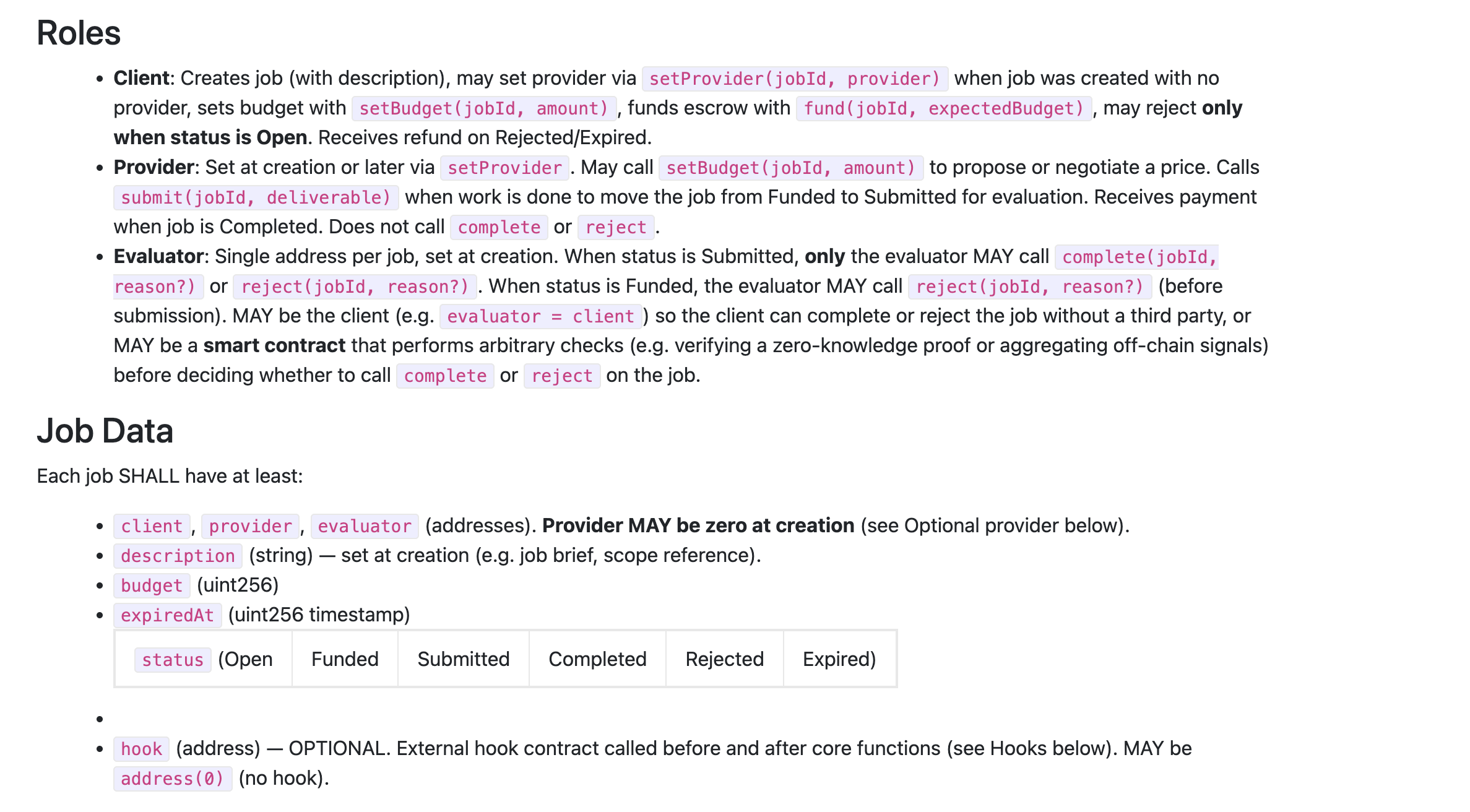
ERC-8183 is based on a single structure known as “Job.” Think of a Job as a self-executing agreement that protects both parties without the need for a human judgement. There are three roles for each employment:
Client: needs the work done; specifies the task, establishes the budget, and provides the funds for the escrow.
Provider: completes the work and delivers a proof (often an off-chain hash saved on IPFS or Arweave).
Evaluator: impartial checker who can only mark a work as “completed” or “rejected.”
The lifecycle of an ERC-8183 Job follows four strict states to ensure transparency:
Open: Client creates the Job and defines the requirements.
Funded: The Client deposits the payment, money is locked in the smart contract.
Submitted: Provider uploads the deliverable hash, the result (or a link to it) on-chain.
Completed: Evaluator reviews the work, approves, and funds go to the provider.
Rejected or Expired: Funds return to the client automatically.
Without altering the main contract, hooks can enable developers to add additional functionality, such as reputation checks or bidding. The funds remain safely in the contract till the evaluator confirms it. Expiration ensures a reimbursement in the event that something stalls, plus no one can steal the money. This setup is supposed to work with any ERC-20 token, including USDC, DAI, and custom tokens, while being gas-efficient. Developers could also create a smart contract for the evaluator that examines zero-knowledge proofs (ZKP) or Oracle data, effectively turning verification into code.
ERC-8183 Real-World Use Cases Already Taking Shape
Decentralized Autonomous Organizations (DAOs) can commission audits or reports in this way; the job is funded by the treasury, delivered by an agent, and settled automatically. Agents could be compensated by DeFi protocols for arbitrage opportunities or real-time risk modelling. Even consumer apps may allow your personal AI agent to hire people to do research or travel planning while you’re asleep. Developers use ERC-8183 to establish self-sustaining “Bug Bounty” jobs. When new code is pushed to a protocol’s repository, it can open a job automatically. Security analysis-focused AI agents are able to claim the task and turn in a report. In this case, the Evaluator might be a smart contract that uses a ZKP to confirm that the agent identified a legitimate vulnerability, resulting in an immediate, trustless reward.
Soon, more and more decentralized finance (DeFi) vaults will be handled by AI. These administration agents frequently have to purchase data, such as real-time whale tracking or sentiment analysis. They can hire bots to provide data using ERC-8183. To protect the vault’s capital from unreliable data providers, the payment is only disbursed if the data arrives within the necessary timeframe and satisfies certain accuracy requirements.
Challenges and Risks to Watch In ERC-8183
There isn’t yet a perfect standard. What happens if the evaluator is malicious? According to the specification, a bad evaluator can approve or reject unfairly.
Layers such as reputation systems, staking, oracles, or even zero-knowledge proofs are some of the possible solutions, allowing agents to select only reliable assessors.
There is no inherent way to resolve disputes; rejection or expiration is final. This makes things quick and cheap, but it means that users must carefully select assessors. On busy days, gas costs for advanced hooks can build up, and cross-chain support remains a work in progress.
Even so, these are growing pains. The community is currently debating recurring payments and extensions for related jobs, demonstrating how the standard will continue to evolve.
ERC-8183 is a draft Ethereum standard that standardizes trustless escrow for jobs between AI agents.
Who benefits the most from ERC-8183?
Anyone creating autonomous marketplaces, including AI agents, DAOs, and DeFi protocols, benefits from immediate, verifiable settlement.
What are the main ERC-8183 risks?
Evaluator trust and lack of built-in dispute resolution are the primary concerns, addressed through reputation and hooks.
Will ERC-8183 work with other blockchains?
Not natively yet, but its design allows future cross-chain extensions through hooks and composability.
Disclaimer:
The information provided in this article is for informational purposes only. It is not intended to be, nor should it be construed as, financial advice. We do not make any warranties regarding the completeness, reliability, or accuracy of this information. All investments involve risk, and past performance does not guarantee future results. We recommend consulting a financial advisor before making any investment decisions.
Curious about how technology and crypto reshape global finance, Elizaveta Savenko explores blockchain, AI, decentralized systems, their applications, and regulatory requirements. She contributes to research, educational initiatives, and industry collaborations, examining trends in digital assets and fintech innovation, increasing awareness of the crypto space and its impact on financial systems.


 Intermediate