What Would It Take for XRP to Reach $100? — And Why It Hasn’t Yet
Share
Key Takeaways
$100 XRP implies a multi-trillion-dollar valuation at today’s circulating supply, roughly $6.1 trillion circulating supply figure.
The core constraint is the combination of liquidity depth, sustained demand, and market confidence required to support that valuation across market cycles.
XRP’s market structure was shaped for years by U.S. regulatory uncertainty, with the SEC case concluding in 2025 and earlier rulings drawing distinctions between institutional and programmatic sales.
Even in traditional finance, cross-border payments are hard to upgrade, with global targets still lagging—useful context for why “payments adoption at scale” is a high bar for any rail.
XRP is a digital asset used on the XRP Ledger (XRPL) and in some payment and liquidity workflows associated with Ripple’s network. It’s also one of crypto’s most persistent “big-number” debates: could XRP ever trade at $100?
That question sounds like a price prediction. It isn’t, at least not if you want a serious answer. A $100 XRP is a claim about scale: how much value markets would assign to XRP, how deep global liquidity would need to be, and what kind of sustained demand could justify holding that valuation over time.
This article breaks the topic into checkable parts: the market-cap math, the market-structure requirements, the supply and distribution mechanics, the regulatory history that shaped access, and the adoption realities that tend to get lost in “$100 soon” discourse.
XRP Price Math: What a $100 XRP Implies for Market Capitalization
The quickest way to turn a price target into something concrete is basic arithmetic: price × circulating supply = implied market cap.
CoinMarketCap lists XRP with a circulating supply in the tens of billions, and a maximum supply of 100 billion. Using CoinMarketCap’s circulating-supply figure (about 60.85 billion XRP), a $100 price implies roughly: $100 × 60.85B ≈ $6.1 trillion.
That number matters because it changes the category of the conversation. A multi-trillion valuation is usually associated with assets that are either:
held broadly as long-term stores of value, or
embedded in financial plumbing with persistent, large-scale demand, or
supported by extremely deep liquidity across many venues and jurisdictions.
XRP Price and Market Capitalization: Why a $6 Trillion Valuation Requires Depth and Confidence
Market capitalization is a blunt metric. It does not tell you:
how concentrated ownership is,
whether liquidity disappears under stress,
how fragmented trading is across venues, or
how much “real” demand exists beyond speculation.
But market cap is still the first gate because it forces a simple question: what would the world need to believe for XRP to be worth $6 trillion?
To support valuations at that scale, markets usually need two things at the same time:
Depth (large buy/sell capacity without huge slippage)
Confidence (participants trust the asset’s market access, legal footing, and durability)
For a payments-adjacent asset, depth and confidence are not abstract. Payment systems are judged by their worst days: when volatility spikes, liquidity spreads widen, and compliance teams say “no.”
XRP Price at $100: The Structural Requirements Behind a Multi-Trillion-Dollar Claim
This section is a requirements checklist. If $100 is a multi-trillion-dollar claim, what kinds of conditions typically support claims of that size?
Sustained Demand Would Need to Be “Structural,” Not Episodic
A big rally can happen on flows and narratives. A sustained multi-trillion valuation usually needs demand that repeats for functional reasons.
For XRP, the long-running narrative is a role in cross-border value transfer, using XRP as a bridge between currency pairs or liquidity pools. The key word is repeated: demand would need to show up as a persistent need to source XRP liquidity, not just a periodic trading wave.
Liquidity Would Need to Be Deep Across Many Corridors at Once
Cross-border payments aren’t one market. They’re thousands of corridors, each with its own:
liquidity profile,
regulation and compliance constraints,
settlement expectations,
and risk tolerances.
One corridor working well doesn’t solve the global problem. At “$100 scale,” the requirement is closer to broad corridor coverage with consistently tight spreads and resilient market making.
It’s worth noting how hard this is even for traditional systems. A 2025 BIS Bulletin on cross-border payments reports that progress toward G20 targets has been modest, and key speed/cost targets are still not being met. Reuters reporting echoed that assessment via comments attributed to an FSB deputy secretary general about targets likely being missed.
That context matters: “payments adoption” is not just a tech claim. It’s a coordination one.
Holding Incentives Would Need to Exist Alongside “Bridge” Usage
There’s an underappreciated tension in the bridge-asset story: if an asset is mainly used as a short-lived hop (in and out within seconds or minutes), high velocity can reduce the amount that needs to be held at any time.
A very high valuation, by contrast, is easier to sustain when market participants are incentivized to hold inventory: for liquidity provisioning, reserves, collateral use, or other recurring needs.
So the $100 question quietly becomes: what would cause meaningful segments of the market to hold XRP at scale through time, rather than just pass through it?
Market Access Would Need to Be Broad, Predictable, and Regulator-Friendly
Large pools of capital tend to require:
clear custody pathways,
consistent exchange/venue access,
predictable compliance treatment,
and legal clarity about what risks attach to holding and transacting the asset.
This is one reason regulation matters even when readers “don’t care about court cases.” Market access shapes liquidity. Liquidity shapes price discovery. Price discovery shapes everything else.
Why XRP Price Hasn’t Reached $100 Yet
There is a stack of constraints that compound.
The Valuation Bar Is Historically Huge
Using current circulating supply, $100 implies about $6.1 trillion in market cap. That scale demands a level of sustained demand, liquidity depth, and institutional comfort that few crypto assets have ever demonstrated for long periods. The question isn’t “could the price touch $100 during an extreme episode?” It’s “what would make $100 stick?”
Public Debate Often Confuses “Trading Activity” With “Economic Demand”
XRP can have heavy trading volume without that translating into the kind of real-economy settlement needed that anchors long-term valuation.
Speculative turnover can be enormous. But speculative turnover is not the same as recurring functional demand, especially demand that must repeatedly source and hold liquidity across jurisdictions.
“Expert Views” Are Often More Skeptical Than Social Media
A useful reality check is to look at what prominent insiders actually say when pressed on big-number targets.
On Jan. 30, 2026, Ripple CTO David Schwartz pushed back on expectations that XRP would reach $50–$100, calling it not likely — comments that triggered backlash from some long-term holders.
But I will say this:
If many rational people believed that there was a 10% chance that XRP hit $100 within a few years, they definitely wouldn't sell very much today at much less than $10. Those with that belief would quickly buy up most of the XRP, because they'd value it more…
You can disagree with Schwartz’s framing. But the underlying point is important for readers: serious evaluations tend to revert to expected value, adoption constraints, and market structure, not viral price ladders.
Payments Modernization Has Multiple Rails, and ‘Winning’ Is Slow
Even if you exclude a big stablecoin discussion, one structural factor remains: cross-border payments are being attacked from many directions: bank-led upgrades, shared ledgers, messaging improvements, and various tokenization models.
The BIS/FSB work on cross-border targets illustrates the pace and friction of change in this domain.
For XRP to justify a $6T valuation via a payments thesis, it would likely need to become a default or near-default liquidity component across meaningful parts of that evolving landscape, not just a viable option in some corridors.
XRP Price and Tokenomics: How Supply Dynamics Shape the $100 Case
XRP’s tokenomics are unusual compared to mined assets: the total supply was created up front and distribution has been a long-running market topic. Currently, a max supply of 100B with 60.85B circulating.
A key recurring narrative is Ripple’s escrow program and monthly unlocks. The typical pattern: 1 billion XRP unlocked monthly, with a large share often re-locked, and only a portion used for various purposes.
Two practical observations:
A headline “unlock” figure is not the same as “net new supply dumped on the market.” The net effect depends on how much is re-locked and how much is sold or distributed.
Even if the market expects the schedule, predictable supply events can still create a psychological overhang, influencing risk models and sentiment.
Overhang doesn’t guarantee lower prices. It does mean the $100 case has to overcome not only demand requirements, but also persistent market focus on distribution and supply dynamics.
US Regulatory History of XRP: From SEC Enforcement to Market Reopening
For years, XRP market structure in the U.S. was shaped by the SEC’s enforcement action against Ripple (filed in December 2020).
Several milestones matter, including:
July 13, 2023: The SDNY summary judgment decision analyzed whether different XRP transactions constituted investment contracts under U.S. securities law, drawing distinctions across transaction types.
Aug. 7, 2025: The SEC published a litigation release indicating the matter’s procedural closure (including dismissal steps).
Aug. 8, 2025: Reported that the SEC ended the lawsuit and that Ripple would pay a $125 million fine, with both sides dropping appeals.
Regulation can restrict market access, delistings can reduce liquidity, and liquidity constraints can suppress price discovery, especially for an asset whose “scale story” depends on broad market participation.
What to Watch Instead of XRP Price Targets
If $100 is really a proxy for “global-scale relevance,” then the best indicators are not round numbers. They’re structural signals:
Liquidity quality: depth and spreads during calm periods and stress events (a $6T asset needs to function under pressure).
Breadth of access: consistent availability across major regulated venues and jurisdictions.
Evidence of repeatable usage: patterns that suggest recurring demand rather than one-off announcements.
Legal and compliance stability: fewer “unknown unknowns” for institutions deciding whether to hold XRP inventory.
This framework won’t give you a dopamine hit. It does give you a way to evaluate the real substance behind a viral target.
Why the $100 XRP Case Remains a High Bar
A $100 target survives because it forces the argument out into the open. It turns “XRP will moon” into a concrete claim about market cap, liquidity depth, adoption reality, and regulation.
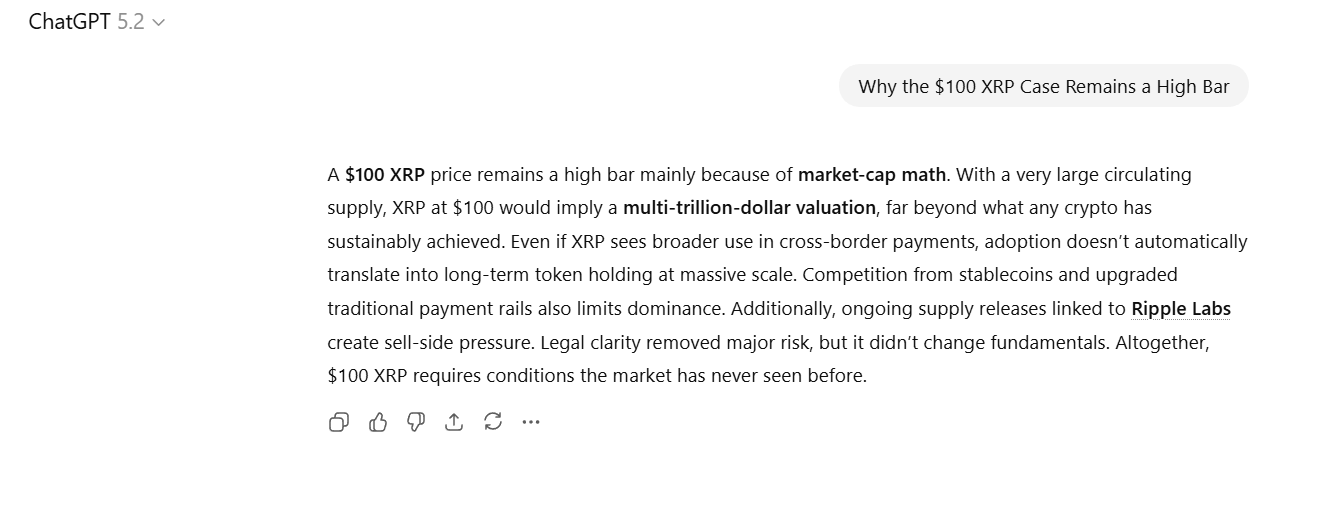
ChatGPT on Why the $100 XRP Case Remains a High Bar. | Source: ChatGPT
The honest version of the $100 question is: what would have to be true about XRP’s role in the world for markets to value it like a top-tier global asset, consistently, not just briefly?
Today’s constraints: valuation scale, liquidity requirements, distribution overhang, and the long shadow of regulatory uncertainty, help explain why it hasn’t happened.
Using CoinMarketCap’s circulating supply figure of 60,853,233,336 XRP, $100 implies roughly $6.1 trillion in market cap.
Did the SEC case against Ripple end?
Yes. The SEC issued litigation releases in 2025, and Reuters reported that the SEC ended the lawsuit with Ripple paying a $125 million fine and both sides dropping appeals.
What did Ripple’s CTO say about XRP reaching $100?
Ripple CTO David Schwartz said XRP reaching $50–$100 was not likely, prompting pushback from some holders.
Why do analysts say a $100 XRP valuation is such a high bar?
Because a $100 valuation implies a multi-trillion-dollar market cap, which typically requires more than speculative demand. It would need sustained, structural usage; very deep liquidity across many global corridors; incentives for long-term holding; and broad, regulator-friendly market access. Without all of those conditions working together consistently, valuations at that scale are difficult to sustain.
Disclaimer:
The information provided in this article is for informational purposes only. It is not intended to be, nor should it be construed as, financial advice. We do not make any warranties regarding the completeness, reliability, or accuracy of this information. All investments involve risk, and past performance does not guarantee future results. We recommend consulting a financial advisor before making any investment decisions.


 Easy
Easy