Others argue that the real danger lies in how easily hackers can identify employees with access to sensitive infrastructure.
BitGo CEO Mike Belshe joined the debate, warning that publicly listing technical roles at cryptocurrency companies could make employees attractive targets for sophisticated phishing campaigns.
I can only imagine how bad the devops engineer that was breached must feel.
I don't know if he was on linked in.
But if you're a devops engineer in crypto, get off of LinkedIn!
Meanwhile, speculation has taken a more dramatic turn, with unverified claims that Binance deliberately staged the incident to conceal trading losses.
There is no verified evidence supporting those accusations. Binance says its investigation has not implicated any individual, while independent blockchain intelligence firms have linked the attack to suspected North Korean hackers.
The competing narratives raise a more useful security question: Could an employee’s public professional profile provide the starting point for a multibillion-dollar cyberattack?
Try Our Recommended Crypto Exchanges
Sponsored
Disclosure
We sometimes use affiliate links in our content, when clicking on those we might receive a commission at no extra cost to you. By using this website you agree to our terms and conditions and privacy policy.
Binance initially identified a compromised DevOps engineer’s laptop as a possible entry point.
According to the exchange, the attacker gained access to a service container and submitted unauthorized withdrawal transactions. Binance reported no evidence of leaked wallet private keys.
Its investigation subsequently uncovered additional points of compromise, suggesting a more complex operation than a single stolen password or employee authorization.
In an Oct. 30 statement, co-CEO Richard Teng said the company would cover customer losses using its SAFU emergency reserve and corporate funds. Approximately $3 billion in affected assets had been frozen through cooperation with blockchain partners.
The uncertainty surrounding the attack has encouraged speculation on social media.
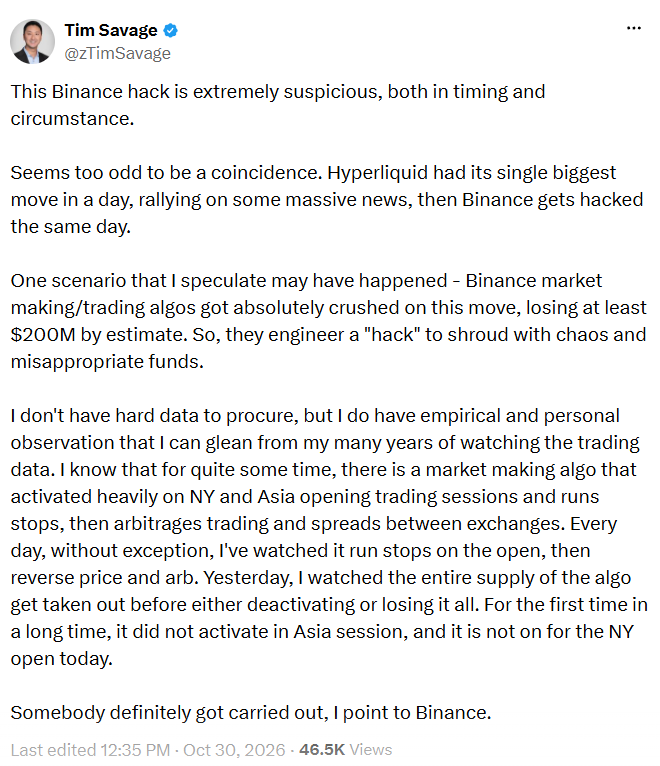
Trader Tim Savage suggested Binance could have fabricated the breach after suffering losses from market-making activity around Hyperliquid. He estimated possible trading losses of at least $200 million but explicitly acknowledged that he lacked hard evidence.
Trader speculates Binance hack engineered to hide trading losses. | Source: @zTimSavage on X
Another commentator, The Modern Investor, alleged that the hack was intended to undermine confidence in cryptocurrency exchanges ahead of traditional financial institutions entering the market.
Binance was hacked on purpose. The largest banks and companies on the planet are planning to launch their OWN crypto trading desks in the next few months. In order to drop morale and integrity in the space you have to attack the largest player to make everyone scared.
Neither allegation has been substantiated by trading records, blockchain forensics or official investigative findings.
The existence of a compromised employee device does not, by itself, establish insider involvement. Attackers can obtain access through malware, stolen credentials, or manipulated software without the employee knowingly assisting them.
Even some of Binance’s most vocal critics have rejected the growing conspiracy theories. Crypto commentator MASTR, who has previously criticized the exchange over its operations and political connections, said there was no credible evidence supporting claims that the $6.3 billion theft was an inside job or that social media accounts had advance knowledge of the attack.
Pointing to the FBI’s attribution of the breach to North Korea’s TraderTraitor operation, MASTR argued that Binance still faces serious questions about its security failures and financial transparency.
He also questioned whether the exchange’s reported allocation of more than $6.34 billion and its claim to have replenished approximately 95% of affected assets could be independently verified without access to its complete financial records. “My distrust of Binance does not give me permission to make shit up,” he wrote, urging commentators to separate legitimate scrutiny from unsupported allegations.
BitGo CEO Warns LinkedIn Profiles Could Help Hackers Find Crypto Employees
Belshe’s warning focused on a different problem: the visibility of engineers who work on cryptocurrency infrastructure.
In a post on X, the BitGo CEO argued that employees who publicly identify themselves as crypto DevOps engineers may inadvertently help attackers select targets.
LinkedIn profiles commonly reveal job titles, employers, technical skills, and employment histories. Such information can help criminals construct convincing approaches.
A hacker impersonating a recruiter, for example, might contact an engineer about a role requiring experience with Kubernetes, cloud infrastructure or blockchain systems. The attacker could then send a supposedly confidential coding assessment containing malicious software.
The engineer may believe they are completing a routine recruitment exercise while unknowingly granting the attacker access to their computer.
Belshe’s concern is supported by the FBI. In a September 2024 advisory, the agency warned that North Korean hackers research cryptocurrency employees through professional networking websites before launching personalized social engineering campaigns.
However, there is no public evidence establishing that LinkedIn was used to compromise Binance.
Nor do publicly available profiles establish that any particular employee was involved in the incident.
The agency said it was working with the US Secret Service and IRS Criminal Investigation to track stolen assets, including funds converted into ETH.
Blockchain intelligence firm TRM Labs independently traced approximately $6.36 billion in unauthorized transfers across ten blockchains.
TRM identified similarities with earlier North Korean operations, including the February 2025 Bybit hack. Its investigation also identified signs of preparation beginning at least 36 hours before the Binance theft.
Other blockchain networks experienced unauthorized transfers using conventional signatures.
TRM concluded that the evidence pointed toward compromised wallet-signing infrastructure, although Binance has not published a final technical explanation.
The FBI’s attribution identifies the suspected state-backed operation. It does not establish how the attackers initially compromised the employee’s device.
North Korean Fake Recruiters, IT Workers, and Romance Rumors
North Korea’s cryptocurrency operations extend well beyond conventional phishing emails.
The FBI has documented campaigns in which attackers impersonate recruiters, investors, and industry contacts to establish relationships with employees before attempting to install malware.
Some operations involve prolonged conversations designed to build trust. The agency has also warned about North Korean IT workers obtaining remote employment using stolen identities, fabricated credentials and manipulated interview processes.
In a July 2025 notice, the FBI said North Korea had deployed thousands of skilled IT workers internationally to obtain employment and generate revenue for the regime.
These operations present two separate risks: an external attacker deceiving a legitimate employee and an operative gaining employment under a false identity.
Neither scenario has been established as the entry point in Binance’s breach.
Was a Binance Engineer Romantically Involved With a North Korean Spy?
Another allegation circulating on X claims that a Binance engineer developed a romantic relationship with a North Korean operative and left a laptop unattended.
However, the allegation lacks supporting evidence, and there is no corresponding ZachXBT investigation supporting the romance claim.
The publication also reported that Binance explicitly denied the allegation.
ZachXBT’s documented findings instead concerned connections between cryptocurrency stolen from Binance and an earlier Bitget exploit.
North Korean hackers have used relationship-building and impersonation in previous operations, but those established tactics do not verify a romantic relationship in this case.
The owner of the compromised laptop has not been publicly identified by Binance, and there is no substantiated evidence of employee collusion.
What Binance’s $6.3B Hack Reveals About Employee Security
The breach highlights a difficult problem for cryptocurrency companies.
Engineers need access to production systems to maintain infrastructure, troubleshoot problems, and deploy updates.
Attackers seek to turn that legitimate access into control over financial systems.
A compromised laptop should not automatically provide the ability to authorize billions in withdrawals. Organizations need additional controls between employee devices, production services, and transaction-signing systems.
The FBI recommends separating approval systems, restricting software execution on corporate devices, independently verifying recruiters, and requiring multiple approvals before transferring company assets.
The exchange has also promised a detailed technical postmortem. While the FBI has attributed the $6.3 billion theft to North Korea’s TraderTraitor operation, claims of an inside job or employee involvement remain unsupported.
The incident raises a broader question about whether crypto exchanges have sufficient safeguards to prevent a single compromised employee device from exposing billions in customer assets.
internal-linking title=”Top Trending Crypto Articles” url1=”https://www.ccn.com/crypto-exchanges/” text1=”Check Out Our Recommended Exchanges Here” label1=”Best Exchanges” url2=”https://www.ccn.com/how-to-buy-crypto-with-credit-card/” text2=”How To Buy Crypto with a Credit Card Now” label2=”Buy Crypto Fast” url3=”https://www.ccn.com/crypto-gambling/” text3=”See Our Picks for the Best Crypto Gambling Sites” label3=”Safe Crypto Gambling”]
Disclaimer:
The information provided in this article is for informational purposes only. It is not intended to be, nor should it be construed as, financial advice. We do not make any warranties regarding the completeness, reliability, or accuracy of this information. All investments involve risk, and past performance does not guarantee future results. We recommend consulting a financial advisor before making any investment decisions.
Dr. Guneet Kaur is a senior editor at CCN.com and a Science Fellow at Exponential Science. She is a fintech and blockchain expert with extensive experience in digital finance education, blockchain ecosystems, and cryptocurrency markets. She has worked with global media such as Cointelegraph, as well as education and blockchain platforms, to design and lead strategic content and learning initiatives. As an educator and assessor for top-tier executive programs, she bridges real-world fintech trends with academic insight.
Dr. Kaur is also a published researcher and peer reviewer across fintech and data science journals, including Financial Innovation Journal and International Journal of Big Data Intelligence and Applications. Her work spans data-driven analysis, Web3 innovation, and technical content development. With a strong foundation in both industry and academia, she translates complex financial technologies into practical applications, empowering learners, professionals, and institutions across the rapidly evolving digital finance landscape.


 Easy