Binance's $1B SAFU Fund Faces a $6.3B Hack: How Much Must the Exchange Pay?
Share
Key Takeaways
Binance estimates its Oct. 29 security breach affected $6.3 billion in crypto assets, while CryptoQuant values its Bitcoin-backed SAFU fund at approximately $1.18 billion.
Around $3 billion in stolen assets has been frozen, potentially reducing the unrecovered exposure to $3.3 billion if those funds can be returned.
Binance has promised to cover customer losses, but the amount it must pay from corporate reserves depends on recoveries, Bitcoin prices, and available liquidity.
Binance built its Secure Asset Fund for Users (SAFU) to protect customers when things go wrong. But what happens when a single security breach is worth more than five times the emergency fund’s reported value?
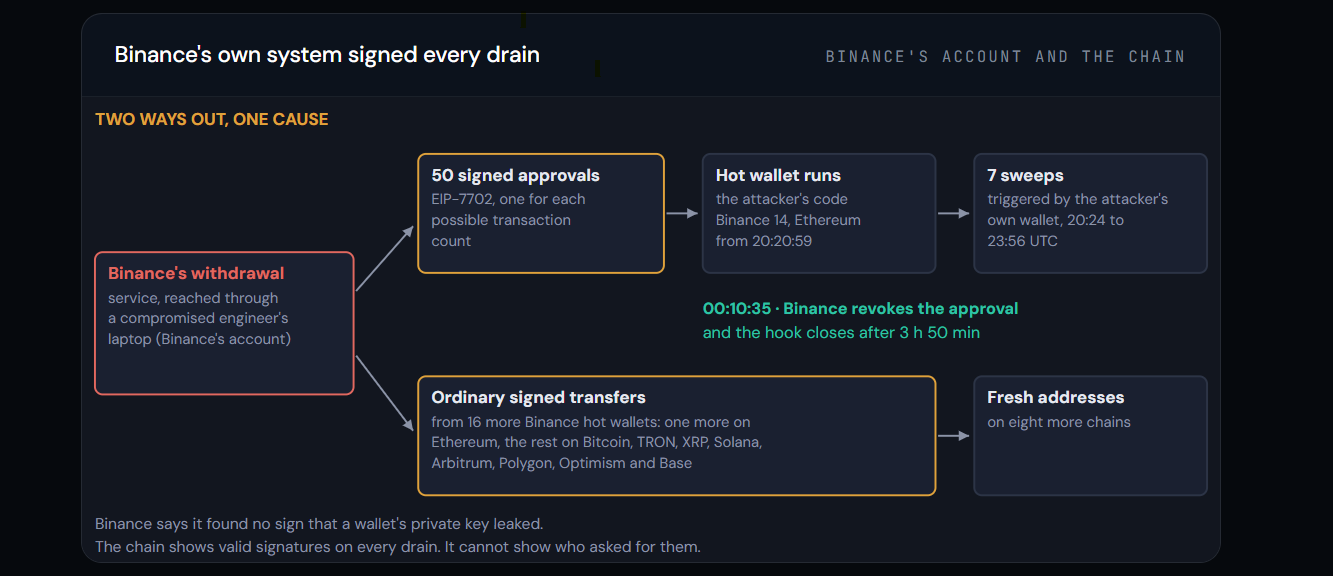
Teng said investigators suspect the attack began with a compromised DevOps engineer’s laptop, which gave the attacker access to a service container and allowed unauthorized withdrawal transactions.
How Binance’s own system signed every drain. | Source: Bitquery
He emphasized that investigators had found no evidence of leaked wallet private keys and had not attributed responsibility to any individual.
The financial consequences are still being assessed.
CryptoQuant estimates that SAFU holds 15,000 BTC, valued at approximately $1.18 billion. With around $3 billion in stolen assets frozen, the remaining exposure could be approximately $3.3 billion.
The rest? Binance pays.
SAFU, its emergency fund, holds 15,000 BTC (~$1.18B). It was built for exactly this.
If Binance deployed the entire Bitcoin reserve at that valuation and recovered all frozen assets, its corporate funds would need to cover approximately $2.12 billion.
However, neither full recovery nor the use of SAFU’s entire balance has been confirmed.
Try Our Recommended Crypto Exchanges
Sponsored
Disclosure
We sometimes use affiliate links in our content, when clicking on those we might receive a commission at no extra cost to you. By using this website you agree to our terms and conditions and privacy policy.
At that valuation, the fund represents approximately 18.7% of the estimated $6.3 billion breach. If no assets were recovered, using the entire reserve would still leave a $5.12 billion funding requirement.
However, Binance says approximately $3 billion has already been frozen through cooperation with stablecoin issuers and blockchain partners.
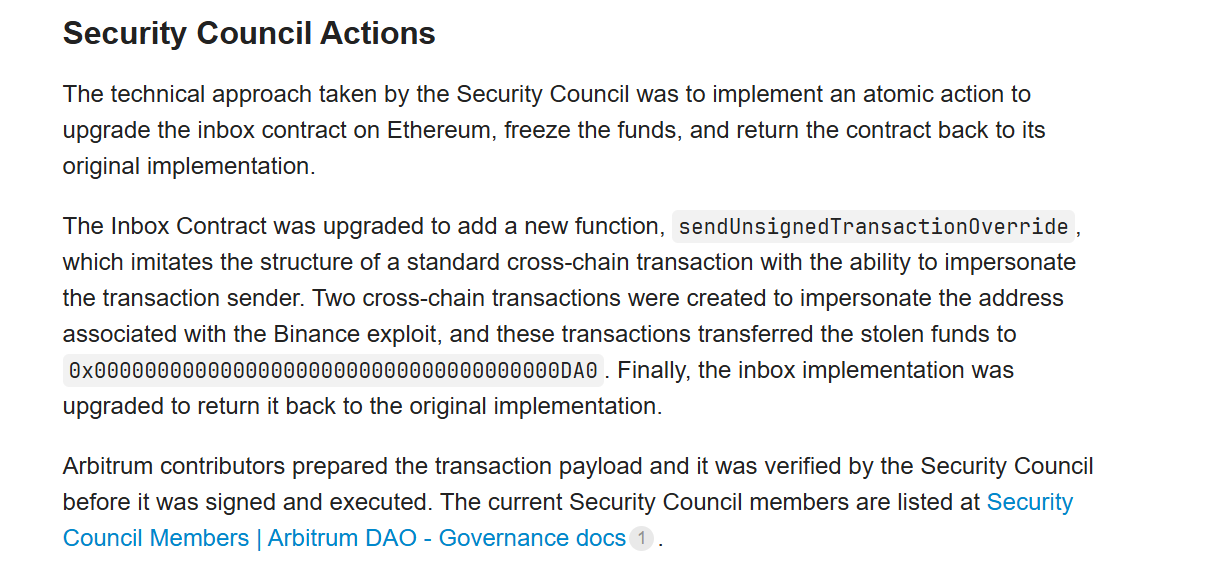
CryptoQuant estimates that Tether froze 1.567 billion USDT, Circle froze more than $800 million in USDC, and Arbitrum’s Security Council restricted 74.6 million ARB and 8,425 ETH.
The Security Council executed an emergency action to freeze 8,425 ETH and 74,559,805.2 ARB. | Source: forum.arbitrum.foundation
These interventions could substantially reduce the eventual loss, provided the frozen assets can be recovered.
The question is no longer simply whether SAFU can cover $6.3 billion. It is how much Binance will need to replace before the recovery process concludes.
CryptoQuant’s estimates provide a starting point for calculating the potential exposure.
Scenario
Assets recovered
Unrecovered exposure
Gap after hypothetical $1.18B SAFU use
No recovery
$0
$6.30B
$5.12B
25% recovered
$1.58B
$4.73B
$3.55B
Approximately $3B recovered
$3B
$3.30B
$2.12B
75% recovered
$4.73B
$1.58B
$395M
The above table represents illustrative calculations, not forecasts. Figures assume SAFU contributes $1.18 billion and exclude changes in asset prices, recovery costs, and other funding sources.
The $2.12 billion estimate represents a possible corporate funding requirement, not a confirmed expense or payment already made by Binance.
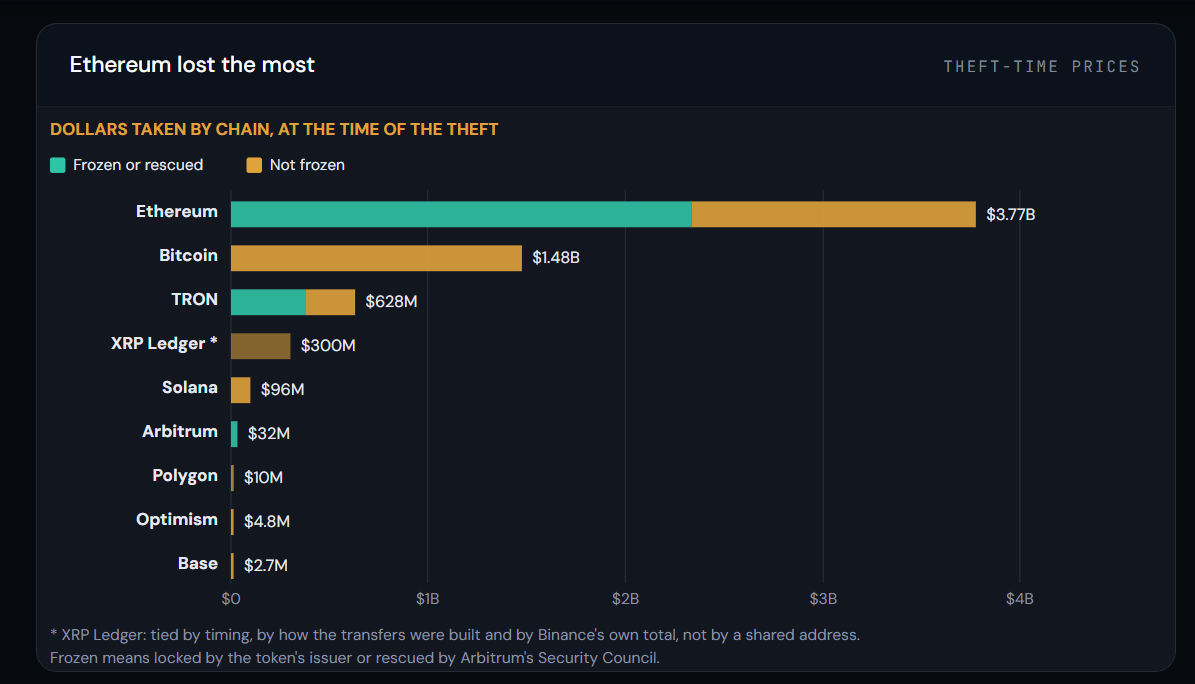
According to Bitquery’s onchain investigation, attackers moved approximately $6.3 billion from 17 Binance hot wallets across nine blockchains.
Ethereum lost the most in the wBinance Hack. | Source: Bitquery
Investigators also found that roughly $729 million in stolen USDT had been converted into ETH and TRX before Tether’s freezes took effect.
Crypto commentator Blaney highlighted another potential complication involving decentralized lending.
Blaney suggested the attacker may have deposited stolen USDT into Aave as collateral before borrowing ETH. Under such a scenario, freezing the stablecoin collateral would not automatically immobilize the borrowed Ether.
The Binance hacker might have just pulled off one of the smartest moves I’ve seen in crypto.
First, Tether froze $1.5 billion in USDT.
Then Circle froze another $800 million in USDC.
At that point, it looked like the hacker’s money was trapped.
The mechanism illustrates how attackers could retain transferable assets even after an issuer freezes the tokens used to obtain them.
However, the specific lending transactions, outstanding debt, and any resulting losses to Aave require transaction-level verification. A frozen collateral position does not automatically establish a permanent loss for the protocol.
Binance’s SAFU Fund Holds 15,000 BTC, Adding Price Risk
The composition of SAFU creates another challenge.
CryptoQuant estimates that the fund holds 15,000 BTC, valued at approximately $1.18 billion, implying a Bitcoin price of around $78,667.
Unlike a dollar-denominated cash reserve, the fund’s market value changes with Bitcoin’s price.
A 10% decline from the reported valuation would reduce its dollar value by approximately $118 million, assuming the Bitcoin balance remained unchanged.
A 20% decline would reduce the reserve’s value to around $944 million.
Bitcoin’s recent fall below $80,000 highlights the potential problem. An emergency fund denominated in a volatile cryptocurrency could lose value during the same market disruption that requires its deployment.
Binance could sell Bitcoin, transfer funds internally, or use other corporate assets to replace stolen customer balances.
Its public announcement, however, does not specify how much Bitcoin it intends to liquidate or when the reserve might be used.
The breach also raises questions about the relationship between customer reserves and corporate funds.
According to CryptoQuant, Binance’s Oct. 1 proof-of-reserves snapshot showed approximately $151.5 billion held across its eight largest reported assets, with each backed at least one-to-one.
The estimated $6.3 billion breach represents approximately 4.2% of that reported asset total.
If the full $3 billion in frozen assets were recovered, the remaining $3.3 billion would represent approximately 2.2%.
After a hypothetical $1.18 billion SAFU contribution, the residual $2.12 billion would equal roughly 1.4% of the reported reserve total.
However, customer reserves cannot be treated as freely available corporate capital.
Assets held to back customer balances must remain available to meet customer obligations. Binance would need to use its own resources, SAFU or recovered funds to replace missing assets.
The exchange’s Oct. 1 reserve snapshot also predates the attack. It cannot establish the exchange’s financial position after the breach.
In itsofficial security update, Binance promised to publish an updated proof of reserves once remediation is complete.
The next disclosure could help establish whether the exchange has restored the assets backing customer balances.
Proof of reserves, however, does not provide a complete picture of corporate liabilities, profitability or unrestricted liquidity.
Can Binance Cover the Losses Without Draining SAFU?
Binance’s commitment to reimburse customers has drawn attention from figures across the cryptocurrency industry.
In an X post, Nikita Bier characterized the breach as an extraordinary robbery, criticizing the stark contrast between its scale and Binance’s public assurances that customer funds remained protected.
The largest crypto exchange in the world just experienced the largest robbery in human history—and the person running it is a nomadic autistic man in Dubai posting “Funds are SAFU!”
His statement also confirms that withdrawals were temporarily suspended while the exchange reviewed its withdrawal infrastructure and revoked affected authorizations.
The company is working with law enforcement and blockchain intelligence firms to trace stolen assets.
Yet the financial outcome remains uncertain.
Even if Binance ultimately recovers the full $3 billion currently frozen, the remaining $3.3 billion exposure would exceed SAFU’s reported value by approximately $2.12 billion.
If recoveries are delayed, the immediate liquidity requirement could be substantially larger.
The next disclosures should establish how much of the frozen cryptocurrency has been returned, whether SAFU’s Bitcoin holdings have changed, and how much corporate capital Binance has committed.
The central question is no longer whether Binance has promised to reimburse customers. It is how the exchange will fund that promise while maintaining full backing for customer assets.
Disclaimer:
The information provided in this article is for informational purposes only. It is not intended to be, nor should it be construed as, financial advice. We do not make any warranties regarding the completeness, reliability, or accuracy of this information. All investments involve risk, and past performance does not guarantee future results. We recommend consulting a financial advisor before making any investment decisions.
Dr. Guneet Kaur is a senior editor at CCN.com and a Science Fellow at Exponential Science. She is a fintech and blockchain expert with extensive experience in digital finance education, blockchain ecosystems, and cryptocurrency markets. She has worked with global media such as Cointelegraph, as well as education and blockchain platforms, to design and lead strategic content and learning initiatives. As an educator and assessor for top-tier executive programs, she bridges real-world fintech trends with academic insight.
Dr. Kaur is also a published researcher and peer reviewer across fintech and data science journals, including Financial Innovation Journal and International Journal of Big Data Intelligence and Applications. Her work spans data-driven analysis, Web3 innovation, and technical content development. With a strong foundation in both industry and academia, she translates complex financial technologies into practical applications, empowering learners, professionals, and institutions across the rapidly evolving digital finance landscape.


 Intermediate