Home / Education / Crypto / Trading / John Daghita Launches $LICK Token on Pump.fun Amid $40M Crypto Theft Allegations — Here’s Why It’s a Major Red Flag
Malicious Axios npm Packages Trigger Supply Chain Attack: How Attackers Could Access Crypto Wallets and API Keys
Share
Key Takeaways
John Daghita launched $LICK after being publicly accused of involvement in the unauthorized movement of approximately $40 million from wallets linked to U.S. government seizures.
The accusations reference a contractor (CMDSS) reportedly connected to U.S. Marshals Service crypto custody operations, raising concerns about potential exposure of public funds.
Daghita reportedly controls 40% of the supply, giving him the ability to materially influence price, liquidity, and market outcomes.
As of now, it has not been publicly explained how access to wallets tied to government-managed seized assets may have occurred.
The crypto market has no shortage of controversy, but some episodes stand out as textbook examples of why users need to approach memecoins and influencer-led tokens with extreme caution.
One such case is the recent launch of the $LICK token on Pump.fun, tied to John Daghita, also known online as @lick, a figure publicly accused of involvement in the movement of more than $40 million in crypto assets linked to U.S. government seizure wallets.
🚨JUST IN: John Daghita (@lick), linked to a reported $40M theft from US government wallets, has launched $LICK on https://t.co/VS31GZ3dMY and is livestreaming on Telegram. https://t.co/VS31GZ3dMY has removed the ticker name from the platform.
This article breaks down what is known so far, why this situation raises serious ethical and risk concerns, and what broader lessons it offers for anyone navigating today’s fast-moving memecoin ecosystem.
Who Is John Daghita and What Are the Crypto Theft Allegations?
John Daghita has been publicly accused, most notably by on-chain investigator ZachXBT, of orchestrating transactions that resulted in the unauthorized transfer of over $40 million worth of crypto. These wallets were associated with assets managed by the U.S. Marshals Service (USMS).
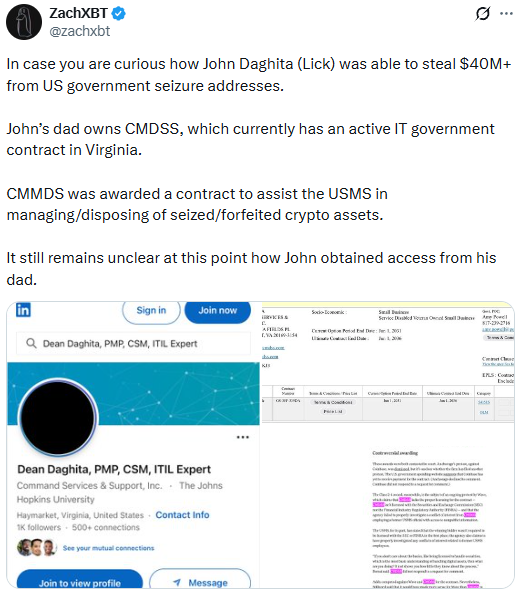
According to ZachXBT’s reporting, the alleged access point traces back to CMDSS, an IT services company owned by Daghita’s father. CMDSS reportedly held (and may still hold) an active government contract in Virginia to assist the USMS in managing and disposing of seized or forfeited cryptocurrency.
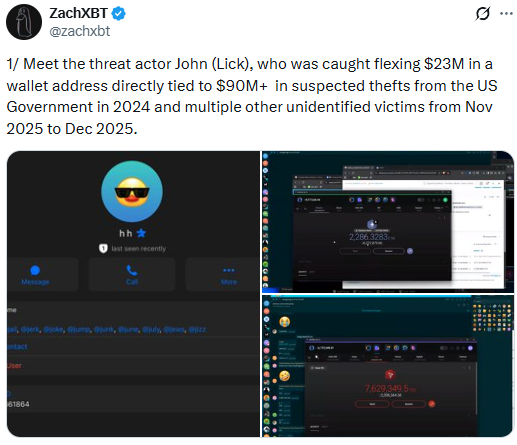
John Daghita is “introduced” on X. | Credit: ZachXBT X profile
The unresolved, deeply concerning question is this: How access to assets tied to a sensitive government crypto-custody operation may have occurred remains unclear.
While the full technical and legal details remain unclear, the allegations alone place Daghita at the center of one of the most serious crypto-related security scandals involving public funds.
$LICK Token Launch on Pump.fun
Against this backdrop, Daghita launched a memecoin called $LICK on Pump.fun, a platform designed to make token creation fast, cheap, and viral, often with little to no due diligence.
Key details of the $LICK launch include:
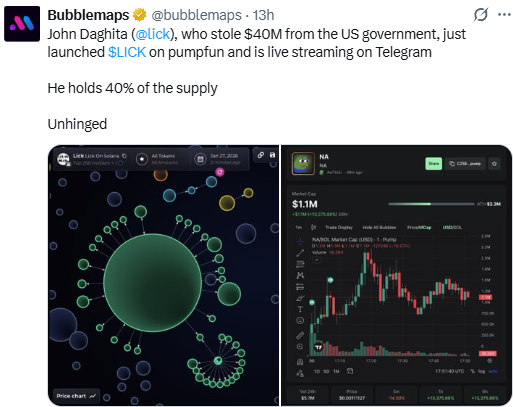
Supply concentration: Daghita reportedly controls approximately 40% of the total token supply, a level of centralization that poses immediate market manipulation risk.
Promotion tactics: He has been livestreaming on Telegram, publicly giving away money and encouraging participation, classic attention-grabbing tactics commonly seen in speculative memecoin launches.
Platform response: Pump.fun removed the $LICK ticker amid active trading, suggesting concerns significant enough to warrant intervention, even by a platform known for permissive listings.
Even without the surrounding allegations, these characteristics would already place $LICK in the high-risk category. Combined with Daghita’s background, they become something else entirely.
Why $LICK Token Is a Major Red Flag
The entire situation around Daghita raises several red flags, especially for non-expert crypto traders-
1. Unresolved Allegations Involving Public Funds
The most obvious red flag is reputational and ethical. Launching a speculative token while under unresolved allegations involving government-controlled crypto assets raises serious questions about intent, legitimacy, and accountability.
In traditional finance, an individual facing allegations involving misappropriation of public funds would not be launching new financial instruments for retail investors. In crypto, however, the absence of gatekeepers makes this scenario possible and dangerous.
John Daghita’s previous legal problems. | Credit: ZachXBT
The ability to significantly affect price and liquidity if large amounts were sold.
The ability to manufacture scarcity.
The ability to exit liquidity onto retail participants.
This level of concentration is incompatible with claims of “community-driven” or “fair launch” narratives that often accompany memecoins.
3. Attention-Based Liquidity Tactics
Livestreaming on Telegram, giveaways, and rapid-fire social promotion are not inherently bad, but in high-risk contexts, they often serve a specific function: accelerating liquidity inflow before scrutiny catches up.
These tactics can create short-term hype that masks structural issues long enough for insiders to benefit.
4. Platform Intervention Is Rare and Telling
Pump.fun operates at the extreme end of permissionless token creation. The platform’s removal of a ticker during live trading is notable.
While the exact reason for removal hasn’t been formally disclosed, such actions usually point to:
When combined with a controversial founder, the risk multiplies.
3. Allegations Matter Even Before Court Outcomes
Some argue that allegations alone shouldn’t disqualify someone from launching a project. Legally, that may be true. Practically, markets price risk, not verdicts.
Unresolved allegations involving government contracts and seized assets represent a material risk, regardless of eventual legal outcomes.
4. On-Chain Investigators Are a Critical Defense Layer
The role of independent investigators like ZachXBT is crucial. In a space without centralized enforcement, transparency often comes from:
Ignoring these signals is a choice, but often an expensive one.
Red Flags Are Warnings, Not Guarantees
While the combination of allegations, supply concentration, and aggressive promotion raises legitimate concerns, none of these factors alone proves that a rug pull or other misconduct will occur. Crypto markets often move faster than investigations or legal processes, and not every controversial project ends in fraud.
However, risk assessment is not about waiting for certainty, it is about recognizing when multiple warning signs overlap and adjusting exposure accordingly. For traders, the presence of unresolved allegations, centralized token control, and platform intervention represents elevated risk, regardless of how the situation ultimately develops.
Thus, several open questions remain:
Will law enforcement formally charge anyone in connection with the alleged $40 million theft?
Will platforms impose stricter controls on token launches tied to active investigations?
Will users continue to reward attention-driven launches despite mounting red flags?
Daghita launched $LICK on Pump.fun. | Credit: Bubblemaps X profile
Regardless of the answers, the $LICK episode already serves as a cautionary tale.
However, not every controversial token ends in a rug pull. Not every accused individual is guilty. But risk management in crypto is about probabilities, not absolutes.
When you see:
A founder facing unresolved allegations involving public funds.
A token with extreme supply concentration.
Aggressive hype tactics.
Platform intervention mid-trade.
You are not looking at innovation. You are looking at risk stacked on risk.
In crypto, ignoring red flags doesn’t make them disappear; it just transfers the cost to whoever is last to notice.
John Daghita is an online personality known as @lick who has been publicly accused by on-chain investigators of being involved in the unauthorized transfer of more than $40 million in crypto assets linked to U.S. government seizures. The allegations connect the access pathway to CMDSS, an IT firm owned by his father that held a contract with the U.S. Marshals Service. No final legal judgment has been announced at the time of writing.
What is the $LICK token?
$LICK is a memecoin launched on Pump.fun, a platform that allows rapid creation and trading of speculative tokens. The token has no publicly disclosed utility, roadmap, or governance structure beyond its viral branding and promotion.
Does Pump.fun removing the ticker mean the token was a scam?
Not necessarily. Pump.fun has not publicly stated the reason for the removal. However, platform intervention during live trading typically indicates legal, reputational, or compliance concerns. It should be treated as a serious warning sign by users.
Are the theft allegations proven in court?
As of now, the allegations are publicly reported but unresolved. No final court ruling has been disclosed. That said, markets often react to risk exposure, not just legal outcomes.
Disclaimer:
The information provided in this article is for informational purposes only. It is not intended to be, nor should it be construed as, financial advice. We do not make any warranties regarding the completeness, reliability, or accuracy of this information. All investments involve risk, and past performance does not guarantee future results. We recommend consulting a financial advisor before making any investment decisions.
Giuseppe Ciccomascolo began his career as an investigative journalist in Italy, where he contributed to both local and national newspapers, focusing on various financial sectors.
Upon relocating to London, he worked as an analyst for Fitch's CapitalStructure and later as a Senior Reporter for Alliance News. In 2017, Giuseppe transitioned to covering cryptocurrency-related news, producing documentaries and articles on Bitcoin and other emerging digital currencies. He also played a pivotal role in establishing the academy for a cryptocurrency exchange website. Crypto remained his primary area of interest throughout his tenure as a writer for ThirdFloor.


 Easy
Easy