Mantle (MNT) has surged 73% in the past month and is poised to retest its all-time high.
CCN’s long-term wave count analysis predicts MNT could range between $0.96 and $2.97.
Technical indicators remain bullish, with the weekly and daily charts supporting a breakout.
After surging 73% in the past month, Mantle (MNT) is poised to retest its all-time high. The rally is fueled by a pivotal Bybit integration and the highly anticipated Coinbase listing, which will boost liquidity and exposure.
But what does this mean for Mantle’s long-term trajectory? In this analysis, CCN breaks down the Mantle price predictions for 2025, 2026, and 2030 — exploring how far the token could go in the years ahead.
Mantle Price Prediction
Let’s look at the MNT price prediction made by CCN on Aug. 19, 2025. We will use the wave count method to arrive at our predictions and then add and remove 20% from the final targets to create the minimum and maximum Mantle price predictions.
Minimum Mantle Price Prediction
Average Mantle Price Prediction
Maximum Mantle Price Prediction
2025
$0.96
$1.43
$2.97
2026
$0.48
$0.75
$0.86
2030
$2.04
$3.91
$5.25
MNT Price Prediction 2025
With rate cuts expected to come before the end of the year and the MNT Coinbase listing coming, the price could hit $2.97. At the minimum, MNT could drop to $0.96, while the average price prediction could be $1.43.
MNT Price Prediction 2026
The Mantle price prediction for 2026 might differ from the 2025 expectations. By then, the crypto market might have fallen into a bear phase, which could drag MNT to a swing low of $0.48. At the maximum level, the price might trade at $0.86.
Try Our Recommended Crypto Exchanges
Sponsored
Disclosure
We sometimes use affiliate links in our content, when clicking on those we might receive a commission at no extra cost to you. By using this website you agree to our terms and conditions and privacy policy.
MNT’s price might hit a new all-time high by 2030. One reason could be its connection to Ethereum (ETH), as the second-most valuable cryptocurrency could have hit $10,000 by then.
If that is true, MNT might trade between $2.04 and $5.25.
MNT Price Analysis
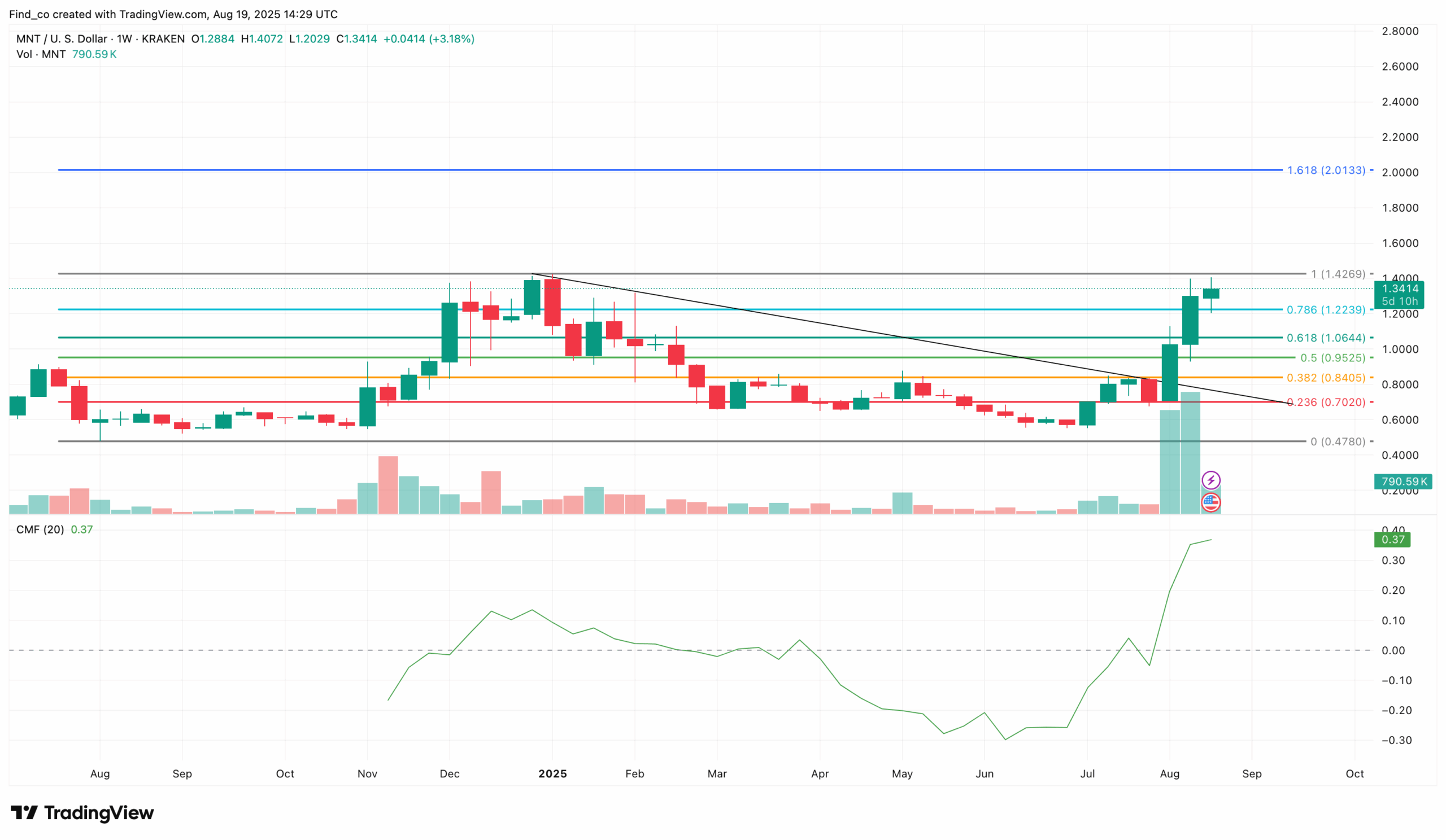
On the weekly chart, MNT has broken above the upper trendline of a descending triangle, signaling a strong bullish reversal. At the same time, the Chaikin Money Flow (CMF) has climbed to 0.37, highlighting a surge in buying pressure and sustained investor demand.
If this momentum continues, Mantle’s token could extend its rally and potentially surpass $3.
Like the long-term outlook, the MNT short-term chart also presents a bullish thesis. As seen below, MNT has broken above the upper trendline of a falling channel.
With this, it could break the resistance at $1.43. Once that happens, the next target could be a rally to $2.
The Total Value Locked (TVL) to market cap ratio (TVL ratio) measures the valuation of a decentralized finance (DeFi) project by comparing its market capitalization to the total value of assets locked in its smart contracts.
This ratio shows the project’s utilization and links the platform’s health to locked asset value.
A ratio above 1.0 indicates overvaluation because the market cap exceeds the value of assets used in the platform. A ratio below 1.0 indicates undervaluation because the market cap is lower than the value of locked assets.
On Aug. 12, 2025, the Mantle TVL ratio was 33.33, indicating that the token is nearing an area of extreme overvaluation.
CCN Strength Index
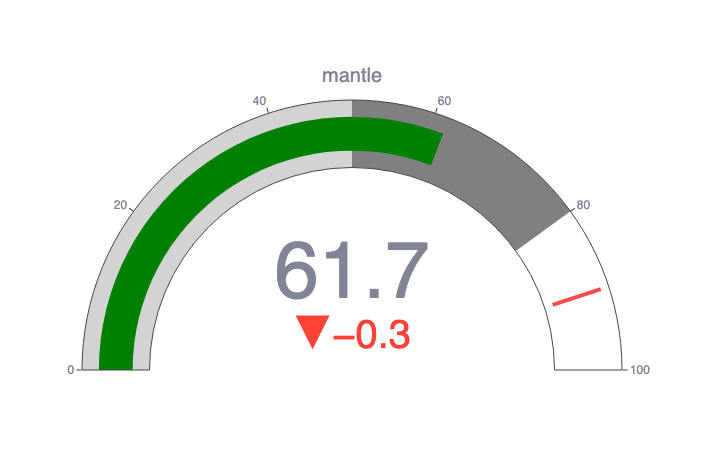
The CCN Strength Index combines an array of advanced market signals to measure the strength of individual cryptocurrencies over the last 30 days.
Every day, it assigns a strength score, ranging from 0 to 100, to the top 500 assets by market capitalization on CoinMarketCap, focusing on both trend direction and the intensity of price movements.
0 to 24: Assets exhibit significant weakness, showing signs of sustained downtrend behavior.
25 to 35: The price tends to move within stable bounds with minimal volatility.
36 to 49: Assets begin a stable uptrend but without strong surges.
50 to 59: Consistent growth with moderate price advances, building momentum.
60+: Sharp price movements and high demand indicate stronger volatility and trend shifts.
The index dynamically adapts to rapid changes. For example, an asset experiencing a 100% increase within a short timeframe would see a sharp jump in its score to reflect the intensity of the rise.
However, should that asset stabilize at this new price level, the score will gradually taper down and align with the dampened momentum as the movement normalizes. The same principle applies to rapid declines: a sudden drop will spike the score downward, but as volatility decreases, the score will slowly adjust back up.
On Aug. 12, 2025, Mantle scored 61.7 on the CCN Index, suggesting highly bullish momentum.
We looked at the Mantle price history and found the times when the price was at its lowest across certain days, months, quarters, and even weeks in the year, indicating the best times to buy MNT.
Time to Buy MNT
Days, Months, and Quarters
Best Day
Wednesday
Best Week
13
Best Month
February
Best Quarter
First
Advantages and Disadvantages of Mantle
CCN.com’s Senior Research Analyst, Toghrul Aliyev, examined Mantle and found the following advantages and disadvantages.
Advantages of Mantle
High Total Value Locked: Mantle ranks in the top five platforms for TVL. Despite a smaller active user base, its users are willing to commit significant amounts of money to the ecosystem.
Advanced Optimistic Rollup Design: Mantle’s optimistic rollup uses EigenLayer for data availability, allowing nodes to handle small data portions while maintaining the entire dataset. As a result, Mantle achieves lower latency and higher throughput compared to other solutions that build new networks from scratch.
Permissionless Liquid Staking: Mantle allows users to stake ETH through its platform with permissionless, non-custodial liquid staking. As of July 2024, Mantle holds a 1.5% market share in the staking ecosystem. Although this may seem low, it places Mantle in the top 12 among nearly 100 staking platforms.
Low Transaction Fees: The average fee on the Mantle blockchain is around 0.02 MNT, which translates to less than $0.02 per transaction. This makes Mantle appealing to developers and users who prioritize cost-effectiveness.
Improved Scalability and Speed: Although Mantle may not be the fastest blockchain, it significantly improves Ethereum’s scalability with an average block time of 0.498 seconds. Faster block times can reduce transaction costs by decreasing network congestion and improving efficiency as new blocks are added more frequently, allowing more transactions to be processed.
Developer-Friendly Environment and EVM Compatibility: EVM compatibility benefits Mantle by leveraging the extensive Ethereum developer ecosystem. Developers can seamlessly use existing tools and libraries, which streamlines the development process. The compatibility ensures the smooth operation of Ethereum assets and tokens on Mantle. As a result, interoperability improves, entry barriers decrease, and adoption accelerates.
Ethereum-Backed Security: Mantle leverages Ethereum’s security by executing transactions off the main chain and grouping them into batches for settlement on Ethereum’s Mainnet. This ensures that Ethereum’s consensus mechanism secures its transactions.
Disadvantages of Mantle
Underutilized Throughput: Despite having a theoretical throughput of 500 TPS, Mantle has yet to reach this potential in practical use. The maximum throughput achieved was 200 TPS in December 2023. Since then, the average daily TPS has been about five. Additionally, multiple other Layer 2 solutions have a higher theoretical TPS and have achieved higher practical TPS, which further shows Mantle’s underperformance. Low usage raises concerns about the blockchain’s real-world applicability and effectiveness, suggesting that user adoption remains low rather than Mantle being hindered by its operational challenges, such as network stability or technical limitations.
Credit: CCN.com/Chainspects/L2BEAT
Modest User Base: Mantle faces low adoption, with about 55,000 daily active addresses, which is not high compared to other layer 2 solutions. The limited user base results in a daily transaction volume of approximately 500,000 transactions. While the per-user activity of nine transactions per user is on par with other blockchains, the total daily transaction volume is still low due to fewer active wallets.
Credit: ArtemisCredit: Artemis
Low Developer Activity: Mantle ranks 76th with only 638 repositories, 54th with 26 sub-ecosystems, 153rd with 131 weekly commits, and 92nd with 40 weekly active developers. Lower developer activity can result in more bugs, reduced software quality, fewer features, a smaller ecosystem, and slower development progress. It also means longer response times for issue resolution, less innovation, and a reduced ability to keep up with user demands and competitive advancements.
Highly Competitive Industry: Mantle operates in a very competitive industry of Layer-2 blockchains. With numerous established platforms like Arbitrum, Optimism, and Base already capturing significant market share, Mantle faces challenges in differentiating itself and gaining traction.
MNT Price History
Let’s now take a look at the Mantle price history. While past performance should never be taken as an indicator of future results, knowing what the token has done can help give us some very useful context when it comes to either making or interpreting a Mantle price prediction.
Period
Mantle Price
Last Week (Aug. 12, 2025)
$1.01
Last Month (July 19, 205)
$0.79
Three Months Ago (May 19, 2025)
$0.72
Last Year (Aug 19, 2024)
$0.59
Launch Price (July 17, 2023)
$0.5905
All-Time High (April 8, 2024)
$1.51
All-Time Low (Oct. 18, 2023)
$0.31
Who Owns the Most Mantle (MNT) Tokens?
On Jan. 24, 2025, one wallet held nearly 45% of Mantle’s supply.
0x78605df79524164911c144801f41e9811b7db73d. This wallet held 2,795,022,409 MNT, or 44.94% of the supply.
0x2ebf891f4718eb8367013d8d975a1e5afcae277f. This wallet held 706,717,699 MNT, or 11.36% of the supply.
0xec949f12a3acab835f3eed8b54b7361a8fbb3ee0. This wallet held 500,000,000 MNT, or 8.04% of the supply.
0x5a076b2d0941f2bc9b49d05d3a1ff9c7acdc5e78. This wallet held 463,932,756 MNT, or 7.46% of the supply.
0xe1ab8c08294f8ee707d4efa458eab8bbeeb09215. This wallet held 335,994,166 MNT, or 5.40% of the supply.
Mantle Supply and Distribution
Supply and distribution
Figures
Maximum Supply
6,219,316,794
Circulating supply as of Aug. 19, 2025
3,365,794,382 (54.1% of maximum supply)
Holder distribution
Top 10 holders owned 90.06% of the supply as of Aug. 19, 2025
From the Mantle Whitepaper
Mantle says it is a “technology stack for scaling Ethereum ” in its technical documentation or whitepaper.
It adds: “We strive to be EVM-compatible. Being EVM-compatible means all the contracts and tools that work on Ethereum also work on Mantle Network with minimal modifications. Users can experiment with exciting web3 apps, and developers can deploy smart contracts in an efficient, low-fee environment.”
Mantle (MNT) Explained
Although Ethereum (ETH) is the largest blockchain for giving people somewhere to develop their decentralized applications (dApps), it is not without its problems. Historically, Ethereum was a very slow system, meaning that transactions took longer to process and cost people more money.
Although Ethereum’s switch from a Proof-of-Work consensus mechanism to a Proof-of-Stake one helped the system somewhat, there was already a market for protocols that made the blockchain work quickly.
Layer 2 scaling solutions take transactions off blockchains, carry them out elsewhere, and return them to the blockchain. Mantle, launched in 2023 by the BitDAO organization, is a layer 2 scaling solution based on Ethereum, and the MNT token supports it.
BitDAO’s previous crypto, BIT, was swapped for MNT on a 1:1 basis. This meant that BIT holders got the same amount of MNT in return for their old tokens.
Pascal Leblanc is the current CEO, CTO, founder of Mantle, and co-founder of Ambo Technology. He previously worked at EY as a Blockchain Strategist and attended the University of Quebec at Trois-Rivières.
How Mantle Works
Mantle uses optimistic roll-ups to process transactions. This means that the transactions are carried out away from the system and are assumed to be valid. However, people can still flag up what they consider fraudulent transactions.
This system, at least in theory, helps reduce slowness on the platform.
Mantle’s MNT cryptocurrency is used to pay for fees on the network. People can also stake it or set it aside to operate one of the computers or nodes that help the system run. Holders can vote on changes to the platform and be bought, sold, and traded on exchanges.
Because Mantle is based on Ethereum, it is a token, not a coin. You might see references to such things as a Mantle coin price prediction, but these are wrong.
Is Mantle a Good Investment?
It is hard to say. A lot will depend on how the market performs in the coming weeks. Remember that MNT must attract people who would not have bothered with BIT while keeping BitDAO investors on board.
As a Layer-2 scaling solution, it also depends on slow Ethereum. If Ethereum’s Proof-of-Stake consensus mechanism helps it speed up, then Mantle and its ilk will become effectively redundant.
As always with crypto, you should research before deciding whether or not to invest in MNT.
Will Mantle go up or down?
No one can tell right now. While the Mantle crypto price predictions are largely optimistic, price predictions have a well-earned reputation for being wrong. Keep in mind that prices can and do go down and up.
Should I invest in Mantle?
Before you decide whether or not to invest in Mantle, you will have to do your research, not only on MNT but on other related coins and tokens such as Arbitrum (ARB). Either way, you must also ensure you never invest more money than you can afford to lose.
FAQs
How many Mantle are there?
As of Aug. 19, 2025, there were 3.36 billion MNT in circulation, out of a total supply of just over 6.22 billion.
Will Mantle reach $1?
Our price predictions suggest that Mantle will not reach $10 in the near future.
What is Mantle used for?
The MNT token is used to pay for transactions on the Mantle layer-2 scaling solution platform. It also gives holders the right to vote on changes to the network, and it can be bought, sold, and traded on exchanges.
Disclaimer:
The information provided in this article is for informational purposes only. It is not intended to be, nor should it be construed as, financial advice. We do not make any warranties regarding the completeness, reliability, or accuracy of this information. All investments involve risk, and past performance does not guarantee future results. We recommend consulting a financial advisor before making any investment decisions.
Victor Olanrewaju is a crypto analyst and reporter at CCN with deep roots in on-chain research and technical analysis. His crypto journey began in 2017, but it was the 2020 Uniswap airdrop that sparked a full-time pivot into the space.
With a foundation in copywriting, Victor honed his craft creating high-converting content for leading crypto brokers — most notably an XRP price prediction that ranked #1 on Google during the 2021 bull run.
He later joined AMBCrypto in 2022, where he combined storytelling with technical and on-chain analysis to cover key market narratives.
In 2024, he expanded his expertise at BeInCrypto, collaborating with analysts and using tools like Glassnode, Santiment, and IntoTheBlock to break down Bitcoin and altcoin trends.
At CCN, Victor covers the top cryptocurrencies, memecoins, macro shifts, blending real-time insights with deep-dive metrics.
He holds a Bachelor’s degree in Physics from the University of Ibadan, equipping him to simplify complex data for a wide audience. Follow his work or connect on LinkedIn or X.