A BSC-based WLFI memecoin version briefly surged to a $500 million market cap before collapsing.
Influencer-driven hype fueled the frenzy, as KOLs and high-profile accounts amplified visibility.
The episode highlights memecoin risks, where hype and whale behavior outweigh fundamentals.
As expected, the biggest headline in the crypto market yesterday was the launch of World Liberty Financial (WLFI). Memecoins with similar names quickly popped up across multiple chains in true degenerate fashion.
Several copycat tokens tied themselves to the WLFI narrative on Ethereum, Solana, and Base. However, the largest by far emerged in the Binance Smart Chain (BSC).
That said, it wasn’t all rosy. The token’s explosive gains were short-lived, with prices crashing almost as quickly as they surged, leaving many traders caught on the wrong side of the swing.
While WLFI cwas orrected, a memecoin version of the project launched on BSC and briefly stole the spotlight. Fueled by retail excitement, the token skyrocketed past a $500 million market cap.
Get These Top Crypto Casino Offers Now!
Sponsored
Disclosure
We sometimes use affiliate links in our content, when clicking on those we might receive a commission at no extra cost to you. By using this website you agree to our terms and conditions and privacy policy.
But the euphoria didn’t last. Today, the market cap has collapsed below $80 million, leaving late buyers nursing heavy losses.
According to Cashtags data from X-Alpha, several KOLs were instrumental in driving the frenzy before the memecoin exploded. Early participants included Weeklydose852, Super_taxy, and Rbotzz.
CCN has collaborated with X-Alpha to offer you the best X+On-chain data analysis tool in the market for free! Get the X-Alpha Chrome extension that our CCN Analysts use HERE
Meanwhile, high-profile influencers like Mmcrypto, Tatethetallsman, and Pentosh1 amplified the hype, pushing the token deeper into the spotlight before its eventual crash.
As of this writing, the WLFI memecoin has collapsed from millions in value to just $410,000 in market cap. Its price has also plunged to $0.00075, down sharply from its peak of $0.0056.
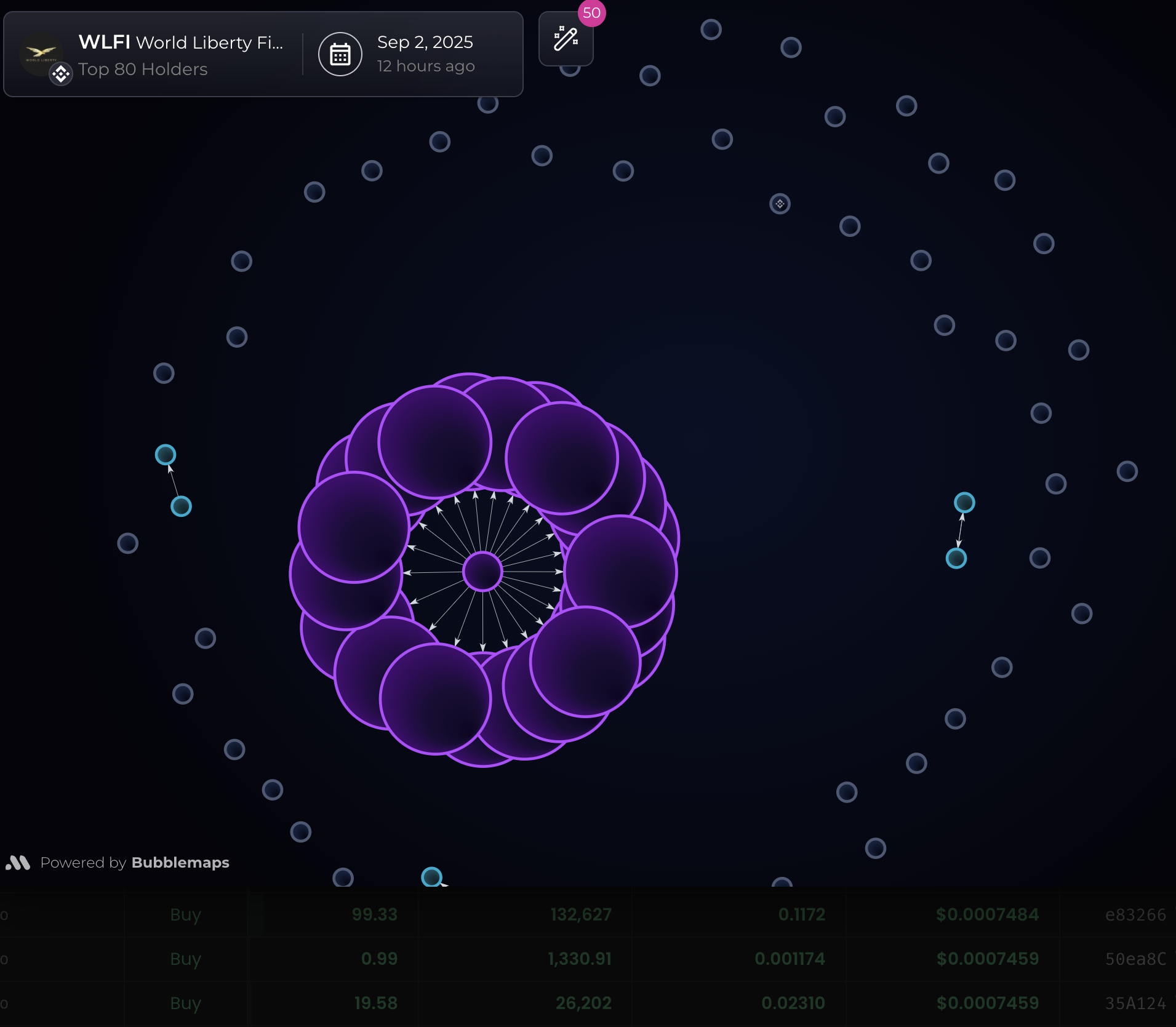
According to CCN’s investigation, the crash was fueled by a heavy concentration of supply among top holders.
Data from Bubblemaps reveals that a few wallets controlled an outsized token share, giving them the power to dump large amounts onto the market.
This pattern is typical in memecoins, where insiders or early buyers hold disproportionate stakes. As soon as hype drives retail interest, these large holders take profits, often leaving latecomers with steep losses.
Final Thoughts
The WLFI memecoin’s rise and crash underscores a recurring theme in the memecoin space: hype can create short-term fortunes, but concentrated ownership often leads to sudden collapses.
While the allure of quick gains is strong, traders must be cautious of projects where supply distribution is skewed toward a handful of wallets.
Ultimately, the WLFI case is less about fundamentals and more about market psychology and whale behavior.
For investors, it serves as a timely reminder: always look beyond the hype, analyze token distribution, and manage risk—especially in the highly speculative world of memecoins.
Disclaimer:
The information provided in this article is for informational purposes only. It is not intended to be, nor should it be construed as, financial advice. We do not make any warranties regarding the completeness, reliability, or accuracy of this information. All investments involve risk, and past performance does not guarantee future results. We recommend consulting a financial advisor before making any investment decisions.
Victor Olanrewaju is a crypto analyst and reporter at CCN with deep roots in on-chain research and technical analysis. His crypto journey began in 2017, but it was the 2020 Uniswap airdrop that sparked a full-time pivot into the space.
With a foundation in copywriting, Victor honed his craft creating high-converting content for leading crypto brokers — most notably an XRP price prediction that ranked #1 on Google during the 2021 bull run.
He later joined AMBCrypto in 2022, where he combined storytelling with technical and on-chain analysis to cover key market narratives.
In 2024, he expanded his expertise at BeInCrypto, collaborating with analysts and using tools like Glassnode, Santiment, and IntoTheBlock to break down Bitcoin and altcoin trends.
At CCN, Victor covers the top cryptocurrencies, memecoins, macro shifts, blending real-time insights with deep-dive metrics.
He holds a Bachelor’s degree in Physics from the University of Ibadan, equipping him to simplify complex data for a wide audience. Follow his work or connect on LinkedIn or X.