USDT is closing the transparency gap With USDC — Here's why That changes everything for the crypto market | Credit: Veronica Cestari
Share
Key Takeaways
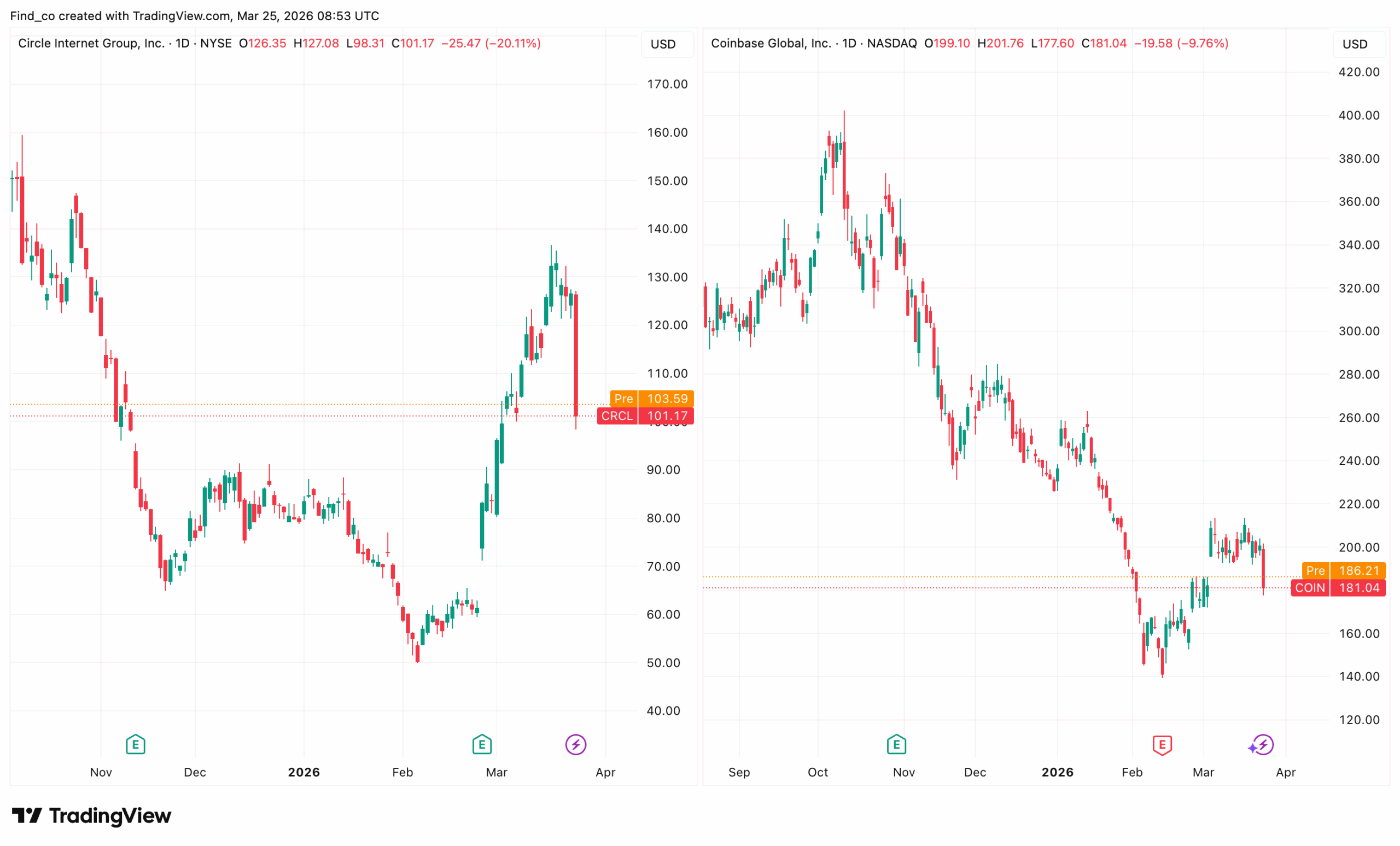
Circle Internet Group (CRCL) shares plummeted 20%, dragging Coinbase (COIN) down by 11% in tandem.
The primary catalyst is the leaked draft of the CLARITY Act, which proposes a ban on passive interest-like returns.
In a challenge to USDC, Tether (USDT) announced that it has engaged an unnamed accounting firm to audit USDT.
With USDT boasting a $184 billion market cap and moving toward transparency, Tether could begin eating into Circle’s share.
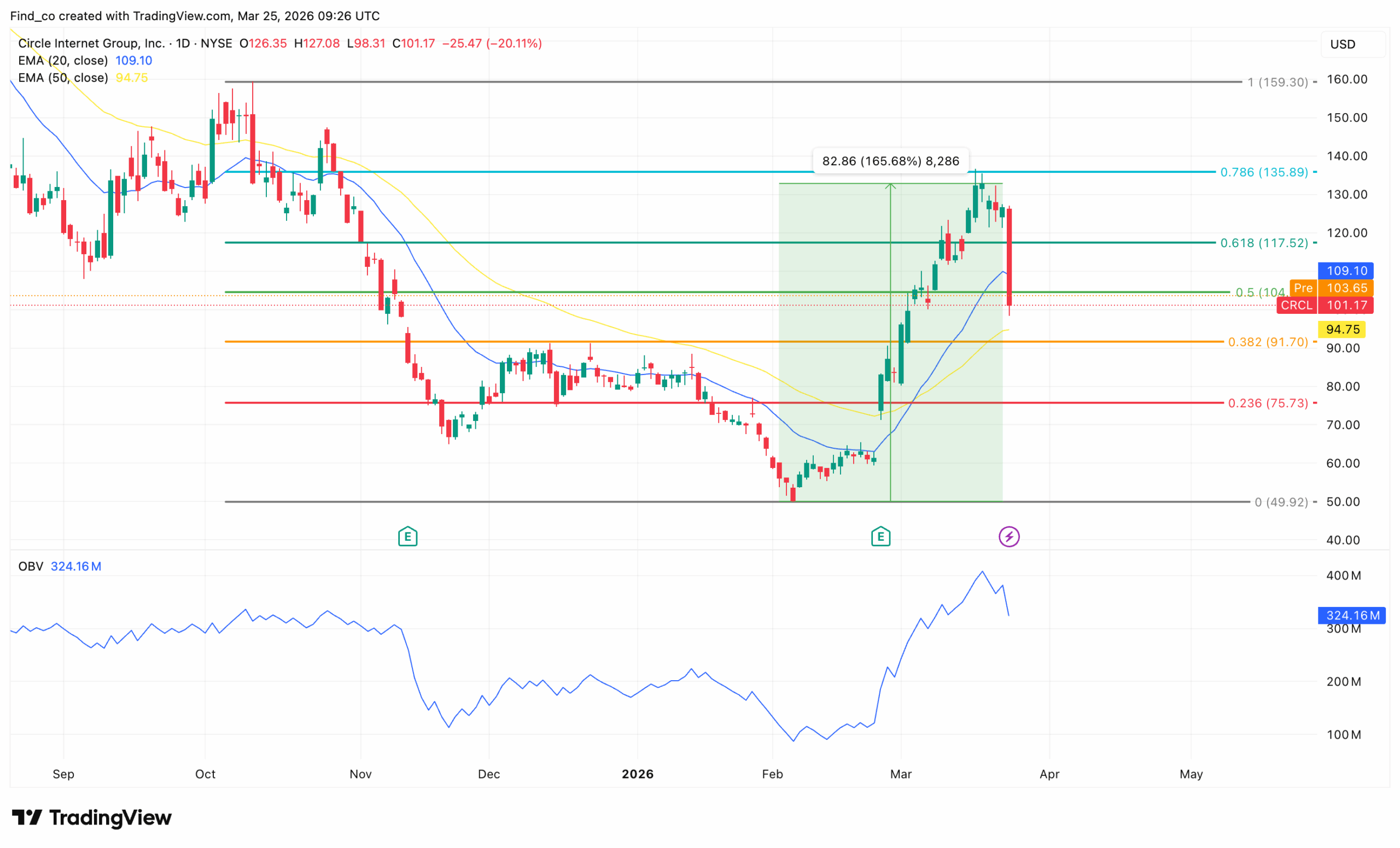
Analysis shows that CRCL has sliced through its 20-day EMA ($109) and is now testing the 0.5 Fibonacci level at $104.
Tether’s announcement that it intends to submit USDT to a formal independent audit has arrived at the worst possible moment for Circle.
In the last 24 hours, Circe’s stock has already fallen 20%. This development happened following the publication of draft language for the CLARITY Act that would restrict stablecoin yield.
Now, the stablecoin market’s dominant operator has chosen this precise window to pursue the one competitive move most capable of eroding Circle’s primary institutional differentiator.
Here is a rundown of all that happened and what lies ahead for USDT, USDC, and the crypto market at large.
Why Circle Stock Declined by 20%
Circle Internet Group took a brutal hit. Shares of CRCL plunged nearly 20%, closing at $101.17 after opening at $126.64 one day earlier.
For context, the sell-off erased $5.6 billion in market capitalization overnight. Meanwhile, Coinbase stock COIN also felt the shockwave, shedding 11% on the same day.
We sometimes use affiliate links in our content, when clicking on those we might receive a commission at no extra cost to you. By using this website you agree to our terms and conditions and privacy policy.
Specifically, it proposes banning interest-like returns on stablecoins entirely. However, it still permits activity-based incentives. Staking, loyalty programs, and liquidity provision all remain on the table.
As Eleanor Terrett reported, regulators, including the SEC, CFTC, and Treasury, would have up to a year to define allowable reward structures.
“This is interesting because if you’ve been following this story, it’s been well reported that yield on passive stablecoin balances was a nonstarter from the beginning and unlikely to make it into the final deal. I think the Tether audit news may be playing into the drop as well,” Terrett said about the matter.
However, some pointed the finger at Cathie Wood rather than USDT. This is because ARK Invest, which Wood leads, sold $5.9 million worth of CRCL on March 20 (four days before the draft surfaced).
Nevertheless, some experts pushed back on that narrative.
USDT Audit Escalates the Competition
Amid all of these, Tether, issuer of the largest stablecoin by market cap, USDT, said it had agreed to undergo a full audit by an unnamed Big Four accounting firm.
“This audit represents years of work to strengthen our systems so that Tether can meet the highest standards applied in global finance. For the hundreds of millions of people and businesses who rely on USD₮ every day, this audit is not just a compliance exercise; it is about accountability, resilience, and confidence in the infrastructure they depend on,” Paolo Ardoino, CEO of Tether explained.
The significance of this move cannot be overstated. For years, Tether promised transparency through quarterly attestations but never provided a full, formal audit.
This worried many investors and regulators, who feared that USDT reserves were too opaque or would not meet audit standards. Circle, by contrast, undergoes full audits annually by Deloitte and issues monthly attestations.
As a result, USDC is widely viewed as more institutional-grade than Tether.
That transparency gap has been Circle’s most durable competitive moat. A fully audited USDT could level the playing field.
In turn, some market participants were blunt, calling the development bearish for Circle, especially if Tether pairs the audit with deeper US market ambitions.
Furthermore, some analysts suggested that Tether’s pursuit of an audit signals that it is likely looking to go public. If this happens, it would clearly pose a competitive threat to Circle’s structure rather than being temporary.
Growth on Both Sides
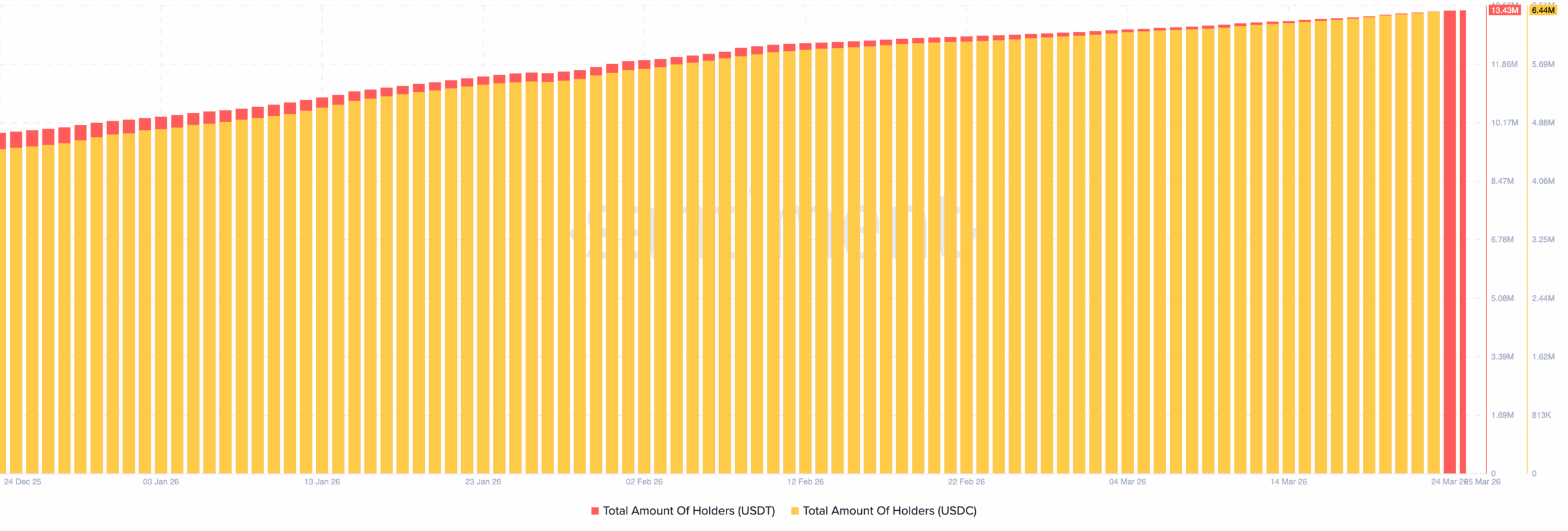
In the meantime, the stablecoin race has a clear leader. However, the gap is closing in ways the chart alone can’t show.
As of March 25, USDT has 13.43 million addresses on Ethereum, compared with USDC’s 6.44 million.
USDC’s holder count, however, has grown steadily and consistently throughout the entire period. That trajectory reflects a deliberate institutional shift.
Approximately 86% of institutional firms now use or hold USDC, compared to 68% for USDT — a gap driven by regulatory compliance.
USDT operates outside the GENIUS Act framework, leading institutional compliance teams to become increasingly cautious about holding it.
Now, a major development threatens to narrow USDC’s transparency advantage.
If successful, the Tether USDT audit could improve the stablecoin’s image among institutional users by demonstrating stronger risk management, potentially eating into USDC’s market share.
But beyond that, the final CLARITY Act bill might also play a role, possibly reshuffling the deck for USDC.
CRCL Price Prediction
From a technical perspective, the Circle stock had everything going for it until it didn’t.
On the daily chart, CRCL crashed 20.11% to $101.17, erasing weeks of hard-won gains in a single brutal session.
The backstory makes the collapse more striking. From February lows near $49.92, CRCL surged an extraordinary 165.68% to a mid-March peak near $135.
The fuel was undeniable. Circle’s Q4 2025 earnings demolished expectations as revenue jumped 77% year-over-year to $770 million, adjusted EPS of $0.43 crushed the $0.25 consensus, and EBITDA skyrocketed 412% to $167 million.
Institutional adoption of USDC accelerated throughout. The On Balance Volume (OBV) indicator confirms it, with volume pouring in throughout the rally.
Then came the double blow. The Circle stock price plunged due to the two major news items mentioned above.
Now, CRCL sits between the 0.5 Fibonacci level at $104 and the 0.382 level at $91.70. The 20 EMA at $109 has flipped to overhead resistance.
CRCL Daily Chart | Credit: TradingView
Meanwhile, OBV has turned sharply lower, suggesting institutional money is quietly exiting.
Bulls need a reclaim of $109 urgently. Otherwise, $91.70 becomes the next destination for the share price.
Interestingly, the market has not yet fully priced that opportunity. RLUSD was designed from inception around regulatory compliance, institutional transparency, and the XRP Ledger’s cross-border payment infrastructure.
It carries none of the legacy opacity baggage that has defined USDT’s institutional barriers. It also lacks the yield-dependent adoption model that has just become Circle’s central liability.
If the CLARITY Act’s yield restrictions finalise in their current form, RLUSD’s positioning becomes structurally advantageous.
“No stablecoin yield in the deal means only stablecoins that are fully compliant under the GENIUS Act will succeed. The banks won, it is what is. That’s RLUSD,” Chad Steingrabe opined, while supporting the bias.
Furthermore, Ripple’s established regulatory engagement creates a compliance-forward narrative that institutional allocators currently navigating USDT opacity concerns and USDC yield uncertainty find increasingly attractive.
RLUSD does not need USDC to collapse or USDT to fail its audit to gain ground. It simply needs the current uncertainty to persist long enough for institutional treasury teams to begin diversifying their stablecoin exposure. That process may already be underway.
Disclaimer:
The information provided in this article is for informational purposes only. It is not intended to be, nor should it be construed as, financial advice. We do not make any warranties regarding the completeness, reliability, or accuracy of this information. All investments involve risk, and past performance does not guarantee future results. We recommend consulting a financial advisor before making any investment decisions.
Victor Olanrewaju is a crypto analyst and reporter at CCN with deep roots in on-chain research and technical analysis. His crypto journey began in 2017, but it was the 2020 Uniswap airdrop that sparked a full-time pivot into the space.
With a foundation in copywriting, Victor honed his craft creating high-converting content for leading crypto brokers — most notably an XRP price prediction that ranked #1 on Google during the 2021 bull run.
He later joined AMBCrypto in 2022, where he combined storytelling with technical and on-chain analysis to cover key market narratives.
In 2024, he expanded his expertise at BeInCrypto, collaborating with analysts and using tools like Glassnode, Santiment, and IntoTheBlock to break down Bitcoin and altcoin trends.
At CCN, Victor covers the top cryptocurrencies, memecoins, macro shifts, blending real-time insights with deep-dive metrics.
He holds a Bachelor’s degree in Physics from the University of Ibadan, equipping him to simplify complex data for a wide audience. Follow his work or connect on LinkedIn or X.