XLM is stuck in a bearish structure, repeatedly rejected at $0.30.
Protocol 25 helped prevent a notable XLM break below $0.20.
Near-term focus is $0.20 as a breakdown opens more downside.
Stellar (XLM) is losing ground as bearish pressure across the altcoin market continues to dominate price action.
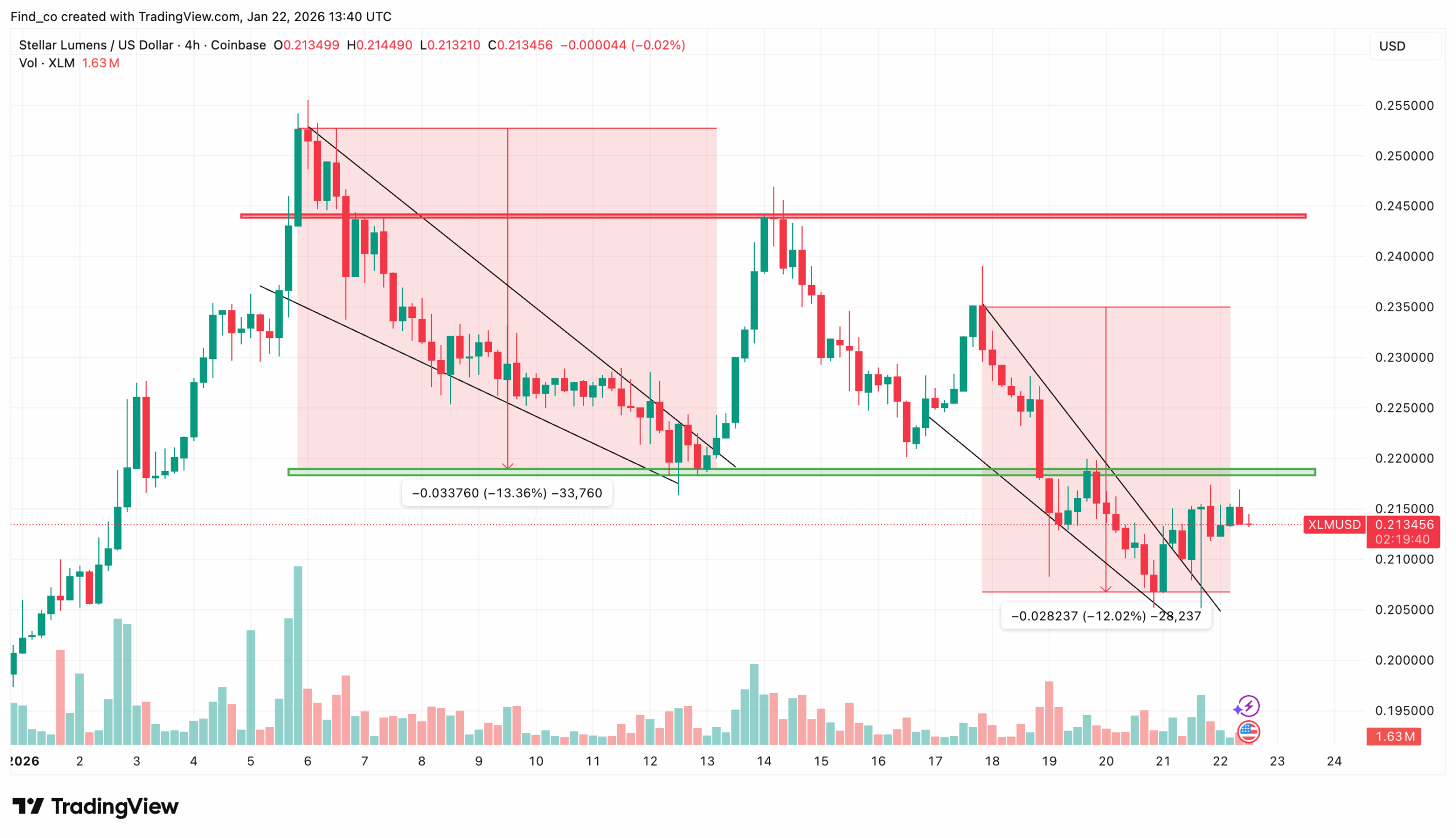
After multiple failed attempts to reclaim the $0.30 psychological level, XLM’s price has slid lower and now trades near $0.21, reflecting the broader market downturn.
Even a major network upgrade has failed to spark a sustained recovery.
For now, bears remain firmly in control, and traders are increasingly bracing for a potential move toward lower support zones.
Recent rebounds have been capped below the $0.24 resistance zone, while the price is once again hovering just above key demand around $0.22.
Get These Top Crypto Casino Offers Now!
Sponsored
Disclosure
We sometimes use affiliate links in our content, when clicking on those we might receive a commission at no extra cost to you. By using this website you agree to our terms and conditions and privacy policy.
Structurally, the market is making lower highs, and the latest selloff mirrors the prior downswing, reinforcing the bearish trend.
As long as XLM’s price stays below the broken support-turned-resistance near $0.23, rallies are likely corrective.
A breakdown below $0.22 would expose deeper downside, while any bullish shift would require a reclaim of the channel and a sustained move back above $0.24.
The $0.30 level has become a formidable ceiling. Heavy overhead resistance continues to cap upside attempts, reinforced by the 200-day Simple Moving Average, which sits near $0.32.
Historically, every approach toward this zone has attracted aggressive selling, and the latest attempt was no different.
Sentiment data reinforces the weakness. Derivatives positioning shows roughly 68% of traders are short XLM, signaling broad skepticism toward a near-term breakout.
This imbalance suggests rallies are being used to sell, not accumulate.
Macro pressure is also weighing on Stellar.
The ongoing Trump–Greenland trade conflict has pushed investors into defensive assets like gold, now near $4,800, draining liquidity from mid-cap altcoins such as XLM.
Protocol 25: A Floor, Not a Breakout
The key factor preventing a deeper breakdown below $0.20 is the rollout of Protocol 25, which went live today.
The upgrade introduces native zero-knowledge privacy via ZK-SNARKs on Stellar’s Soroban smart contract platform.
Operationally, the upgrade also created a temporary supply squeeze. Major exchanges such as Upbit and Bithumb paused XLM deposits and withdrawals to support the transition.
That pause helped stabilize price action during the market sell-off, but it has not been enough to flip momentum bullish.
XLM Price Prediction
XLM continues to trade under structural pressure on the daily chart, with price holding near $0.21 while remaining capped beneath a long-standing descending trendline.
Despite a modest bounce, the broader trend still reflects lower highs and fading upside momentum.
The rebound earlier this month stalled just below the $0.25 region, which aligns with the 0.236 Fibonacci level and with former support-turned-resistance.
Momentum indicators have rolled over again, with Moving Average Convergence Divergence (MACD) and Awesome Oscillator (AO) slipping back into negative territory.
This suggests the recent bounce lacked follow-through. For now, $0.20 and $0.21 serve as key support, preventing a deeper breakdown in XLM’s price.
A loss of this zone would expose further downside, while any shift in bias would require XLM’s price to reclaim the descending trendline and push back above $0.25.
What Comes Next
Looking ahead, the next major catalyst sits in February. On Feb. 9, 2026, the CME Group is scheduled to launch regulated Stellar futures.
That event could finally introduce sustained institutional demand, something XLM has lacked during its repeated failures at $0.30.
Until then, the trend remains fragile.
As long as XLM’s price stays below its long-term moving averages and bearish positioning dominates, upside attempts are likely to stall. For bulls, holding the $0.21 zone is now critical.
Victor Olanrewaju is a crypto analyst and reporter at CCN with deep roots in on-chain research and technical analysis. His crypto journey began in 2017, but it was the 2020 Uniswap airdrop that sparked a full-time pivot into the space.
With a foundation in copywriting, Victor honed his craft creating high-converting content for leading crypto brokers — most notably an XRP price prediction that ranked #1 on Google during the 2021 bull run.
He later joined AMBCrypto in 2022, where he combined storytelling with technical and on-chain analysis to cover key market narratives.
In 2024, he expanded his expertise at BeInCrypto, collaborating with analysts and using tools like Glassnode, Santiment, and IntoTheBlock to break down Bitcoin and altcoin trends.
At CCN, Victor covers the top cryptocurrencies, memecoins, macro shifts, blending real-time insights with deep-dive metrics.
He holds a Bachelor’s degree in Physics from the University of Ibadan, equipping him to simplify complex data for a wide audience. Follow his work or connect on LinkedIn or X.