LINK Everywhere: How Chainlink Connects Banks, Exchanges, and Governments On-Chain | Credit: CCN.com
Share
Key Takeaways
CME will launch futures on ADA, LINK, and XLM on Feb. 9.
LINK shows early recovery signals, while ADA remains technically fragile.
Futures can add legitimacy but also raise “sell-the-news” downside risk.
On Jan. 15, the crypto market reached a significant institutional milestone as Chicago Mercantile Exchange (CME) Group, the world’s leading derivatives marketplace, officially confirmed the launch of futures on Cardano (ADA), Chainlink (LINK), and Stellar (XLM).
Set to debut on February 9, 2026, these regulated contracts signal a new era of maturity for altcoins. But more importantly, how will this development impact their prices?
In this analysis, CCN reveals what this development implies. We also analyze how Chainlink and Cardano prices might react in the run-up to the launch.
CME Opens the Floodgates for LINK and ADA
CME’s decision to expand beyond Bitcoin (BTC), Ether (ETH), XRP, and Solana (SOL) highlights the flight to quality, defining the 2026 market.
By offering both standard and micro-sized contracts, CME is catering to a diverse range of participants.
This ranges from hedge funds seeking capital efficiency to retail traders looking for regulated on-ramps.
CME Launch Snapshot (Effective Feb 9, 2026)
To increase capital efficiency and flexibility, the exchange will list the following contract sizes:
Asset
Standard Contract Size
Micro Contract Size
Cardano (ADA)
100,000 ADA
10,000 ADA
Chainlink (LINK)
5,000 LINK
250 LINK
Stellar (XLM)
250,000 XLM
12,500 XLM
“Given crypto’s record growth over the last year, clients are looking for trusted, regulated products to manage price risk as well as additional tools to gain exposure to this dynamic market,” Giovanni Vicioso, CME Group Global Head of Cryptocurrency Products stated about the upcoming Chainlink and Cardano launch.
Chainlink (LINK) Price Analysis
LINK is starting to build a recovery structure. On the daily chart, the Awesome Oscillator (AO) has flipped positive and now prints green bars above the zero line, signaling improving momentum after months of selling pressure.
At the same time, the Money Flow Index (MFI) has reclaimed the neutral zone and is trending higher, suggesting stronger inflows and early accumulation.
With Chainlink trading around $13.72 and hovering near the 0.236 Fib level, a push above $15.47 would strengthen the reversal case and open the door to more upside.
However, if momentum fades and sellers regain control, LINK could slide toward $11.63 as the first key support before any larger move develops.
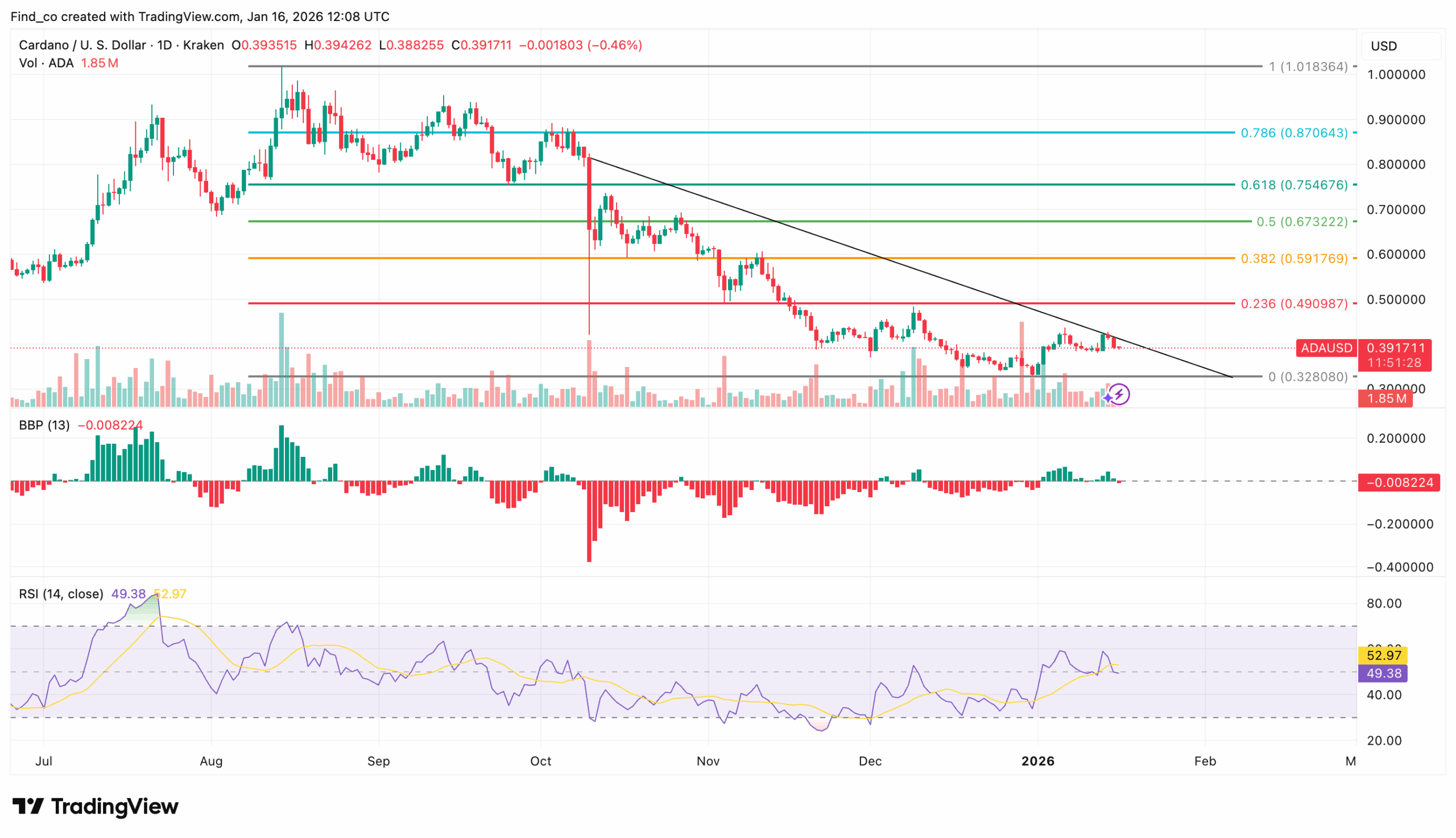
Cardano (ADA) Price Analysis
Unlike Chainlink, ADA’s price is sending a different message. At the time of writing, the altcoin has started to lose upside momentum, with the Relative Strength Index (RSI) hovering near the neutral 49.34 level.
That shift suggests buyers are no longer in control, while sellers are beginning to press back.
The Bull Bear Power (BBP) has also trended lower, dipping into negative territory, signaling that bullish strength is fading. From a structure standpoint, Cardano’s price is leaning on the $0.39 support zone.
If it holds, a rebound toward the 0.236 Fib area stays on the table. But if $0.39 breaks, the downside opens up, and the bearish case strengthens quickly.
It brings institutional legitimacy and deep capital. At the same time, it introduces powerful tools for betting against price, which can pressure the market.
A typical pattern is the “sell the news” effect. Prices often rally hard after a CME product is announced as traders “buy the rumor.”
Retail investors front-run expectations that institutional money will flow in.
However, once trading actually begins, momentum can fade.
Futures markets allow pessimists to participate for the first time, and that shift in price discovery often caps upside.
Unlike spot markets, futures let traders profit from falling prices, which can weigh on the underlying asset.
History Shows Both Outcomes
In December 2017, Bitcoin futures launched on CME after BTC surged from about $6,000 to nearly $20,000.
Almost immediately after the contracts went live, the bull market topped. Later analysis, including research from the San Francisco Fed, suggested futures enabled bearish positioning that contributed to the sharp 2018 drawdown.
ETH
Ethereum told a different story in February 2021. ETH rallied from roughly $600 to $1,600 ahead of its CME debut.
This time, the feared collapse did not materialize. Prices held firm and continued higher.
The takeaway was clear: by 2021, the market had matured. Institutional players used futures more for hedging and structured exposure, not just aggressive shorting.
XRP
Meanwhile, the full launch of XRP Futures and Micro XRP Futures on May 19, 2025, marked XRP’s arrival alongside Bitcoin and Ethereum on the CME.
In the month before the debut, XRP’s price rallied about 12% as traders accumulated in anticipation.
Once trading went live, early volume topped $15 million within hours. Still, the feared post-launch crash never came.
The data confirmed that shift. Within one month, XRP futures recorded more than $542 million in trading volume.
Notably, 45% of that activity came from outside North America, indicating that CME futures served as a conduit for global institutional liquidity rather than a trigger of downside pressure.
Asset
Launch Date
Price Trend Before
Price Trend After
Bitcoin
Dec 17, 2017
Parabolic Growth (+288%)
Multi-year Bear Market
Ether
Feb 8, 2021
Strong Growth
Continued Growth / Volatility
Altcoins (ADA, LINK)
Feb 9, 2026
Anticipated Rally and Decline
Pending (Current Market)
As CME expands into assets like Cardano, Chainlink, and XLM, traders will watch a few mechanics closely. Open interest growth will show whether institutions are building long exposure or leaning bearish.
The basis spread between futures and spot will hint at sentiment. And early volume patterns will reveal whether the launch fuels continuation or triggers another sell-the-news reaction.
What to Watch Next
As we move toward Feb. 9, watch the Open Interest (OI) and the Basis Spread (the difference between futures and spot prices).
A high positive spread would signal extreme bullishness, while a growing OI could indicate that institutions are building large hedging (short) positions for Chainlink and Cardano.
Disclaimer:
The information provided in this article is for informational purposes only. It is not intended to be, nor should it be construed as, financial advice. We do not make any warranties regarding the completeness, reliability, or accuracy of this information. All investments involve risk, and past performance does not guarantee future results. We recommend consulting a financial advisor before making any investment decisions.
Victor Olanrewaju is a crypto analyst and reporter at CCN with deep roots in on-chain research and technical analysis. His crypto journey began in 2017, but it was the 2020 Uniswap airdrop that sparked a full-time pivot into the space.
With a foundation in copywriting, Victor honed his craft creating high-converting content for leading crypto brokers — most notably an XRP price prediction that ranked #1 on Google during the 2021 bull run.
He later joined AMBCrypto in 2022, where he combined storytelling with technical and on-chain analysis to cover key market narratives.
In 2024, he expanded his expertise at BeInCrypto, collaborating with analysts and using tools like Glassnode, Santiment, and IntoTheBlock to break down Bitcoin and altcoin trends.
At CCN, Victor covers the top cryptocurrencies, memecoins, macro shifts, blending real-time insights with deep-dive metrics.
He holds a Bachelor’s degree in Physics from the University of Ibadan, equipping him to simplify complex data for a wide audience. Follow his work or connect on LinkedIn or X.