OP whales have decided to buy the dip after the crash — what does it mean? | Credit: Hameem Sarwar
Share
Key Takeaways
Base announced it’s transitioning from OP Stack to its own unified technology, crashing Optimism’s price.
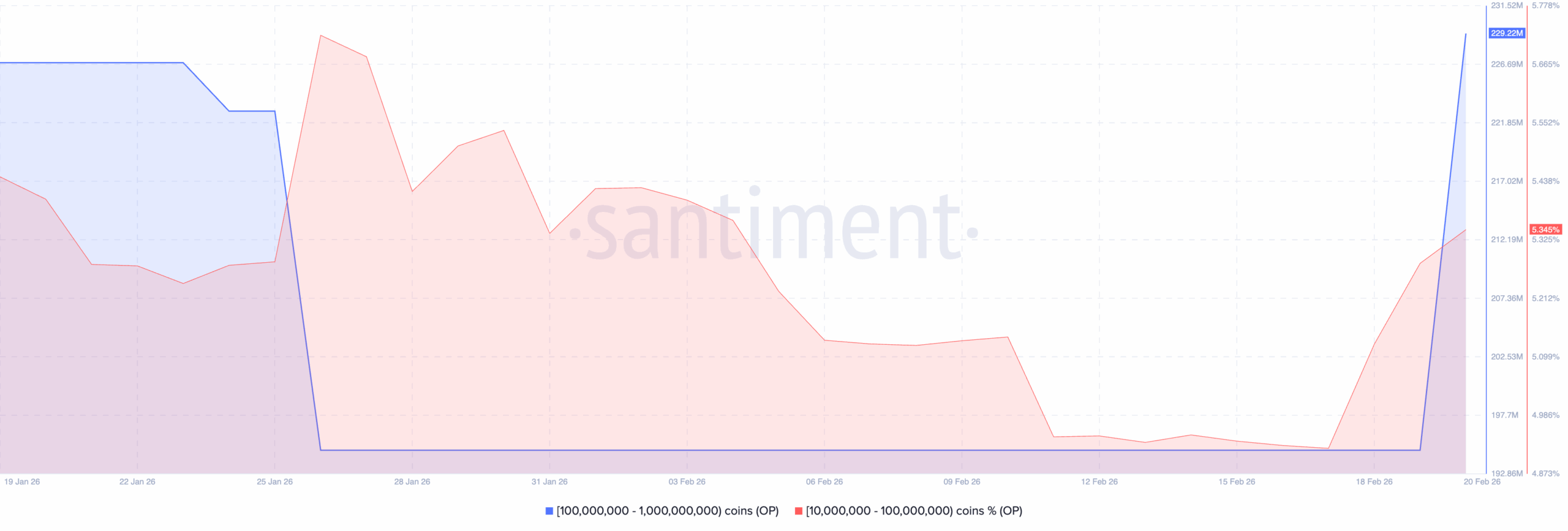
Despite the crash, whale wallets holding 10 million to 1 billion OP accumulated over 60 million tokens.
OP is oversold; however, buying pressure may not be intense enough to drive a quick rebound.
Optimism is bleeding. Hard.
The Layer-2 token crashed 28% over the last 48 hours, hitting an all-time low of $0.12 on Feb. 20, 2026. It’s now trading around $0.14, down 97% from its March 2024 peak of $4.85.
The trigger? Coinbase’s Base network announced it’s abandoning the OP Stack to build its own unified technology infrastructure.
The market reacted instantly. Sell volume surged 157%, pushing $187 million worth of tokens toward the exits — the heaviest selling pressure OP has seen all month.
Futures traders panicked, with $1.28 million in leveraged long positions liquidated in just 24 hours.
But here’s the twist. While retail investors fled as Optimism’s price crashed, whales quietly accumulated.
Base was more than just another chain on the OP Stack. It was the ecosystem’s crown jewel.
With $3.85 billion in total value locked, Base contributed the lion’s share of sequencer revenue to Optimism’s treasury.
Under the original agreement, Base could earn up to 118 million OP tokens over six years. Now that the deal is out, the market is pricing in the worst-case scenario.
In a blog post titled “The Next Chapter for Base,” Coinbase explained its decision to take full control of its codebase and infrastructure.
“Over time, we grew to incorporate a diverse range of software in collaboration with various partners, including Optimism, Flashbots, and Paradigm. These collaborations enabled features like Flashblocks, but also introduced a complex web of external dependencies,” It revealed.
The company plans to accelerate development cycles, targeting six major upgrades per year instead of three.
Base emphasized it would remain compatible with OP Stack standards during the transition and continue working with Optimism as an “enterprise customer.”
However, investors aren’t buying the reassurances, and this has affected Optimism’s price.
The shift signals a fundamental weakening of the Superchain vision — Optimism’s grand strategy to unite multiple Layer-2 chains under shared governance and revenue-sharing agreements.
If Base can walk away, others might follow.
Optimism Price: The Numbers Behind the Collapse
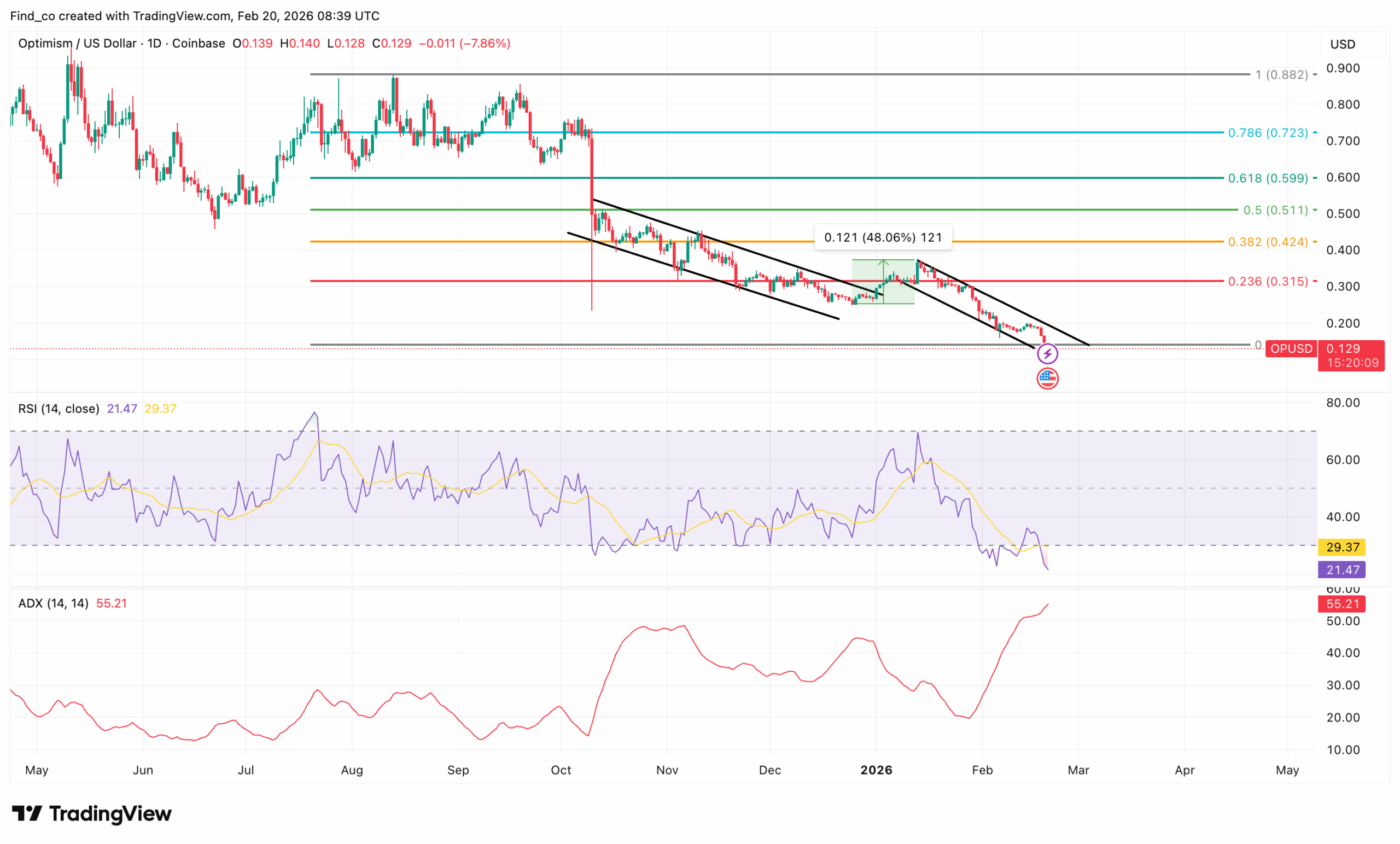
The technical damage is severe. OP is now trading below all major moving averages, with the 50-day SMA at $ 0.181 acting as firm resistance.
The next support level sits at $0.12, a full 15% below current prices.
Meanwhile, futures flows showed $7.5 million in capital leaving exchanges in just 12 hours, a 19% outflow that intensified the sell-off.
This divergence matters. Whales typically accumulate when retail panics, positioning for recoveries others can’t see coming.
Is It Time to Buy the OP Dip?
The case for buying hinges on three factors.
First, Optimism’s fundamentals haven’t collapsed.
The network recently launched a governance-approved buyback program, allocating 50% of Superchain sequencer revenue to monthly OP token purchases.
That’s real value accrual, not vaporware. In a highly bullish market condition, this could drive OP’s price higher.
Second, whale accumulation during panic selloffs has historically preceded major reversals. Large holders don’t deploy $8.43 million without conviction in the long-term thesis.
Third, OP is oversold on nearly every timeframe. The Relative Strength Index (RSI) sits at 21, deep in oversold territory, while the Average Directional Index (ADX) suggests strong downward momentum remains elevated.
These mixed signals indicate that Optimism’s price could move in either direction in the short term.
But at the same time, OP’s price is stuck in a descending channel. The last time it had a similar setup, the altcoin registered a 48% price increase.
Disclaimer:
The information provided in this article is for informational purposes only. It is not intended to be, nor should it be construed as, financial advice. We do not make any warranties regarding the completeness, reliability, or accuracy of this information. All investments involve risk, and past performance does not guarantee future results. We recommend consulting a financial advisor before making any investment decisions.
Victor Olanrewaju is a crypto analyst and reporter at CCN with deep roots in on-chain research and technical analysis. His crypto journey began in 2017, but it was the 2020 Uniswap airdrop that sparked a full-time pivot into the space.
With a foundation in copywriting, Victor honed his craft creating high-converting content for leading crypto brokers — most notably an XRP price prediction that ranked #1 on Google during the 2021 bull run.
He later joined AMBCrypto in 2022, where he combined storytelling with technical and on-chain analysis to cover key market narratives.
In 2024, he expanded his expertise at BeInCrypto, collaborating with analysts and using tools like Glassnode, Santiment, and IntoTheBlock to break down Bitcoin and altcoin trends.
At CCN, Victor covers the top cryptocurrencies, memecoins, macro shifts, blending real-time insights with deep-dive metrics.
He holds a Bachelor’s degree in Physics from the University of Ibadan, equipping him to simplify complex data for a wide audience. Follow his work or connect on LinkedIn or X.