Cardano Payments Arrive at 137 Swiss SPAR Stores — Can ADA Become Everyday Money?
Share
Key Takeaways
LayerZero integration and USDCx launch boost Cardano’s interoperability.
On-chain data shows weak participation, with price still printing lower highs.
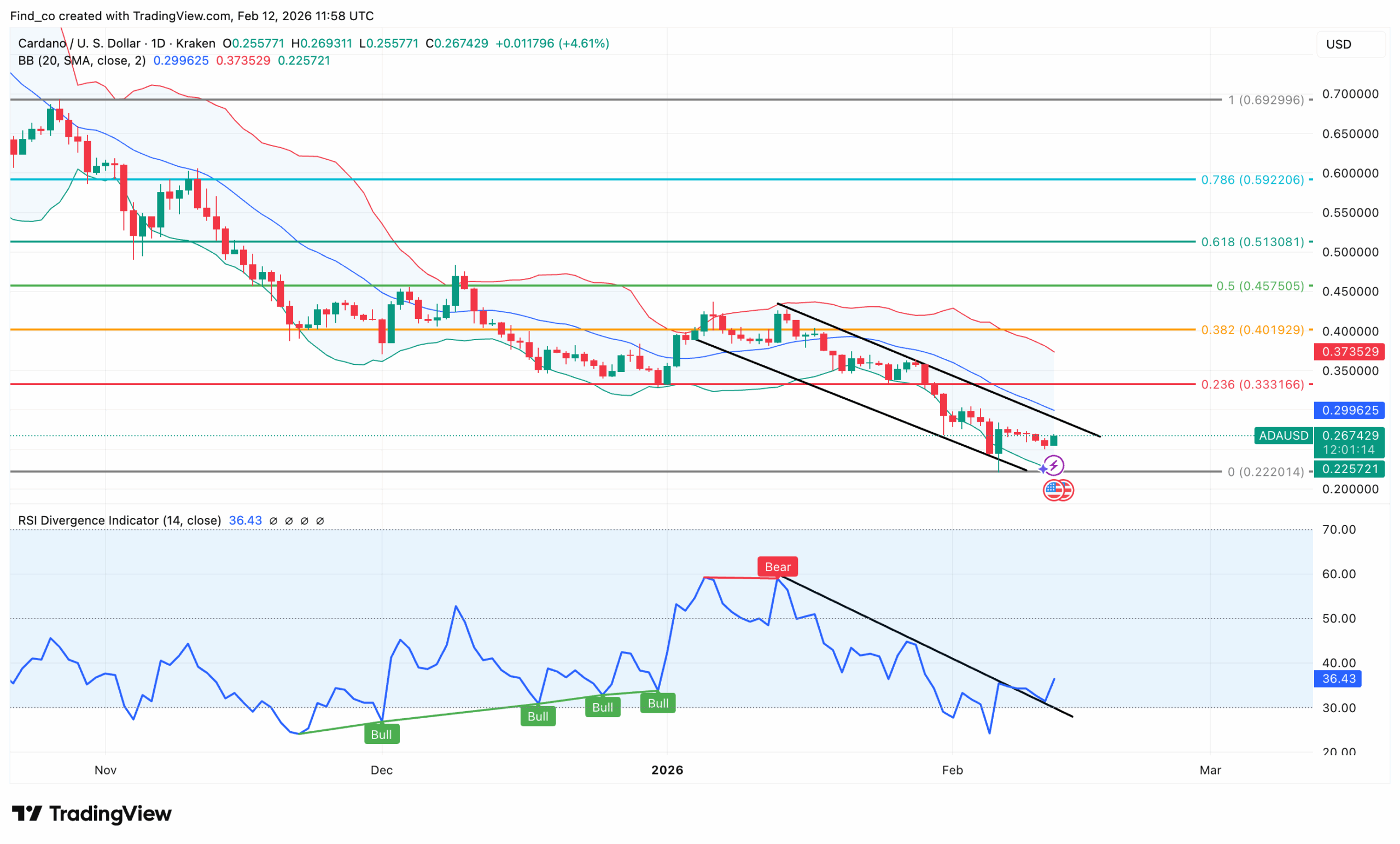
Unless Cardano’s price reclaims $0.33, it risks sliding toward $0.22.
Cardano (ADA) is trying to hold support near $0.26, and for the first time in weeks, it has a fundamental headline strong enough to hold it.
At Consensus Hong Kong 2026, Charles Hoskinson confirmed that LayerZero’s institutional-grade interoperability protocol is being integrated into the Cardano ecosystem.
The announcement injected immediate relief into price action. At the time of writing, Cardano’s price has increased by 5.39%.
However, it does not seem that ADA will continue trading higher. Here is why.
The LayerZero Integration: What Is It?
The LayerZero integration isn’t ordinary when implemented. According to CCN’s findings, it could be Cardano’s connectivity profile.
“I’m excited to announce our partnership with LayerZero,” the Founder of Cardano stated.
For years, one of Cardano’s structural criticisms was isolation. With LayerZero, Cardano dApps can now communicate trustlessly with 50+ blockchains, including Ethereum, Solana, and Avalanche.
The headline within the headline is USDCx, a LayerZero-powered, compliant stablecoin set to launch on Cardano.
For a DeFi ecosystem that has long lacked institutional-grade stable liquidity, this is a foundational upgrade.
Add to that a confirmed Midnight mainnet launch in the final week of March 2026, and the roadmap suddenly looks concrete rather than aspirational.
“We’re bringing USDCx to Cardano with a launch date set, complete with broad wallet and exchange support. This means stablecoins with true privacy and immutability, powered by zero-knowledge tech. It’s institutional-grade, and it’s happening now, alongside Midnight’s mainnet rollout,” Hoskinson added at Consensus Hong Kong 2026
From a development standpoint, Cardano is building.
From a market standpoint, it’s still raining as ADA’s price remains well below last year’s peak.
Cardano Holds Bearish Divergence
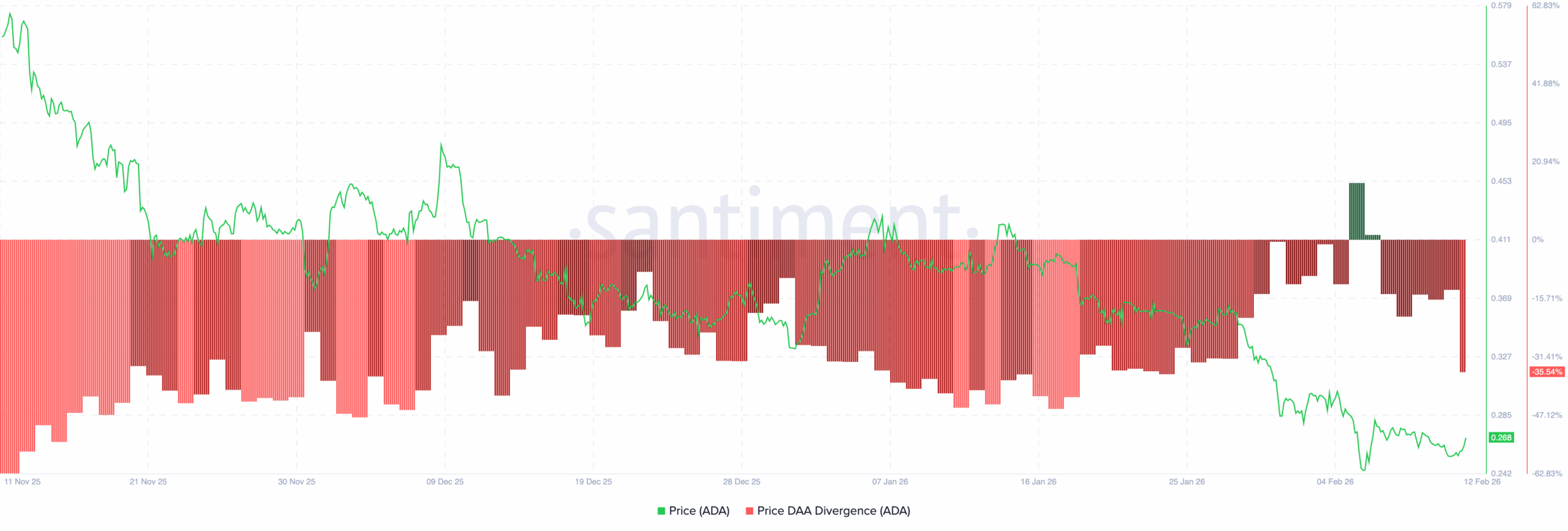
Looking at on-chain data, Cardano’s price continues to trend lower, printing a series of lower highs and lower lows while hovering near recent local bottoms around $0.26.
The persistent red bars in the Price DAA Divergence indicate that on-chain activity has not been supporting price, with network participation lagging behind valuation.
This kind of sustained negative divergence typically reflects weak underlying demand during the downtrend.
Recently, however, there was a brief shift into positive divergence (green bars), suggesting a short-term spike in network activity relative to price.
That kind of move can sometimes precede relief bounces. However, it has not yet translated into a bullish reversal on the chart.
With overall divergence still largely negative, ADA’s price remains in a critical position.
As such, any sustained recovery will likely require consistent improvement in on-chain participation alongside higher lows in price.
In that process, it could decline to $0.22. Complicating matters further, the launch of CME ADA futures on Feb. 9 introduced institutional hedging flows.
Early positioning suggests desks are using these contracts to protect downside exposure, not front-run a breakout. However, if buying volume increases, ADA might rise to $0.40.
Disclaimer:
The information provided in this article is for informational purposes only. It is not intended to be, nor should it be construed as, financial advice. We do not make any warranties regarding the completeness, reliability, or accuracy of this information. All investments involve risk, and past performance does not guarantee future results. We recommend consulting a financial advisor before making any investment decisions.
Victor Olanrewaju is a crypto analyst and reporter at CCN with deep roots in on-chain research and technical analysis. His crypto journey began in 2017, but it was the 2020 Uniswap airdrop that sparked a full-time pivot into the space.
With a foundation in copywriting, Victor honed his craft creating high-converting content for leading crypto brokers — most notably an XRP price prediction that ranked #1 on Google during the 2021 bull run.
He later joined AMBCrypto in 2022, where he combined storytelling with technical and on-chain analysis to cover key market narratives.
In 2024, he expanded his expertise at BeInCrypto, collaborating with analysts and using tools like Glassnode, Santiment, and IntoTheBlock to break down Bitcoin and altcoin trends.
At CCN, Victor covers the top cryptocurrencies, memecoins, macro shifts, blending real-time insights with deep-dive metrics.
He holds a Bachelor’s degree in Physics from the University of Ibadan, equipping him to simplify complex data for a wide audience. Follow his work or connect on LinkedIn or X.