Home / Analysis / Crypto / Technical Analysis / ZRO Could Avoid 30% Drop After LayerZero Claims ‘No Vulnerability’ Following $292M KelpDAO rsETH Exploit
If support holds, ZRO’s price could rebound toward $2, but continued selling may push it lower toward $1
LayerZero’s native token, ZRO, is trying to stabilize.
After dropping around 15% over the past week, the price has edged higher today, showing early signs of recovery.
That bounce comes in the wake of one of the most damaging weekends for DeFi in 2026.
On April 18, KelpDAO suffered a roughly $292 million exploit, which LayerZero initially linked to a highly sophisticated state-backed actor, widely believed to be North Korea’s Lazarus Group.
Now that the narrative around the attack is evolving and LayerZero is pushing back on parts of it, the response could play a key role in whether ZRO avoids another leg lower.
What Happened
The attack was surgical. Attackers drained 116,500 rsETH, worth about $290 million, from Kelp’s LayerZero-powered bridge by poisoning the servers that LayerZero’s verifier relied on to check transactions.
It did not stop there. Kelp’s emergency pause, 46 minutes after the drain, blocked two follow-up attempts that would have released an additional $200 million in rsETH.
Sponsored
Disclosure
We sometimes use affiliate links in our content, when clicking on those we might receive a commission at no extra cost to you. By using this website you agree to our terms and conditions and privacy policy.
The method was sophisticated. Attackers first compromised the downstream RPC used by the DVN, then launched a DDoS attack on other nodes to force a failover to the poisoned endpoint.
From there, the attacker tricked LayerZero’s cross-chain messaging layer into believing a valid instruction had arrived from another network, which triggered Kelp’s bridge to release 116,500 rsETH to an attacker-controlled address.
Is ZRO Over the Hack?
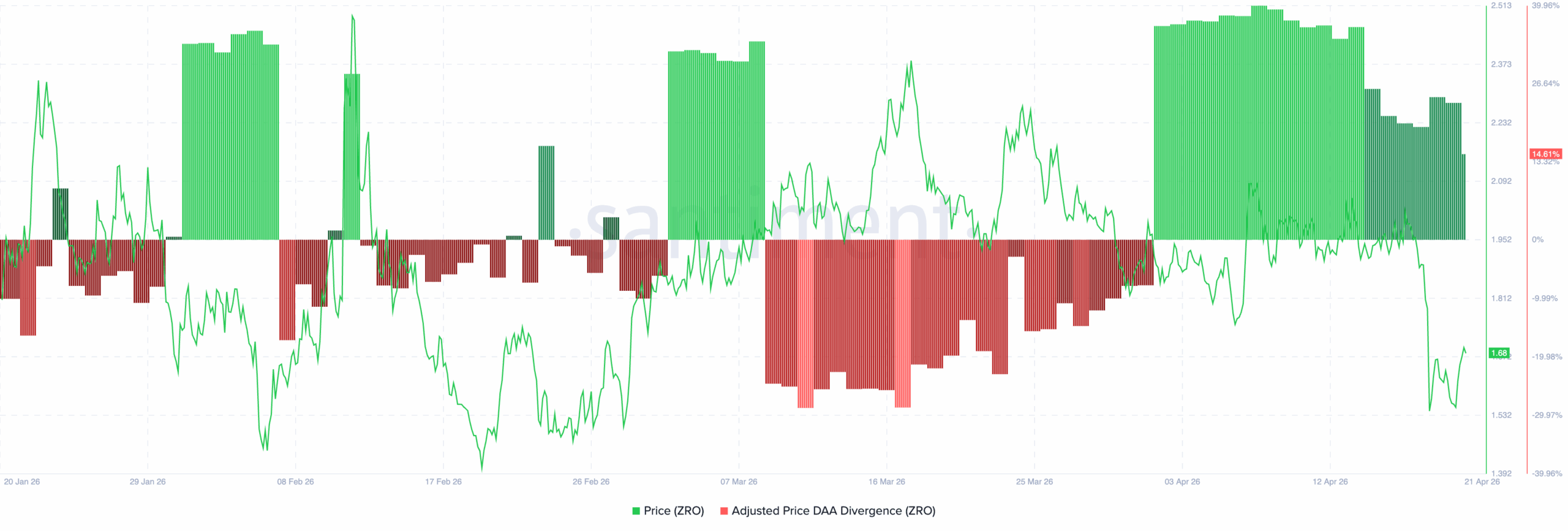
Meanwhile, on-chain data from Santiment shows that ZRO initially dropped while the DAA divergence turned negative.
However, if the divergence starts declining while the price is still rising, that weakening support could lead to a rejection and a pullback toward the $1.50 area.
LayerZero Fires in Its Defense
Despite the change in market sentiment, LayerZero moved quickly to contain the narrative.
“We’re fully aware of the rsETH exploit and have been in active remediation with the KelpDAO team since the incident, and continue to monitor. All other applications remain safe,” LayerZero said.
Then came the blame. LayerZero argued that the incident was isolated to KelpDAO’s rsETH configuration, a direct consequence of their single-DVN setup.
However, the team was blunt.
“KelpDAO chose to utilize a 1/1 DVN configuration. A properly hardened configuration would have required consensus across multiple independent DVNs, rendering this attack ineffective even in the event of any single DVN being compromised,” LayerZero wrote.
On contagion, LayerZero was firm.
“We can confirm with confidence that there is zero contagion to any other asset or application,” They stated.
As CCN reported earlier, the protocol disputed LayerZero’s account, arguing that the compromised single-verifier setup relied on LayerZero’s own infrastructure and default configurations—not a custom setup it chose against guidance.
In KelpDAO’s view, responsibility does not sit solely with the protocol.
The team said it relied on LayerZero’s documentation, default settings, and direct guidance when configuring the system.
Some security researchers appear to support that position.
For example, Yearn Finance core developer Artem K shared a technical review of LayerZero’s public deployment code, noting that the reference setup itself uses single-source verification.
“As anticipated, LayerZero is deflecting accountability that their very own DVN node infrastructure was compromised and triggered a $290 million bridge exploit.”
The back-and-forth highlights a broader issue: in complex, interconnected systems like DeFi, assigning responsibility is rarely straightforward.
Risk Is Not Totally Gone for ZRO’s Price
Outside the blame game, data from Glassnode shows that it might not yet be time for glitz and glamour for the altcoin.
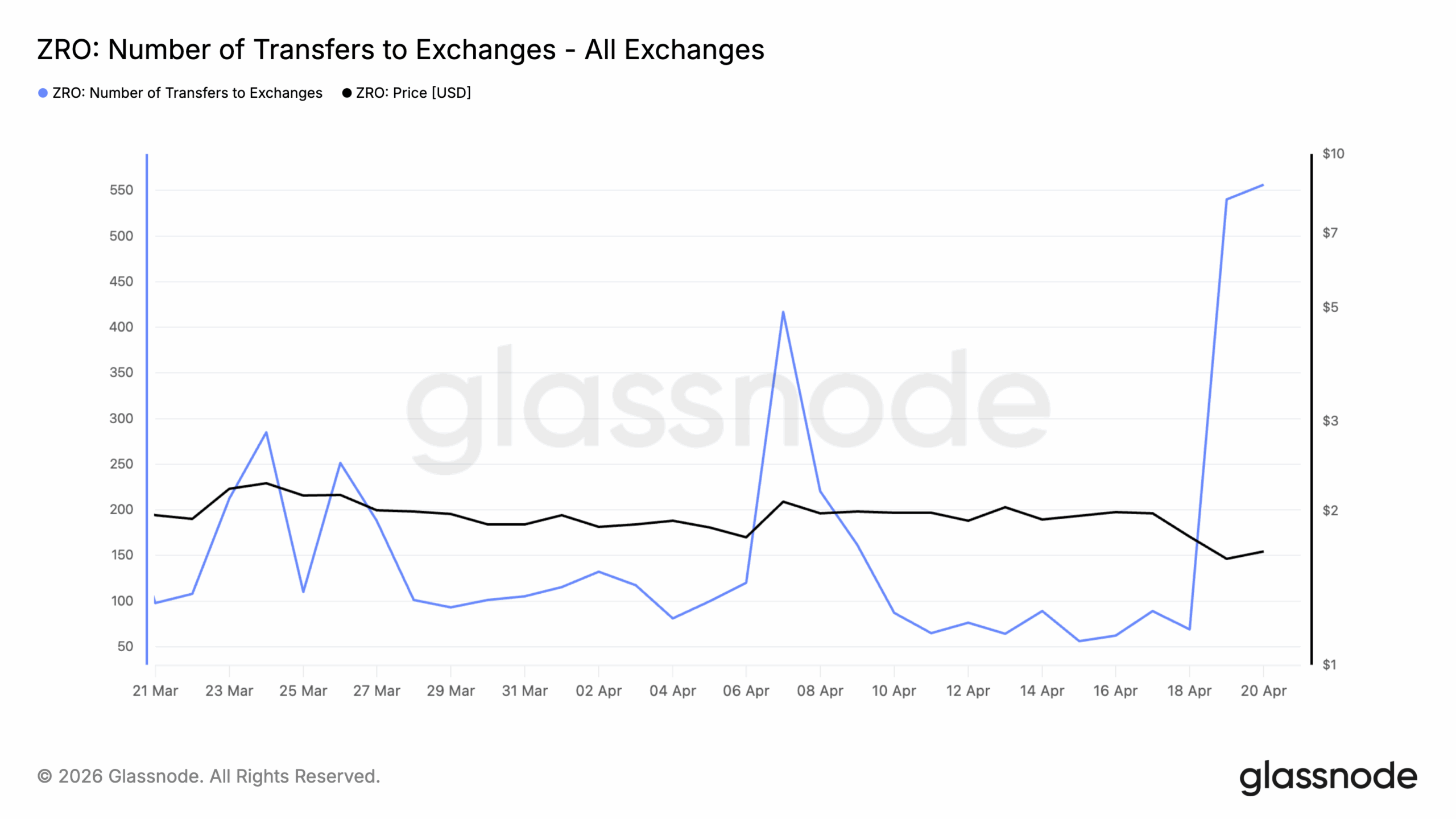
At the time of writing, ZRO’s price has been relatively stable. However, transfers to exchanges have surged, which is typically a warning signal.
This spike in exchange inflows has shown that more holders are moving tokens to sell-side venues, increasing available supply.
Even if the price has not reacted immediately, this kind of behavior has often preceded distribution phases.
Previously, smaller spikes in transfers have coincided with short-term tops or local pullbacks, and the current spike is significantly larger.
If these inflows persist, LayerZero could face downside pressure, with price likely to retest lower levels closer to $1.
However, if inflows drop quickly and demand absorbs the supply released by the token unlock, the price could stabilize. For now, the setup looks like a double-edged sword.
ZRO Price Prediction: Bullish Divergence to $2?
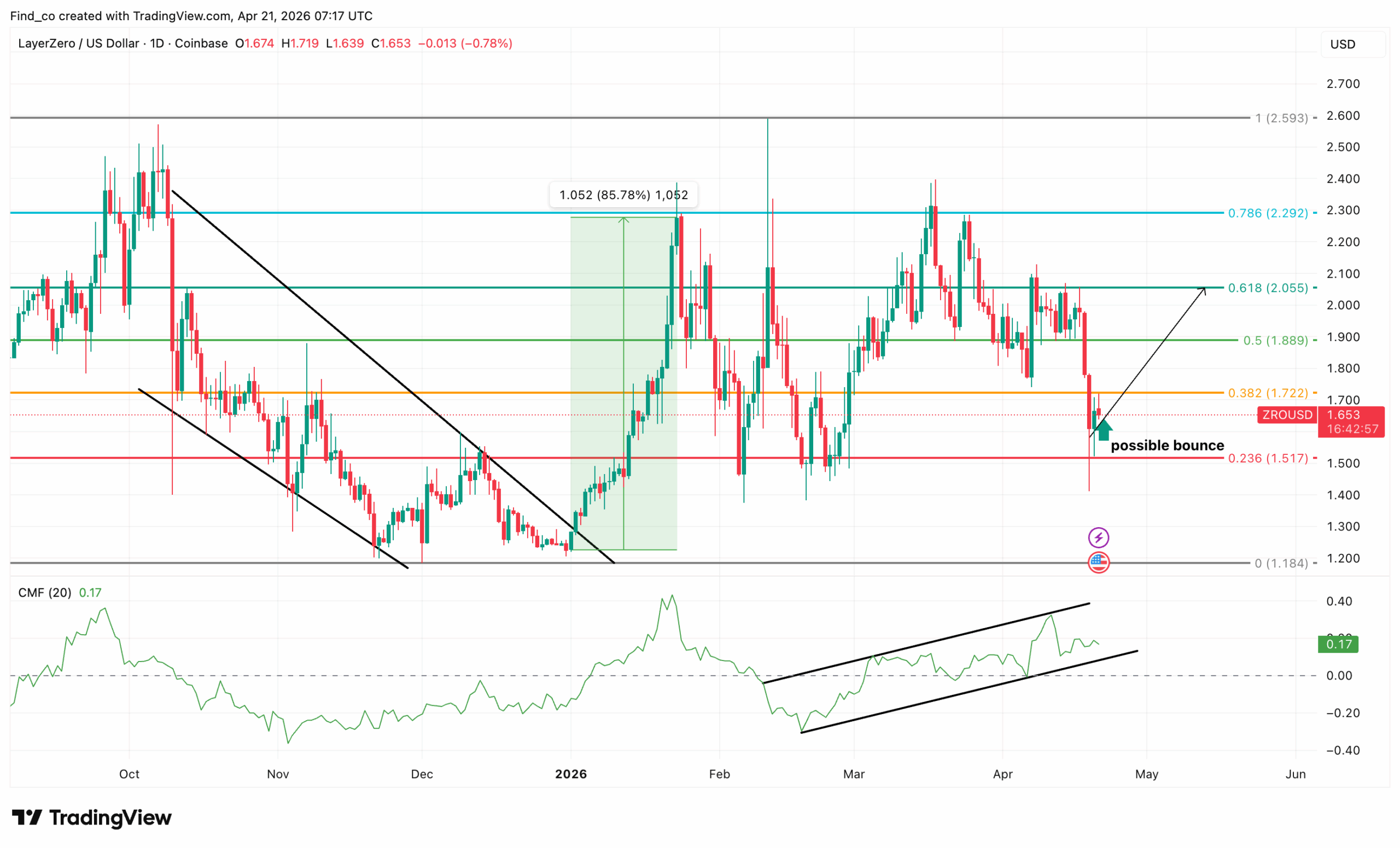
From a technical perspective, the daily chart shows that ZRO’s price dropped into the $1.50 support zone after rejection near the $2 resistance earlier.
However, at press time, the Chaikin Money Flow (CMF) has been trending upward, showing that buying pressure has been building despite the pullback.
Besides that, this divergence suggests that capital has been flowing in while the price has been correcting.
This is typically a sign of accumulation rather than weakness. But when this is combined with the earlier spike in exchange transfers, the picture becomes mixed.
Buying pressure has been increasing alongside supply on exchanges, meaning any recovery is facing overhead sell pressure.
If the CMF continues to rise and the price holds above $1.50, ZRO could rebound toward $2.06 near the 0.618 golden ratio.
But if selling from those exchange inflows starts dominating, the support could break, and the price will likely slide below $1.52.
In that scenario, the altcoin risks a 30% drop toward $1.18.
What Else Is Going on With LayerZero?
As of yesterday, LayerZero is already taking action.
The team has vowed to stop signing messages for any application using a single-verifier setup, forcing a broad migration across its ecosystem.
Recovery efforts are also underway. LayerZero says it has replaced the affected RPC endpoint, restored DVN operations, and is working with KelpDAO, SEAL, and law enforcement agencies to trace funds.
The blame war, however, is far from settled. Both sides are pointing fingers.
The community is divided, and LayerZero’s price remains caught in the middle, hovering above its all-time low, waiting to see who the market ultimately believes.
Disclaimer:
The information provided in this article is for informational purposes only. It is not intended to be, nor should it be construed as, financial advice. We do not make any warranties regarding the completeness, reliability, or accuracy of this information. All investments involve risk, and past performance does not guarantee future results. We recommend consulting a financial advisor before making any investment decisions.
Victor Olanrewaju is a crypto analyst and reporter at CCN with deep roots in on-chain research and technical analysis. His crypto journey began in 2017, but it was the 2020 Uniswap airdrop that sparked a full-time pivot into the space.
With a foundation in copywriting, Victor honed his craft creating high-converting content for leading crypto brokers — most notably an XRP price prediction that ranked #1 on Google during the 2021 bull run.
He later joined AMBCrypto in 2022, where he combined storytelling with technical and on-chain analysis to cover key market narratives.
In 2024, he expanded his expertise at BeInCrypto, collaborating with analysts and using tools like Glassnode, Santiment, and IntoTheBlock to break down Bitcoin and altcoin trends.
At CCN, Victor covers the top cryptocurrencies, memecoins, macro shifts, blending real-time insights with deep-dive metrics.
He holds a Bachelor’s degree in Physics from the University of Ibadan, equipping him to simplify complex data for a wide audience. Follow his work or connect on LinkedIn or X.