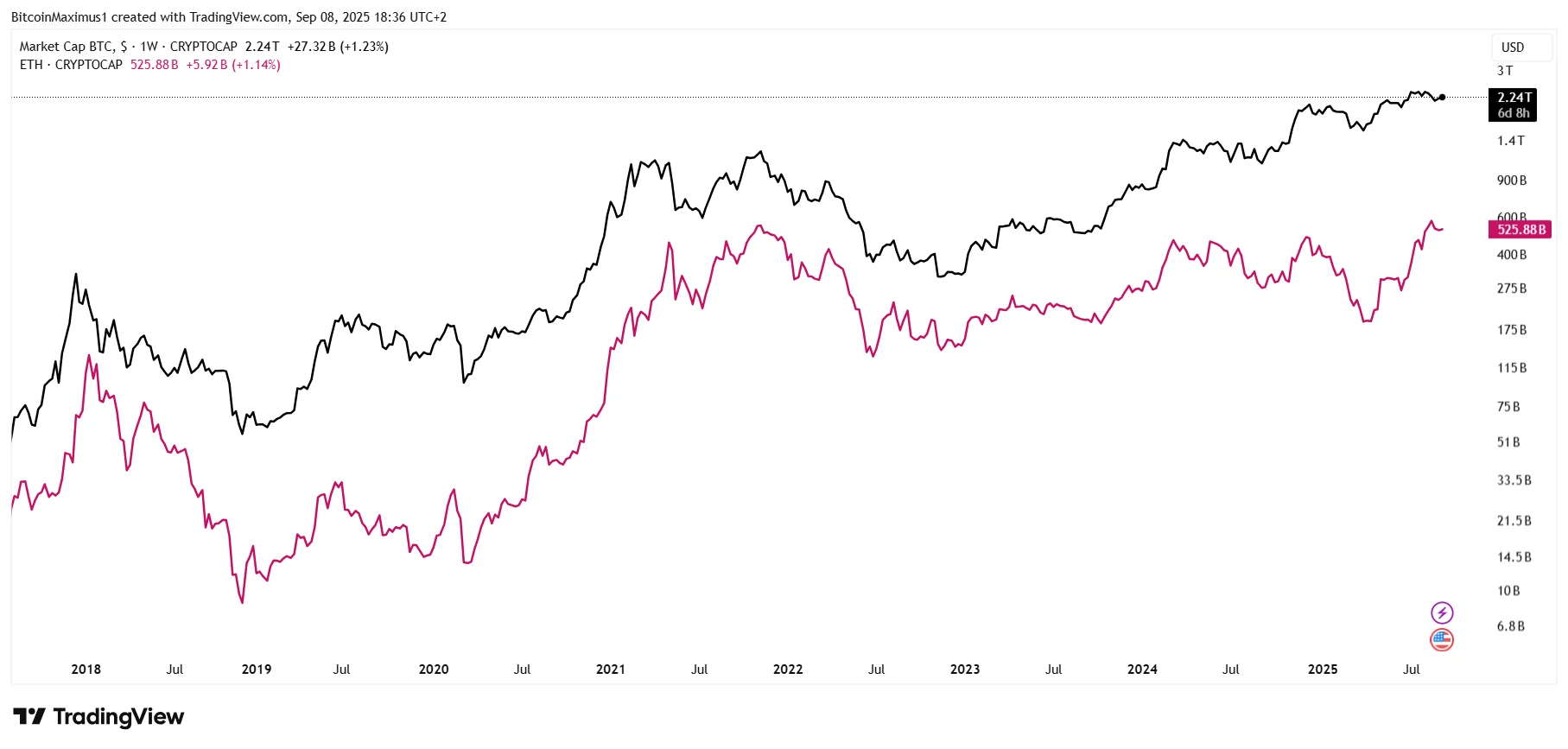
Ethereum currently has a market cap of $523 billion compared to $2.23 trillion for Bitcoin.
Will Ethereum ever surpass Bitcoin? Here’s what ChatGPT has to say about the topic.
For years, Bitcoin has stood as the undisputed king of crypto — the first digital asset to spark an entirely new era in finance.
Ethereum, however, has carved out a very different role. It’s not just a currency but a decentralized global computer powering smart contracts, decentralized finance (DeFi), and NFTs.
The real debate today isn’t whether Ethereum matters — that’s settled. It’s whether it can one day surpass Bitcoin in market dominance, a milestone often referred to as “the Flippening.”
This question goes beyond price. It’s about whether utility-driven blockchains like Ethereum can eventually outgrow Bitcoin’s store-of-value appeal.
ChatGPT’s Case for Ethereum
ChatGPT’s case for Ethereum rests on three key advantages:
Utility Beyond Money:
While Bitcoin primarily functions as digital gold, Ethereum has numerous use cases. It powers an entire ecosystem of decentralized applications (dApps), which gives Ethereum real-world use cases, as seen by the wave of tokenization in 2025.
Network Effects & Developer Activity
Ethereum has the largest developer community in crypto. More projects, apps, and innovations are being built on Ethereum than any other blockchain, reinforcing its position as the backbone of Web3.
Scalability Roadmap
Ethereum’s move to Proof of Stake cut energy usage by ~99% and opened the door for future upgrades. With rollups and sharding on the horizon, Ethereum aims to handle thousands of transactions per second, positioning itself as the go-to settlement layer for the internet of value. If successful, this could transform Ethereum into the settlement layer for both crypto and global finance.
According to ChatGPT:
In short, Ethereum’s multi-use ecosystem, technical progress, and supply mechanics could make it more attractive than Bitcoin to both developers and investors in the long run.
ChatGPT believes Ethereum could eventually surpass Bitcoin in the long run, though multiple factors need to play out in its favor.
ChatGPT’s Case Against Ethereum
However, the case for Ethereum is not clear-cut. On the contrary, the blockchain faces major hurdles that could stop it from flipping Bitcoin.
Complexity = Risk
Ethereum’s versatility is also its weakness. Smart contracts, DeFi protocols, and NFTs all carry risks. Hacks, bugs, and scams have already cost billions. Bitcoin’s simplicity as digital gold is easier to defend, both technically and politically.
Competition from Other Chains
Ethereum is not alone. Blockchains like Solana, Avalanche, and modular ecosystems like Celestia aim to take chunks of its market share. If Ethereum loses dominance in DeFi or NFTs, its flipping potential weakens.
Bitcoin’s Institutional Stronghold
With spot Bitcoin ETFs already approved and trillions in potential capital eyeing BTC as a macro hedge, Bitcoin may be entrenched as the ”safe bet” for institutions. Ethereum would need to make a much stronger case to move those flows away. Moreover, Bitcoin’s regulatory clarity as a commodity gives it a political advantage that Ethereum may struggle to match.
According to ChatGPT:
Ethereum’s innovation and complexity make it exciting, but they also leave it vulnerable to regulatory risk, security issues, and competitive threats that Bitcoin doesn’t face.
So, Ethereum is more of a high-risk, high-reward bet; in this sense, its advantages and drawbacks are also its drawbacks.
Looking at the Data
The closest Ethereum (purple) ever came to flipping Bitcoin (black) was in December 2018 (red). At the time, Ethereum’s market cap was more than half of Bitcoin’s, specifically, $130 billion to $248 billion.
Other times when Ethereum came close were in May and November 2021. It was slightly less than half of Bitcoin’s market cap at the time.
Get These Top Crypto Casino Offers Now!
Sponsored
Disclosure
We sometimes use affiliate links in our content, when clicking on those we might receive a commission at no extra cost to you. By using this website you agree to our terms and conditions and privacy policy.
An interesting observation is that Ethereum’s market cap tends to gain ground against Bitcoin during the most rapid portions of the bull market, while it loses ground during bear markets.
Similar trends have occurred since April 2025, when the Ethereum price increased rapidly compared to a more gradual Bitcoin ascent.
Ethereum vs Bitcoin Market Cap | Credit: Valdrin Tahiri/TradingView
Based on the current ratio, the cycle has not ended but is in its final portion.
If Ethereum keeps its ratio of slightly less than half the market cap of Bitcoin, it will cross $1 trillion for the first time, approaching the $9,000 level at the current circulating supply.
ETFs and Inflation
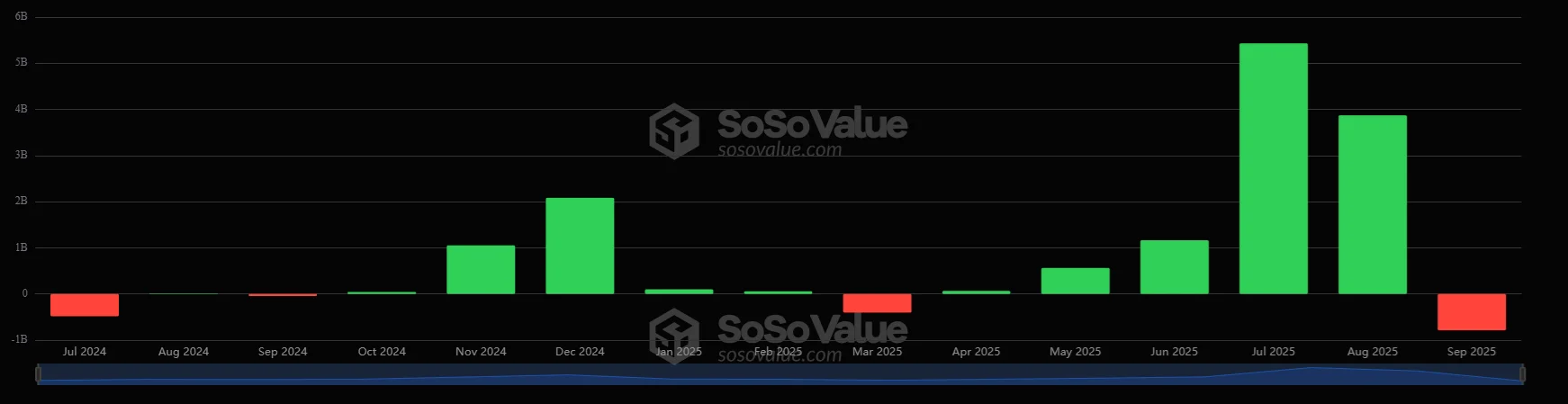
At the time of writing, the Bitcoin spot Exchange-Traded-Funds (ETFs) have a $54.49 billion cumulative total net inflow, while Ethereum has $12.73 billion.
Even when accounting for market cap, Bitcoin has the lead, with 2.4% of its market cap in ETF funds versus 2.2% for Ethereum.
However, it is worth noting that Ethereum is quickly catching up and has recorded more inflows than Bitcoin, even in absolute terms, over the past two months.
This trend signals a shift in investor confidence. Ethereum is starting to attract not just retail enthusiasm but serious institutional capital.
If the same rate continues, its ETF inflows will surpass Bitcoin’s relative to their market cap by the end of September.
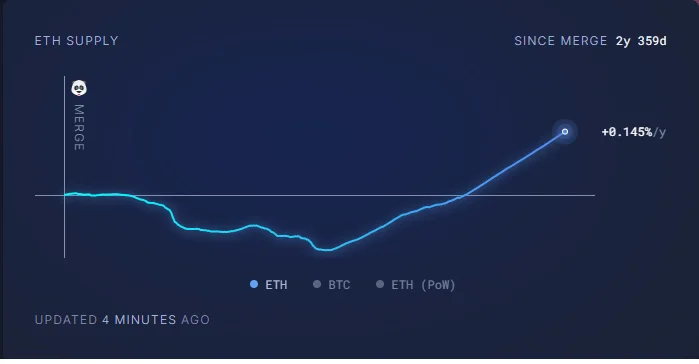
One chart that does not reflect well on Ethereum is its inflationary rate since the Merge. At first, Ethereum became deflationary, creating optimism that it would stay that way and become an ideal store of value.
However, the Dencun upgrade changed that, making fees so minuscule that they had the adverse effect of not contributing enough to the burn mechanisms.
Since Dencun, the inflation rate has skyrocketed, though it is worth mentioning that it is still lower than Ethereum when it was a proof-of-work blockchain.
Ethereum vs Bitcoin
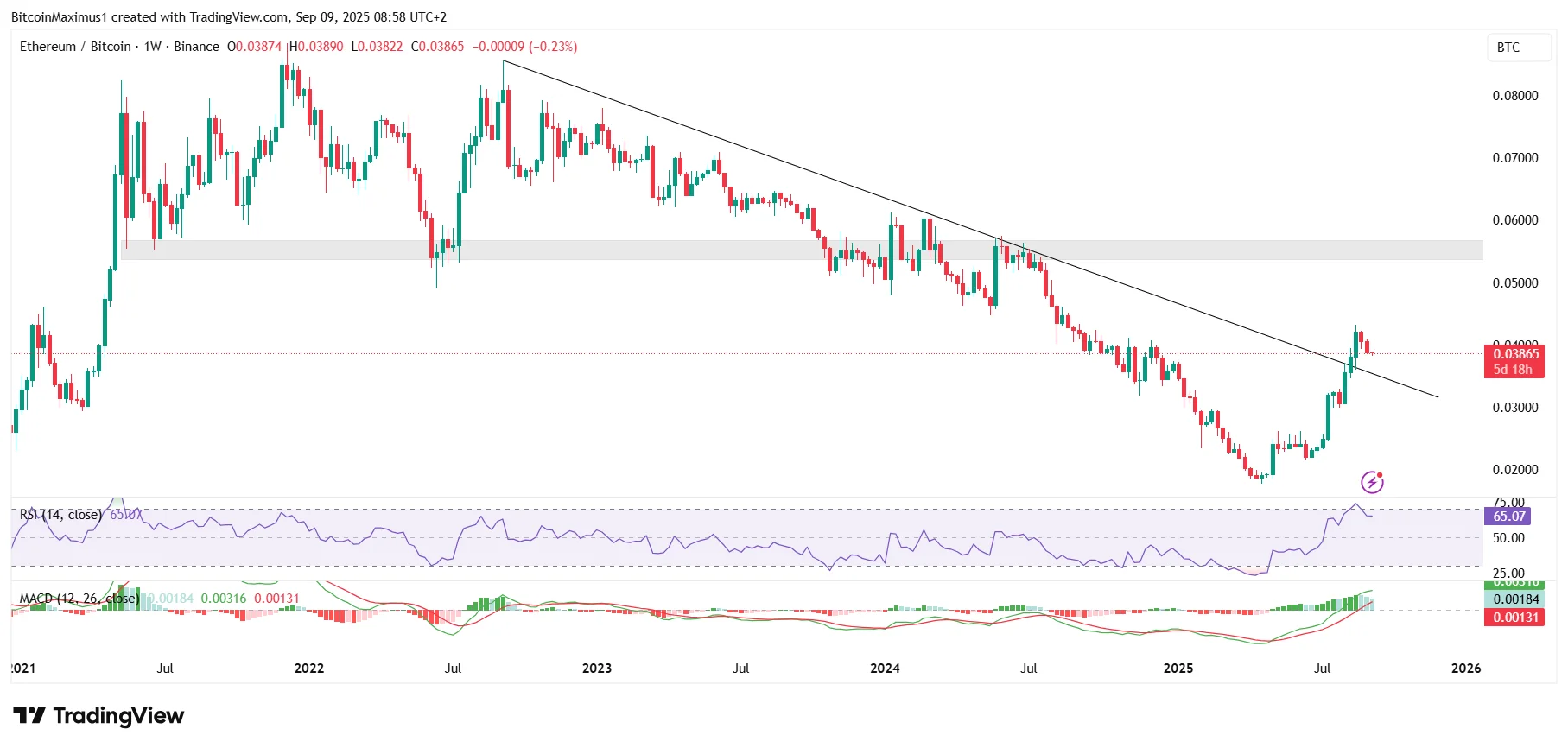
The weekly ETH to BTC chart shows a breakout from a diagonal resistance trend line that has existed since September 2022, the previous cycle high.
Since the trend line has existed for so long, the breakout is a positive sign that could lead to more gains in the future. It suggests that the previous bearish trend has ended.
Alongside the breakout, the RSI and MACD crossed into bullish territory. The RSI moved above 50 while the MACD crossed 0, both signs of a positive trend.
If the rally continues, the main resistance area will be at ₿0.055, a critical level that previously provided support.
Because of how long the area provided support, the Ethereum price faces a tall task if it is to reclaim it.
Since the ETH price needs to reach a high of roughly ₿0.145 to flip Bitcoin, it seems that the “Flippening” is still quite far away, and many obstacles that are difficult to cross lie on the way there.
Final Thoughts
Ethereum has proven itself as the backbone of DeFi and Web3.
While its complexity is one of its advantages against Bitcoin, allowing it to act as more than “digital gold”, it also makes it more challenging to use and introduces a host of complications.
Bitcoin’s simplicity, scarcity, and institutional trust make it hard to displace. However, Ethereum’s growing inflows and utility-driven adoption suggest the gap is narrowing.
If Ethereum continues to lead in inflows, it could signal the first real institutional challenge to Bitcoin’s dominance.
Whether the Flippening happens or not, both assets will likely remain pillars of the crypto economy for years.
Disclaimer:
The information provided in this article is for informational purposes only. It is not intended to be, nor should it be construed as, financial advice. We do not make any warranties regarding the completeness, reliability, or accuracy of this information. All investments involve risk, and past performance does not guarantee future results. We recommend consulting a financial advisor before making any investment decisions.
Valdrin Tahiri is a cryptocurrency analyst and reporter at CCN, specializing in technical analysis with a focus on Elliott Wave theory, on-chain metrics, and fundamental research. He brings over seven years of experience in the crypto space as both a trader and writer.
He discovered cryptocurrencies in 2017 while earning his MSc in Financial Markets at the Barcelona School of Economics, which sparked a deep interest in blockchain and market dynamics. Since then, he’s contributed to top crypto outlets like BeInCrypto and CoinGape.
Valdrin also served as Community Manager of BeInCrypto’s Telegram group for three years, helping grow it into one of the largest crypto communities worldwide. His expertise in market structure and price patterns allows him to break down complex trends into clear, actionable insights.
He’s published thousands of articles covering altcoins, Bitcoin cycles, and macro trends.