Ether is consolidating after a 12% weekly surge as traders watch key support, ETF flows, technical indicators, and upcoming Fed move. | Credit: CCN.com
Share
Key Takeaways
Ethereum researchers have proposed a quantum-resistant signature scheme called SPHINCS- that can be deployed on Ethereum without requiring a hard fork.
Post-quantum protection could cost as little as $0.07 per verification, making it practical for wallets, institutions, and decentralized applications.
The proposal leverages Ethereum’s native KECCAK256 hash function, allowing post-quantum signatures to be verified directly within smart contracts.
Ethereum users may soon be able to protect their wallets from future quantum computing threats for as little as $0.07 per verification, according to new research proposing an efficient post-quantum signature scheme that works on Ethereum today without requiring a hard fork or protocol upgrade.
The proposal, dubbed SPHINCS-, was unveiled by Ethereum researcher Nicolas Consigny and collaborators, including contributors from the Ethereum Foundation’s cryptography team.
The research comes as concerns grow that advances in quantum computing could eventually break the Elliptic Curve Digital Signature Algorithm (ECDSA), the cryptographic system currently used to secure Ethereum accounts and Bitcoin wallets.
At the same time, Ethereum’s native token is attempting to recover from recent lows, with analysts watching whether ETH can reclaim key resistance levels and mount a move back toward the psychologically important $2,000 mark.
Try Our Recommended Crypto Exchanges
Sponsored
Disclosure
We sometimes use affiliate links in our content, when clicking on those we might receive a commission at no extra cost to you. By using this website you agree to our terms and conditions and privacy policy.
SPHINCS- Brings Post-Quantum Security to Ethereum Without Protocol Changes
The core goal of the SPHINCS- proposal is to make quantum-resistant signatures practical on Ethereum’s execution layer using existing infrastructure.
Unlike many post-quantum cryptography solutions that would require new precompiles or network upgrades, SPHINCS- leverages Ethereum’s native KECCAK256 hashing function to verify signatures directly within smart contracts.
Researchers found that one optimized version of the scheme, known as C13, can verify a post-quantum signature using roughly 127,000 gas.
Ethereum can already start preparing accounts for a post quantum world, without waiting for a hard fork.
Today, it would be just 0.07$ .
Further audits incoming. Though I squeezed in a review with Fable before Uncle Sam crashed my party. Verity formal proof included for my…
At current network conditions, that translates to approximately $0.07 per verification, making quantum-resistant protection economically viable for wallet providers, institutions, and decentralized applications.
The proposal derives from SPHINCS+, a hash-based signature scheme already standardized by the US National Institute of Standards and Technology (NIST) under its post-quantum cryptography program.
According to the researchers, the design offers a practical bridge toward quantum-safe Ethereum accounts while avoiding disruptive protocol-level changes.
“Quantum computers will eventually break ECDSA,” the report states, adding that recent resource estimates suggest the threat may arrive sooner than previously anticipated.
Ethereum Community Pushes for Long-Term Quantum Readiness
The research highlights growing efforts within the Ethereum ecosystem to prepare for a future where quantum computers could compromise existing cryptographic standards.
Hash-based signature schemes such as SPHINCS+ are viewed as attractive alternatives because their security relies primarily on the strength of cryptographic hash functions rather than mathematical assumptions used by lattice-based systems.
The researchers also explored future upgrades, including a proposed “leanSPHINCS” model that could integrate more efficiently with zero-knowledge proof systems and transaction aggregation frameworks.
Under one proposed architecture, post-quantum signature verification costs could eventually fall to as little as 3,000 gas through off-chain proof aggregation, further reducing costs for users.
While SPHINCS- remains a research proposal rather than a finalized Ethereum standard, its relatively low verification cost may strengthen the case for introducing optional quantum-resistant wallet protections long before large-scale quantum computers become a reality.
ETH Must Reclaim Key Resistance Levels Before $2K Recovery
While Ethereum’s long-term security roadmap advances, traders remain focused on the network’s near-term price action.
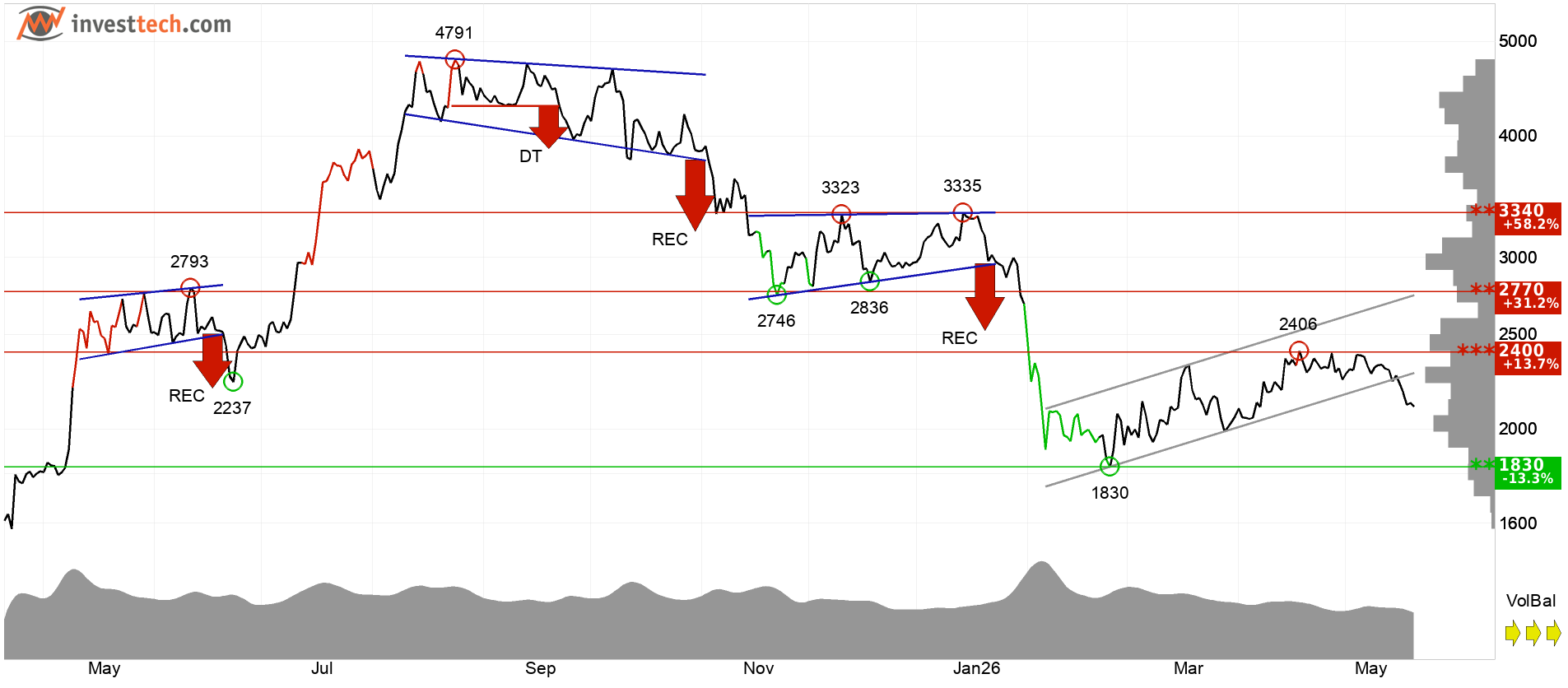
ETH recently rebounded from support near $1,500 and is currently consolidating around the $1,670 level. However, analysts caution that the recovery remains corrective rather than a confirmed bullish reversal.
The first major resistance zone sits between $1,850 and $1,900. Beyond that, Ethereum faces a larger supply area between $2,000 and $2,150, where previous support has turned into resistance and intersects with a long-term descending trendline.
Ethereum has broken through the floor of a rising trend channel. | Credit: InvestTech
On shorter timeframes, liquidation data from Binance suggests a significant concentration of short positions above the current market price. The largest liquidity cluster sits between $1,750 and $1,800, creating the potential for a short squeeze if buyers gain momentum.
A breakout through those levels could accelerate ETH toward the $1,900 region and eventually test the critical $2,000 threshold. However, failure to hold above the $1,500 support zone could expose Ethereum to renewed downside pressure.
For now, Ethereum finds itself balancing two narratives: a long-term push toward quantum-resistant security and a short-term battle to reclaim key technical levels that could determine whether the next major move is toward $2,000 or back toward recent lows.
Giuseppe Ciccomascolo began his career as an investigative journalist in Italy, where he contributed to both local and national newspapers, focusing on various financial sectors.
Upon relocating to London, he worked as an analyst for Fitch's CapitalStructure and later as a Senior Reporter for Alliance News. In 2017, Giuseppe transitioned to covering cryptocurrency-related news, producing documentaries and articles on Bitcoin and other emerging digital currencies. He also played a pivotal role in establishing the academy for a cryptocurrency exchange website. Crypto remained his primary area of interest throughout his tenure as a writer for ThirdFloor.