Bitcoin is struggling to hold above $60,000 as more than $4 billion exits spot ETFs. Analysts warn BTC could test $53,000 or even $47,000. | Credit: CCN.com
Share
Key Takeaways
Bitcoin has fallen from its May high of $82,607 to around $61,000-$63,000, extending a correction that has intensified amid broader market uncertainty.
More than $4 billion has exited Bitcoin ETFs over the past four weeks, signaling weakening institutional demand and reversing much of the positive momentum seen in the year.
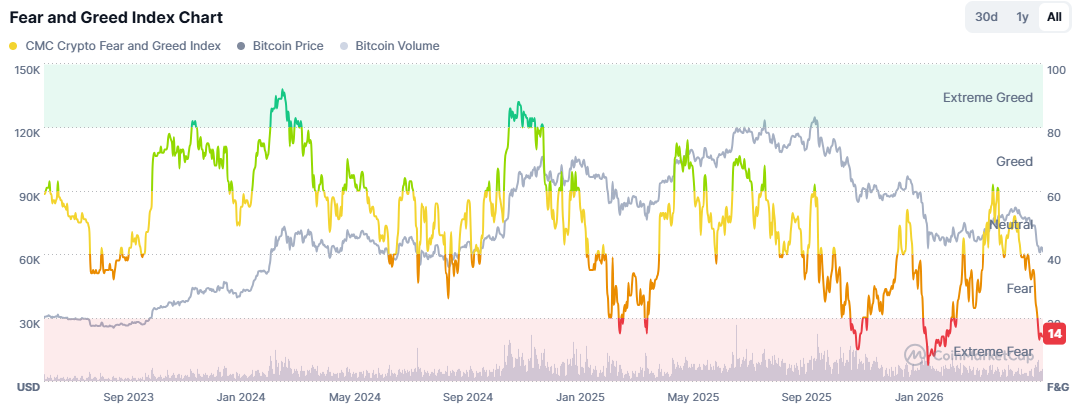
Market sentiment has deteriorated sharply, with the Crypto Fear and Greed Index dropping to 14, placing the market firmly in “extreme fear” territory.
Bitcoin is approaching a critical inflection point as mounting selling pressure, persistent ETF outflows, and deteriorating market sentiment continue to weigh on the world’s largest cryptocurrency.
After reaching a peak of $82,607 in May, Bitcoin has entered a sustained correction, recently falling to the $61,000- $63,000 range as investors reassess risk amid changing macroeconomic conditions.
While bulls are attempting to defend the psychologically important $60,000 level, technical indicators suggest that the market remains vulnerable to further downside.
At the same time, Bitcoin exchange-traded funds have experienced more than $4 billion in outflows over the past four weeks, highlighting weakening institutional demand and adding to concerns that the correction may not yet be complete.
Try Our Recommended Crypto Exchanges
Sponsored
Disclosure
We sometimes use affiliate links in our content, when clicking on those we might receive a commission at no extra cost to you. By using this website you agree to our terms and conditions and privacy policy.
ETF Outflows and Risk-Off Sentiment Weigh on Bitcoin
One of the biggest drivers behind Bitcoin’s recent weakness has been the sharp reversal in institutional flows. According to market data, Bitcoin ETFs have shed more than $4 billion in assets over the past month, effectively erasing much of the momentum generated during March and April.
The outflows reflect a growing sense of caution among investors as financial markets grapple with rising uncertainty.
Recent US economic data showed stronger-than-expected job creation, fueling speculation that the Federal Reserve could maintain a tighter monetary policy stance or even consider additional interest rate hikes later this year.
The Crypto Fear and Greed Index recently fell into ‘extreme fear’ territory. | Credit: CoinMarketCap
Higher interest rates tend to reduce appetite for risk assets, and cryptocurrencies have been among the hardest-hit sectors during the latest bout of risk aversion.
The broader weakness has extended beyond digital assets, with major US equity indices posting significant declines and technology stocks facing renewed selling pressure.
Investor sentiment in the crypto market has also deteriorated sharply. The Crypto Fear and Greed Index recently fell to 14, placing it firmly within the “extreme fear” category.
Historically, such readings often coincide with periods of heightened volatility and investor capitulation, although they can sometimes precede longer-term market bottoms.
Despite the negative sentiment, some institutional buyers continue to accumulate. Strategy announced the purchase of 1,550 BTC, valued at approximately $101.3 million, offering a reminder that long-term conviction among certain corporate investors remains intact.
Technical Structure Points to Further Downside Risk
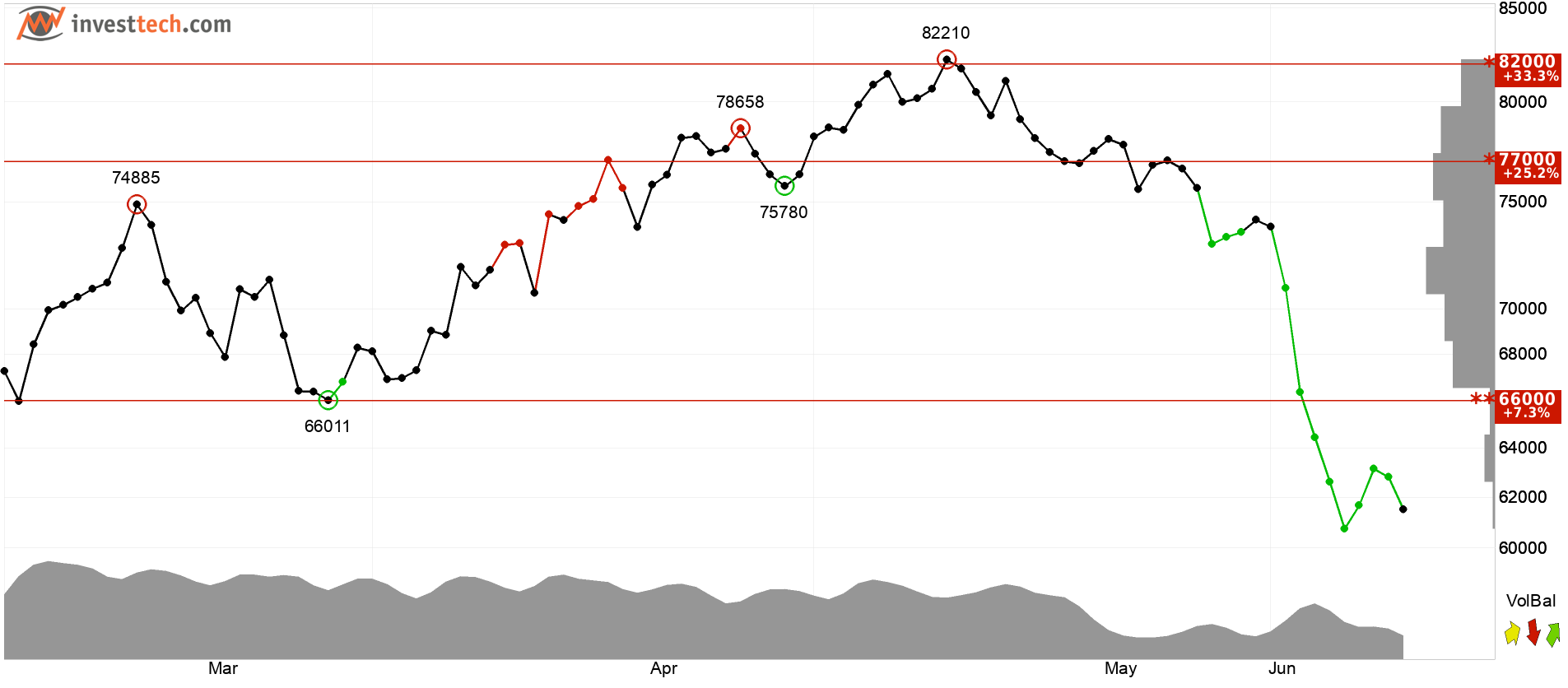
From a technical perspective, Bitcoin’s chart remains decisively bearish. The cryptocurrency is currently trading within a horizontal channel, reflecting uncertainty among market participants as they wait for a clear directional catalyst.
However, the balance of evidence favors sellers. Bitcoin has broken below the lower boundary of a previous ascending channel and remains below key moving averages. Volume metrics indicate aggressive selling activity, while buyers have largely remained on the sidelines.
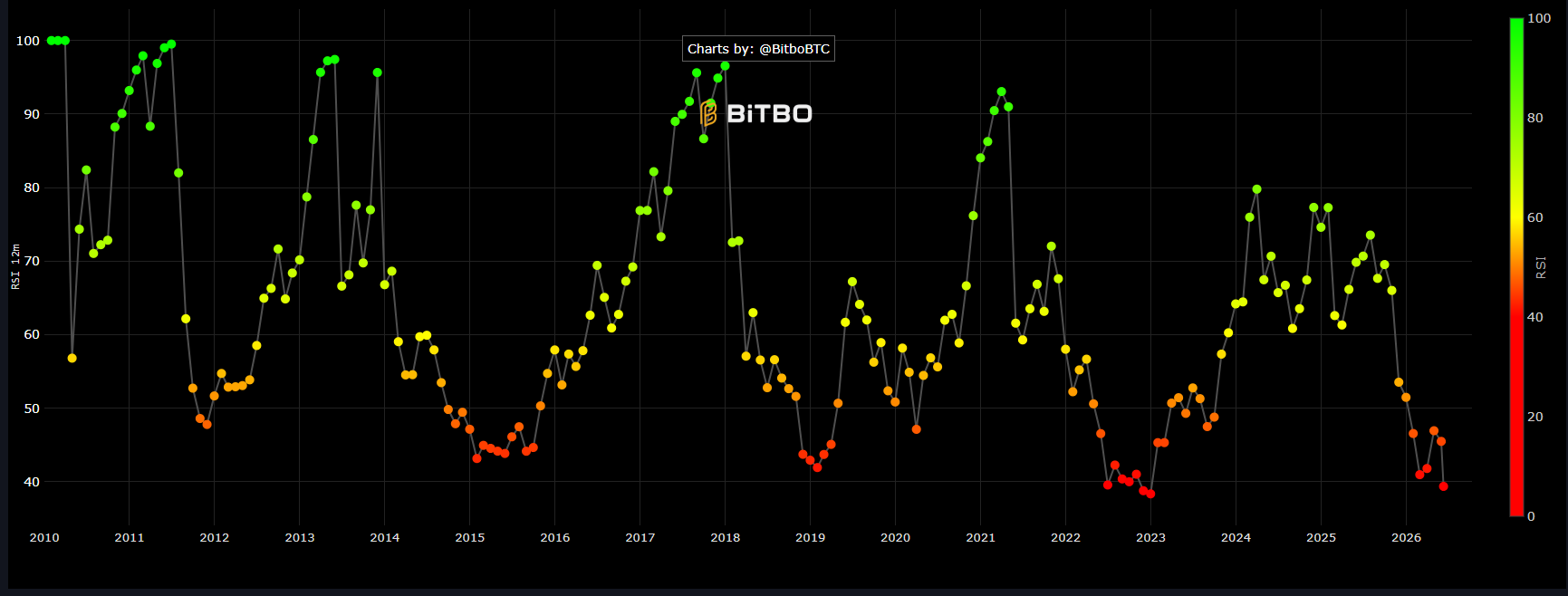
Momentum indicators paint a similarly cautious picture. The Relative Strength Index (RSI) has fallen below 30, signaling extremely negative short-term momentum.
While such readings often suggest oversold conditions that can trigger temporary rebounds, they do not necessarily indicate that a market bottom has been established.
Additional technical weakness emerged after Bitcoin slipped below the ultimate support level of the Murrey Math Lines tool at $62,500.
The recent rebound from around $59,800 resembles a classic dead-cat bounce, a temporary recovery within a broader downtrend.
Immediate resistance now sits near $66,000, while support remains fragile. Without a strong catalyst to attract buyers, traders are increasingly focused on lower support zones that could come into play if selling pressure intensifies.
Potential Drop Toward $47,000
Market observers are increasingly debating how deep the current correction could become. According to on-chain analyst VoidOnChain, Bitcoin is revisiting a region where multiple previous relief rallies have failed, making the current price zone one of the most important decision points of the cycle.
The analyst’s roadmap suggests Bitcoin could first lose the $60,000 level before declining toward $53,000 in the near term.
A deeper capitulation event could then push the cryptocurrency toward $47,000 by July, completing what is viewed as the final leg of the corrective structure.
Bitcoin is within an approximate horizontal trend channel. | Credit: InvestTech
This outlook is based on similarities between the current market setup and previous corrective waves observed earlier in 2026.
If the projected decline materializes and establishes a durable bottom, Bitcoin could eventually recover toward $87,000 before targeting significantly higher levels near $151,000 by early 2027.
For now, however, the focus remains firmly on downside risks. ETF outflows, extreme fear, weakening technical indicators, and macroeconomic uncertainty continue to pressure Bitcoin’s price action.
Unless bulls can successfully defend the $60,000 area and reclaim the $66,000 resistance, the path of least resistance may remain lower in the weeks ahead.
Giuseppe Ciccomascolo began his career as an investigative journalist in Italy, where he contributed to both local and national newspapers, focusing on various financial sectors.
Upon relocating to London, he worked as an analyst for Fitch's CapitalStructure and later as a Senior Reporter for Alliance News. In 2017, Giuseppe transitioned to covering cryptocurrency-related news, producing documentaries and articles on Bitcoin and other emerging digital currencies. He also played a pivotal role in establishing the academy for a cryptocurrency exchange website. Crypto remained his primary area of interest throughout his tenure as a writer for ThirdFloor.