Is Bitcoin's price finally eyeing a bottom? Experts are split. | Source: CCN.
Share
Key Takeaways
Bitcoin has fallen below the critical $65,000 level, reinforcing concerns that the market is entering a deeper bear phase after weeks of sustained selling pressure.
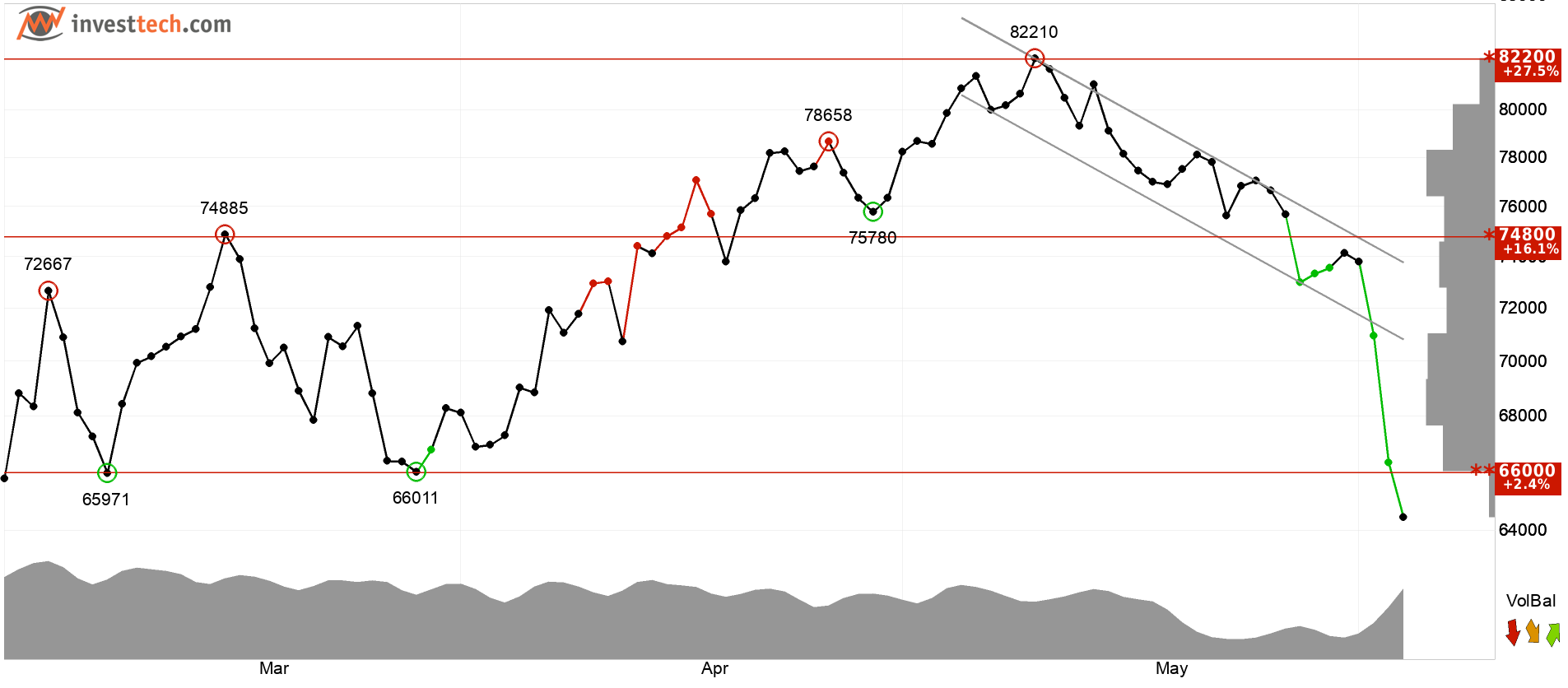
Technical indicators remain firmly bearish, with Bitcoin breaking below a short-term falling trend channel and facing limited chart support below current levels.
Investor capitulation is accelerating, with daily realized losses surging to approximately $1.35 billion, including around $770 million from long-term holders exiting positions.
Bitcoin’s latest slide below the psychologically important $65,000 level has intensified concerns that the cryptocurrency market may be entering a deeper bear market phase.
A combination of deteriorating technical indicators, mounting investor capitulation, weakening spot demand, and substantial institutional outflows has placed significant pressure on the world’s largest digital asset.
The decline comes amid heightened macroeconomic uncertainty, rising Treasury yields, expectations of further Federal Reserve tightening, and growing risk aversion across financial markets.
On-chain analytics firm Glassnode suggests the market structure increasingly resembles past bear-market environments, raising the possibility of further downside in the weeks ahead.
Try Our Recommended Crypto Exchanges
Sponsored
Disclosure
We sometimes use affiliate links in our content, when clicking on those we might receive a commission at no extra cost to you. By using this website you agree to our terms and conditions and privacy policy.
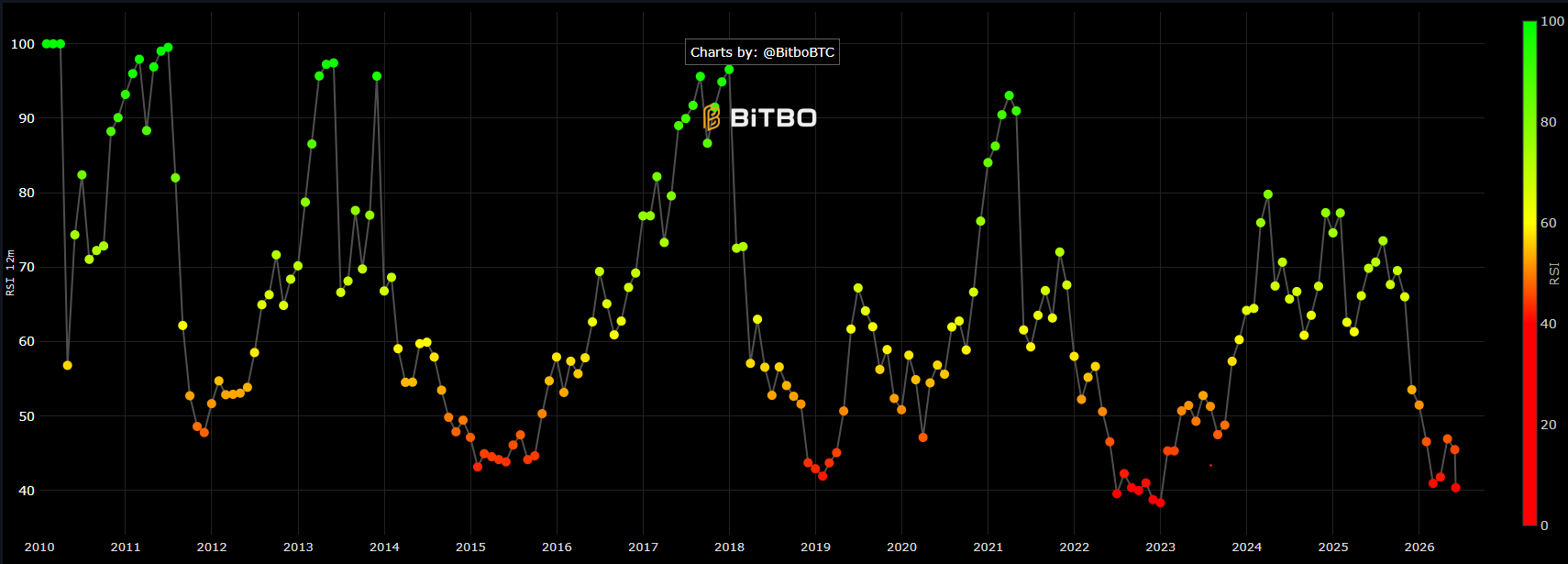
Momentum indicators further reinforce this outlook. The Relative Strength Index (RSI) has fallen below 30, indicating extremely weak short-term momentum and signaling that investors are increasingly unwilling to pay higher prices for the asset.
The RSI itself remains in a declining trend, supporting the view that bearish pressure is still intensifying.
Although an RSI below 30 can sometimes indicate oversold conditions and create opportunities for temporary rebounds, such signals often prove unreliable during strong downtrends.
As a result, technical analysts continue to classify Bitcoin as technically negative in the short term, with the path of least resistance remaining to the downside.
On-Chain Data Reveals Growing Investor Capitulation
Beyond the charts, on-chain data paints an equally concerning picture. According to Glassnode, Bitcoin has entered a critical valuation zone between its Realized Price and True Market Mean, a region historically associated with bear market conditions.
A particularly notable development is the Short-Term Holder (STH) cost basis falling below the True Market Mean for the first time since January 2022.
This suggests that newer investors are accumulating Bitcoin at prices below the market’s average valuation level, a characteristic commonly seen during prolonged bearish cycles.
Bitcoin has broken the short-term falling trend channel. | Credit: InvestTech
Investor profitability metrics have also deteriorated sharply. The seven-day average Realized Profit/Loss Ratio has collapsed from 3.16 to just 0.29, reflecting a rapid shift from profit-taking activity to widespread loss realization.
At the same time, daily realized losses have surged to approximately $1.35 billion.
Long-term holders accounted for roughly $770 million of those losses, indicating that even experienced investors are beginning to capitulate and exit positions accumulated near previous market highs.
Historically, such long-term holder capitulation has often occurred during the later stages of bear markets. However, the current pace of realized losses suggests that the process of transferring supply from weak hands to stronger buyers may not yet be complete.
ETF Outflows and Weak Demand Add Downside Pressure
Institutional sentiment has also weakened significantly. Bitcoin recently failed to reclaim the $83,000 level, which coincides with the aggregate cost basis of US spot Bitcoin ETF investors.
The rejection at this level has transformed it into a major overhead resistance zone.
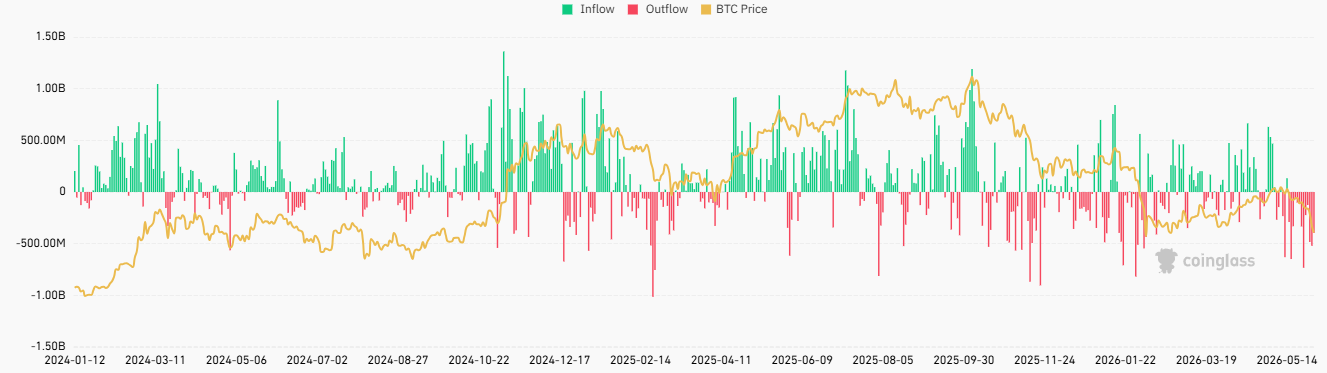
The failed recovery has been accompanied by approximately $4.21 billion in spot Bitcoin ETF outflows over the past three weeks, representing the largest redemption streak recorded this year.
Also, the scale of these outflows highlights falling institutional confidence and reduced appetite for Bitcoin exposure amid worsening market conditions.
Total Bitcoin spot ETF net inflow. | Credit: CoinGlass
Spot market activity has similarly deteriorated. Glassnode’s Spot Volume Delta has turned firmly negative, indicating that selling activity continues to outweigh buying demand.
Persistent negative volume readings are often associated with either capitulation events or the early stages of broader bearish trends.
Meanwhile, derivatives markets remain cautious. Although implied volatility remains subdued, rising volatility risk premiums suggest traders are preparing for larger price swings ahead.
Giuseppe Ciccomascolo began his career as an investigative journalist in Italy, where he contributed to both local and national newspapers, focusing on various financial sectors.
Upon relocating to London, he worked as an analyst for Fitch's CapitalStructure and later as a Senior Reporter for Alliance News. In 2017, Giuseppe transitioned to covering cryptocurrency-related news, producing documentaries and articles on Bitcoin and other emerging digital currencies. He also played a pivotal role in establishing the academy for a cryptocurrency exchange website. Crypto remained his primary area of interest throughout his tenure as a writer for ThirdFloor.