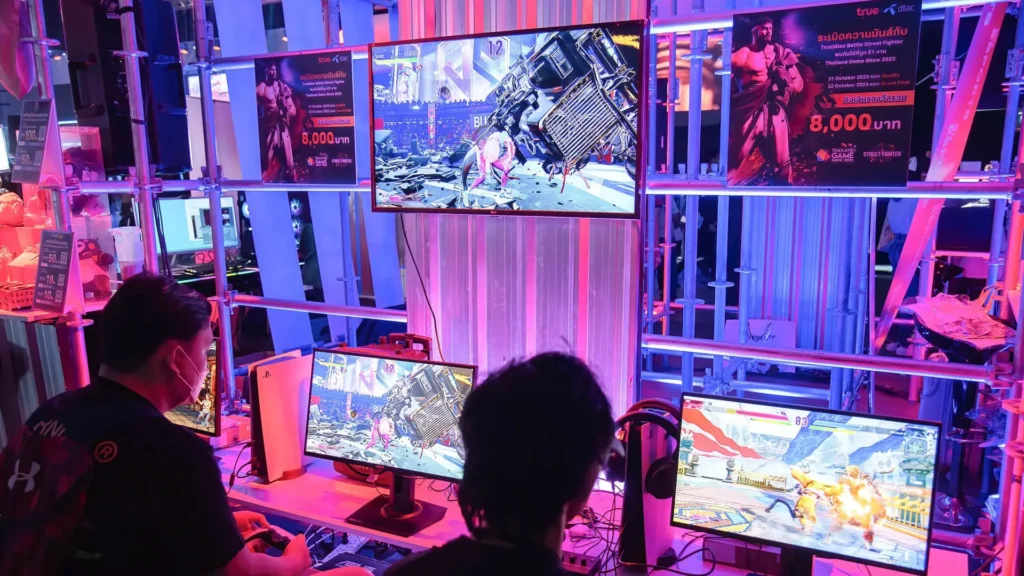
StarGrid Battle Tactics is a Street Fighter / Final Fantasy Tactics inspired Web3 game. | Credit: Peerapon Boonyakiat/SOPA Images/LightRocket via Getty Images.
Share
Key Takeaways
Street Fighter and Final Fantasy Tactics served as inspiration for StarGrid Battle Tactics.
The game prides itself on having zero NFTS, and a memecoin with little to no utility.
Players can soon wager tokens in ranked competitive matches.
In the world of Web3 gaming, your game will stand out from the crowd by meeting some very basic criteria, namely, if you make something that puts the game and its players above the crypto and non-fungible tokens (NFTs) features.
StarGrid Battle Tactics is making a bold leap into on-chain gaming with a fun, competitive, Street Fighter / Final Fantasy Tactics-inspired game.
CCN spoke with its creator, David Kong, to find out more about his game.
Great Games
The Web3 gaming industry is desperate to evolve past the years of scams, vaporware, and failed launches that have held it back from mainstream adoption for years.
“The world deserves crypto games that don’t suck. It’s fun to play good games and earn tokens,” Kong says.
StarGrid Battle Tactics creator and lifelong gamer, Kong, believes this era is coming to an end.
“I think collectively, the industry is going through a ‘great disillusionment’. There have been too many scams, too much vaporware in the past several years.”
“Crypto gaming has been one of the worst verticals in that sense. We obviously didn’t want to follow that tradition,” he adds.
To Kong and the broader gaming community, the idea that a video game should be fun is “so painfully obvious that it’s embarrassing to have to mention that in crypto.”
“Rather than another shitty NFT collection, we knew that coming to market with a real game would be a massive differentiator,”Kong notes.
Indeed, the Web3 label has become cumbersome, just as the NFT tag has become a loaded tag. Yet, just by making a fun game, StarGrid Battle Tactics has become a standout.
Tactical PVP
Kong has a storied career in gaming as a gamer. Years ago, he would travel the world and compete in Street Fighter tournaments, a fighting game franchise that would, in part, serve as inspiration for his Web3 game, StarGrid Battle Tactics.
He’s also cited another iconic title as a key influence, the turn-based tactical role-playing game (RPG) from Square Enix (then Squaresoft), Final Fantasy Tactics.
In StarGrid Battle Tactics, players pick a character to face off in a 1v1 match on a gridded arena. Similar to many top-down/isometric RPGs, rounds are spent positioning the player, building up defenses through buffs, or initiating an attack.
“The most important influence was knowing we needed a very simple game loop that also has room for complexity to naturally emerge. Even though StarGrid should be considered a somewhat “casually competitive” game, we were certainly very serious about thinking through character abilities, balance, and every edge case,” Kong says.
Kong’s lifetime of experience with Street Fighter taught him that every detail needs to be accounted for when creating competitive games.
“Players are serious about winning,” he says, “they’ll pry into every nook and cranny.”
Indeed, gamers are a very attentive and vocal community that will frequently report bugs and balancing issues. With the “Web3” label on top, gamers will likely view StarGrid with a more skeptical eye.
That said, crypto natives are into Web3 gaming, which is Kong’s target audience.
It also pays to work smarter. Kong explains that the decision to make StarGrid a turn-based game was also informed by his budget and time constraints.
If he’d gone with a real-time game with 3D physics, development time would have been more than three times longer.
“FF Tactics is my favorite turn-based game of all time, so it was natural to look there immediately,” he says.
A Splash of Crypto
But, even with all this blockchain backing it, Kong preferred to keep the crypto side of things to a minimum.
“I avoided NFTs because I think digital ownership of game assets is a bad meme. Everyone in the industry always cites Counter Strike skins and World of Warcraft.”
“I’m like, do you realize that those game assets only got value AFTER the massive success of those games? They were symptoms of success, not the cause of it.” He adds,
It also has a DAI stablecoin staking mechanism that generates revenue for the team in the form of newly minted AO tokens.
Kong wanted to avoid repeating the Axie Infinity formula, which he describes as a “dumb business model in 2025.” Furthermore, he believes creating games with “balanced” game economies is a “futile effort.”
A sustainable player ecosystem, he explains, is one where lots of players gather to enjoy the experience, not splash cash and lose their life savings speculating on the outcome of the game they’re playing.
Realistically, he believes it’ll take a few years for the game to reach a point where revenues can sustain the game. But he’s honest and says that there’s no expectation that players will play StarGrid forever. But if they like it, they’ll make a sequel.
That said, the game has a token, Space Money (MONEY), and it’s a capped supply memecoin that was airdropped to private beta players. Kong notes:
“It’s a cool token because it has (almost) no utility, and the vast majority is going straight to players.”
Just 3% of its supply goes to the team, which the team has pledged to spend on marketing and tournament prizes.
“Of course,” he admits, the token could be worth $0, so the game itself needs to be “as compelling as any non-crypto game” in order to retain players in the long haul.
“In terms of specific mechanics, we have ranked matches with high-level ranks that are hard to achieve, as well as non-NFT cosmetic alternate colors for characters that are earned by winning lots of matches,” Kong says.
But moreover, he believes the game they’ve made to be one that is simply worth playing. Hopeful, Kong says that if he’s right, the gameplay itself is the retention mechanism.
It’s not just the game itself that makes StarGrid a standout in Kong’s eyes. There’s no one foot in, one foot out with StarGrid, which Kong describes as a Web 2.5 approach.”
“Having a token in the game is not an excuse for being subpar.”
While players can stake tokens in ranked matches, he reiterates that there are no NFTs, it’s a “real” competitive game with thought-out mechanics, and it’s fully on-chain, targeting crypto natives.
The Reception
StarGrid seems to be one of the few Web3 gaming entries of 2025 that targets crypto players, without targeting their wallets.
“I don’t think normies and trad gamers are interested yet in crypto games marketing towards them, and I’m certainly not trying to win them over. At least not yet,” he says.
He believes that by expanding the stake-to-play feature across multiple chains, they can activate a massive number of users without ever selling anything.
The game trended at the top spot of PlayToEarn following its launch. Confidently, Kong believes the game chimed with players because the user experience was at a higher standard than what “anyone” may expect from an on-chain game.
“We launched with several gaming guild partners like YGG Philippines and KGen. After seeing the substance the game offers, their marketing teams were very enthusiastic about spreading the word. Very grateful to our awesome partners.”
Community is everything, and players are regularly providing Kong with feedback in the Discord and through various channels every day.
The Tech
Thanks to his work at Forward Research and the Arewave/AO ecosystem, Kong’s detailed awareness of the new tech stack gave him a greater insight that “made it obvious” they could build something very special.”
He adds that this one is done using an architecture that the broader crypto industry still “mostly” has no clue about. “They’ll all find out about it soon, though.”
StarGrid runs fully on-chain with a “never done before” tech stack on Arweave’s AO. Kong explains that the biggest challenge here was bringing together feature sets that had never been merged in AO live apps before. Kong states:
“A key example is AO’s compatibility with ECDSA wallets. Although it’s been theoretically possible since testnet, we are the first app in our ecosystem to have both MetaMask and Wander (Arweave) wallets in production, readily available to users.”
Every in-game interaction is a transaction on AO. To ensure smooth real-time gameplay, they kept the core game logic simple, with each match sending just a few hundred messages on AO across several minutes.
Without 3D physics for hit detection “or anything like that,” StarGrid is “fairly lightweight and can scale pretty hard,” meaning it’s got plenty of room to grow and evolve.
“AO is the best crypto gaming platform ever built, because 1. it is deeply integrated with uncapped data storage on Arweave, and 2. parallel execution removes bottlenecks that you have to deal with on global state chains like Ethereum,” Kong adds:
Aiming High
Boldly, Kong hopes to allow players to stake DAI and program bots to compete for them.
“This will be controversial,” he says, but the game’s design has tonnes of RNG for damage, making it highly unlikely for anyone to have a win rate above 75%, “even if you never make a mistake,” he adds.
With plans in place to begin raising funds to support the development of StarGrid and launch a mobile-optimized version.
Kong also says there’ll be new characters and battlefields. Furthermore, in the coming months, custom private matchmaking, a player-versus AI mode, and the MONEY wager match modes will to live.
If StarGrid proves successful, players can expect more games from the team to follow, which he hopes will continue to push the boundaries of on-chain gaming, minus the “scammy business models.”
Kong believes Web3 gaming verticals are in for a shock.
“We built this game with a tiny fraction of the budget of other well-known crypto games. We hope that our presence will cause them all to stop for a second, think about where they went wrong, and how they can get good.”
Eddie is a gaming and crypto writer at CCN. Covering the often weird and wonderful world of Web3 with an adoring, but skeptical eye.
Prior to CCN, Eddie has spent the past seven years working his way through the crypto, finance, and technology industry. He began with PR and journalism with Bitcoin PR Buzz and BitcoinNews.com, eventually working his way to become a copywriter with a dozen firms, including the likes of Polkadot before returning to journalism in 2023.
Having studied Radio production and journalism at University in the UK, Eddie spent a few years making podcasts and presenting on a local London radio station as he built up his writing chops.
A lifelong skateboarder, Eddie can often be found at the skatepark or touring the streets looking for something new to try. That, or kicking back playing JRPGs on his original PSP.