.
Key Takeaways
- Crypto is increasingly being treated as a mainstream asset class.
- Morgan Stanley’s shift—from calling Bitcoin potentially worthless in 2017 to launching its own low-cost Bitcoin ETF in 2026—highlights broader Wall Street acceptance.
- Bitwise CEO Hunter Horsley predicts crypto will become so mainstream it will be “uninteresting” by 2026.
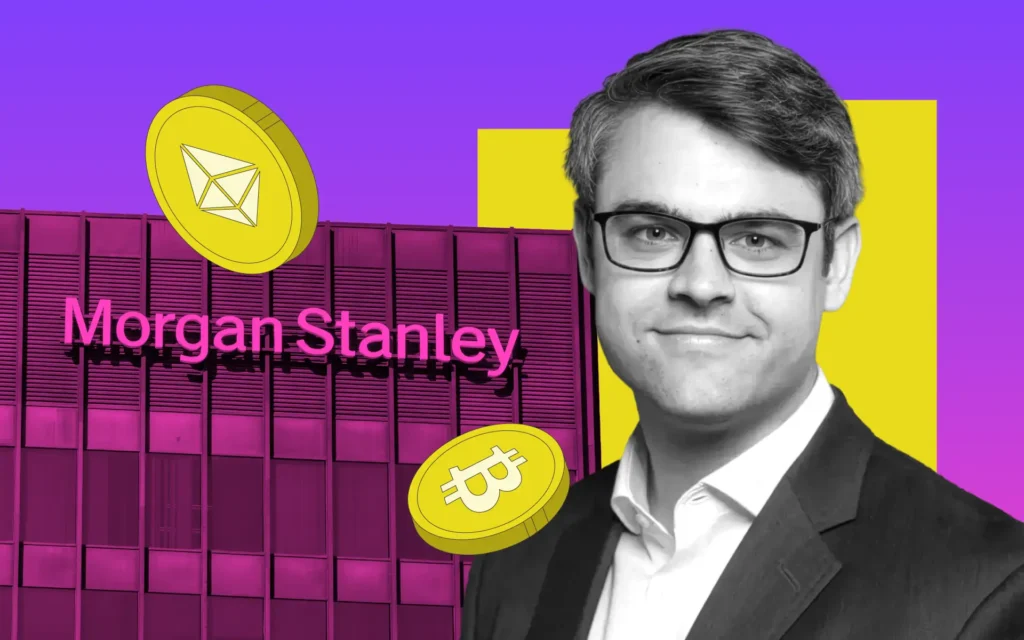
Crypto is on course to become a mainstream part of global finance by the end of 2026, Bitwise Chief Executive Hunter Horsley said, as Morgan Stanley’s growing embrace of digital assets draws attention across Wall Street.
“By the end of 2026, crypto will so obviously be a mainstream asset class, it won’t even be an interesting topic anymore,” Horsley wrote on X.
His comments came in response to ETF analyst Nate Geraci, who pointed out that Morgan Stanley Investment Management prominently features crypto-related offerings on its homepage, calling it “wild to see” a major bank leading with digital assets.
Bitwise CEO Signals Crypto Mainstream Shift
Horsley’s remarks reflect a broader narrative within the industry that crypto is moving beyond speculation toward institutional normalization.
His suggestion that the sector could become “uninteresting” argues that digital assets may eventually be treated similarly to equities or bonds.
The observation was prompted by visible changes at Morgan Stanley, where crypto products are now increasingly being positioned alongside traditional investments.
“This is a one way train,” Horsley wrote.
Morgan Stanley Deepens Crypto Push With Bitcoin ETF
The comments come as Morgan Stanley has taken a significant step into the market with the launch of its spot Bitcoin exchange-traded fund, trading under the ticker MSBT.
With an annual fee of 0.14%, the product undercuts rival offerings, including BlackRock’s iShares Bitcoin Trust.
The bank’s extensive wealth management network — including roughly 16,000 financial advisers — allows it to distribute the fund directly to clients, a factor analysts say differentiates it from earlier ETF launches.
The fund attracted around $34 million in net inflows on its first day, with more than 1.6 million shares traded, placing it among the strongest ETF debuts in the past year, according to Bloomberg Intelligence.
The launch also comes as Bitcoin ETFs recorded a return to net inflows in March, reversing several months of outflows.
Morgan Stanley’s move is also notable for its infrastructure.
The fund holds Bitcoin directly and uses a dual-custodian model involving Bank of New York Mellon for administration and Coinbase for digital asset custody.
A Long Way From Initial Pushback
The bank’s current positioning marks a sharp contrast with its earlier stance on Bitcoin.
In 2017, Morgan Stanley analyst James Faucette suggested the crypto could ultimately be worth nothing.
Talking in a note to clients, the analyst claimed the true value of Bitcoin might be $0.
“If nobody accepts the technology for payment then the value would be 0,” he wrote.
By 2021, however, then-CEO James Gorman acknowledged that while crypto was not yet a core part of the bank’s business, it was unlikely to disappear.
He said at the time that the firm was monitoring client demand and providing access through investment products rather than direct trading.
“It’s not a fad,” Gorman said.
In the years that followed, Morgan Stanley gradually shifted towards more engagement with the sector.
Between 2021 and 2023, the bank expanded its research coverage and began offering select clients access to Bitcoin-linked investment products.
That evolution accelerated after US regulators approved spot Bitcoin exchange-traded funds in 2024, allowing the bank’s wealth advisers to recommend third-party products to eligible clients.
By 2025, Morgan Stanley’s internal research was framing crypto as a key developing part of diversified portfolios.
By early 2026, Morgan Stanley had moved decisively into the space, filing to launch its own crypto investment vehicles and pursuing regulatory approval to expand custody.
Growing Signs of Crypto Going Mainstream
Morgan Stanley’s expansion into crypto reflects a wider trend across traditional financial markets.
Crypto adoption is also expanding beyond institutional portfolios into everyday commerce.
A recent PayPal-backed survey found that nearly 40% of US merchants now accept crypto payments.
The study highlighted strong consumer-driven demand, with a large majority of merchants reporting regular inquiries from customers about paying with digital assets.
Many respondents said they expect crypto payments to become commonplace within the next five years, particularly as younger consumers drive usage.
Morgan Stanley Also Flags Quantum Risk
Morgan Stanley has also entered the emerging debate over quantum computing risks, highlighting the issue in regulatory filings tied to its Bitcoin ETF.
In a March 2026 preliminary prospectus for the Morgan Stanley Bitcoin Trust, the bank cautioned that advances in computing — including quantum technology — could undermine the systems that secure Bitcoin over time.
Such a scenario, it said, could expose wallets to unauthorised access or interfere with the network’s integrity.
The disclosure is notable because it brings a largely theoretical concern into mainstream financial documentation.
Morgan Stanley is not alone in raising the issue, as other asset managers have also started to reference quantum threats in crypto-related filings — though many believe the risk remains distant.
Big Tech Signals Crypto Mainstream
Signs of crypto’s shift toward the mainstream are not limited to Wall Street.
Activity from major technology platforms are also fuelling expectations that crypto could reach a wider consumer base.
Elon Musk’s X recently sparked fresh speculation after a brief post from its head of product, Nikita Bier, hinted at potential new crypto-related developments.
“Crypto has had a rough year. Maybe we should launch something to fix it,” Bier wrote on April 14.
While the comment did not include details, users quickly began theorizing possible crypto-related services.
Many participants linked it to X’s broader push into financial services, particularly its planned “X Money” offering.
The platform, owned by Musk since 2022, has been building out payments infrastructure that includes peer-to-peer transfers and debit card functionality.
Musk has previously said the service is expected to launch across dozens of US states, with features such as instant payments and cash management tools.
If crypto functionality were to be incorporated into such a platform, it could mark another significant turning point for adoption.
Potentially embedding crypto into everyday transactions on one of the largest social media sites in the world, exposing crypto to a mainstream audience beyond traditional investors.
Analysts Say “Mainstream” Moment Already Taking Shape
Analysts say recent developments in finance and new payment systems support the view that crypto is moving firmly toward the mainstream.
Anders Bylund, a contributing crypto analyst on the Motley Fool, described early 2026 as “a monumental moment in crypto history,” adding that crypto was “going mainstream in a big way.”
He argued that deeper integration into traditional financial infrastructure is driving the shift, not headline-grabbing price moves.
“…it’s not all about ETFs,” Bylund said.
He noted that large financial institutions are embedding crypto into existing systems in ways that may go largely unnoticed by consumers.
Bylund pointed to efforts by payment networks such as Visa and Mastercard, which are incorporating stablecoins and blockchain-based systems into their operations.
“This is how technologies tend to go mainstream,” Bylund said.
Over time, he suggested, consumers may begin using blockchain-based systems without realising it.
“Someday in the future, you’ll realise that you’re using cryptocurrencies and blockchain ledgers every day,” he said.
Top Trending Crypto Articles

Kurt Robson is a London-based reporter at CCN, specialising in the fast-moving worlds of crypto and emerging technology. He began his career covering local news in Cornwall after graduating from Falmouth University with First Class Honours in Journalism. There, he cut his teeth on everything from council meetings to missing swans.
He quickly rose through the ranks to become a frontline journalist at several of the UK’s leading national newspapers. Over the years, he has interviewed musicians and celebrities, reported from courtrooms and crime scenes, and secured multiple front-page exclusives.
Following the upheaval of the COVID-19 pandemic, Kurt shifted his focus to technology journalism—just ahead of the AI boom. With a natural curiosity and a trained eye for emerging trends, he has found a new rhythm in reporting on innovation.
At CCN, Kurt's work focuses on the cutting edge of crypto, blockchain, AI, and the evolving digital world. Drawing on his background in people-first reporting and his deep interest in disruptive tech, Kurt delivers stories that are insightful, entertaining, and human-centric.