Home / News / Crypto / News / Why Is a Research Group Shorting Ethereum? Vitalik’s Father Slams Firm That Denounced Tom Lee’s ‘Misleading’ Bullish Thesis
The move has drawn criticism from members of the Ethereum ecosystem. | Source: CCN
Share
Key Takeaways
Culper Research said it has taken a short position in Ethereum.
Tom Lee’s bullish thesis challenged.
Backlash from the Ethereum community.
A research firm known for activist short reports has taken aim at Ethereum, arguing the world’s second-largest cryptocurrency is entering a “death spiral” due to flawed tokenomics and declining network fundamentals.
The claims have triggered backlash from members of the Ethereum community, including the father of co-founder Vitalik Buterin.
Try Our Recommended Crypto Exchanges
Sponsored
Disclosure
We sometimes use affiliate links in our content, when clicking on those we might receive a commission at no extra cost to you. By using this website you agree to our terms and conditions and privacy policy.
Culper Research said it had established a short position in Ethereum and published a thread on X outlining why it believes the crypto could fall further.
Culper Research said its analysis of Ethereum’s on-chain data from January 2025 through February 2026 suggests that recent growth metrics cited by bullish analysts may be misleading.
The firm argued that much of the apparent expansion in Ethereum wallet activity is driven by “address poisoning” or “wallet dusting” attacks rather than genuine user adoption.
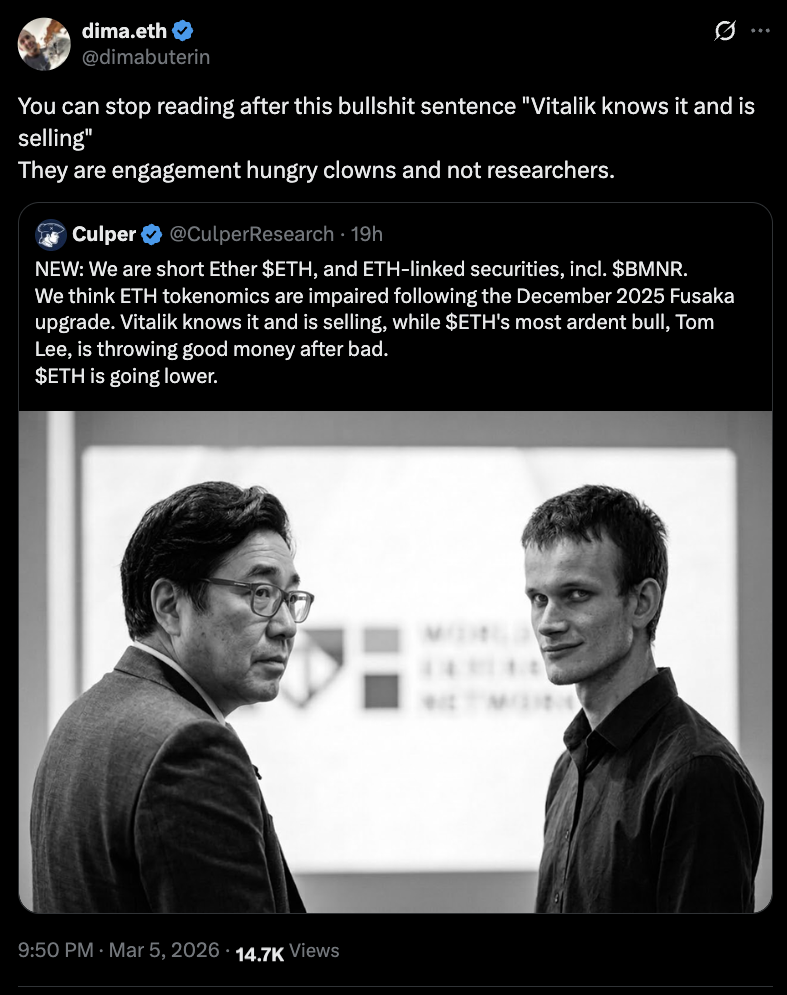
NEW: We are short Ether $ETH, and ETH-linked securities, incl. $BMNR. We think ETH tokenomics are impaired following the December 2025 Fusaka upgrade. Vitalik knows it and is selling, while $ETH's most ardent bull, Tom Lee, is throwing good money after bad.$ETH is going lower. pic.twitter.com/WQnQVJWkED
According to Culper, about 95% of growth in new wallets since the Fusaka upgrade can be attributed to newly created dusting wallets.
The group also claimed that such activity accounts for more than half of Ethereum’s transaction growth and now represents roughly 22.5% of all ETH transactions.
Gas Limits, Rival Blockchains
Culper further pointed to Ethereum’s recent gas limit increase to between 45 million and 60 million, introduced to expand layer-1 capacity after the Fusaka upgrade.
While Ethereum co-founder Vitalik Buterin and protocol researchers had estimated transaction fees would fall 10% to 30%, the firm said gas fees have instead dropped around 90%.
Lower fees, Culper said, have reduced validator revenue, claiming tips per gas are now 40% to 50% lower.
The firm also suggested Ethereum faces growing competitive pressure from rival blockchain Solana, citing faster developer growth and higher decentralized exchange trading volumes.
Culper additionally pointed to recent Ethereum sales by Buterin, noting he announced in January plans to sell 16,384 ETH to fund what he described as an “austerity period” for the ETH Foundation.
The report claims he has sold more than 19,000 ETH since then, which Culper argued reflects declining confidence in Ethereum’s token economics.
Culper Targets Tom Lee’s Bullish Ethereum Thesis
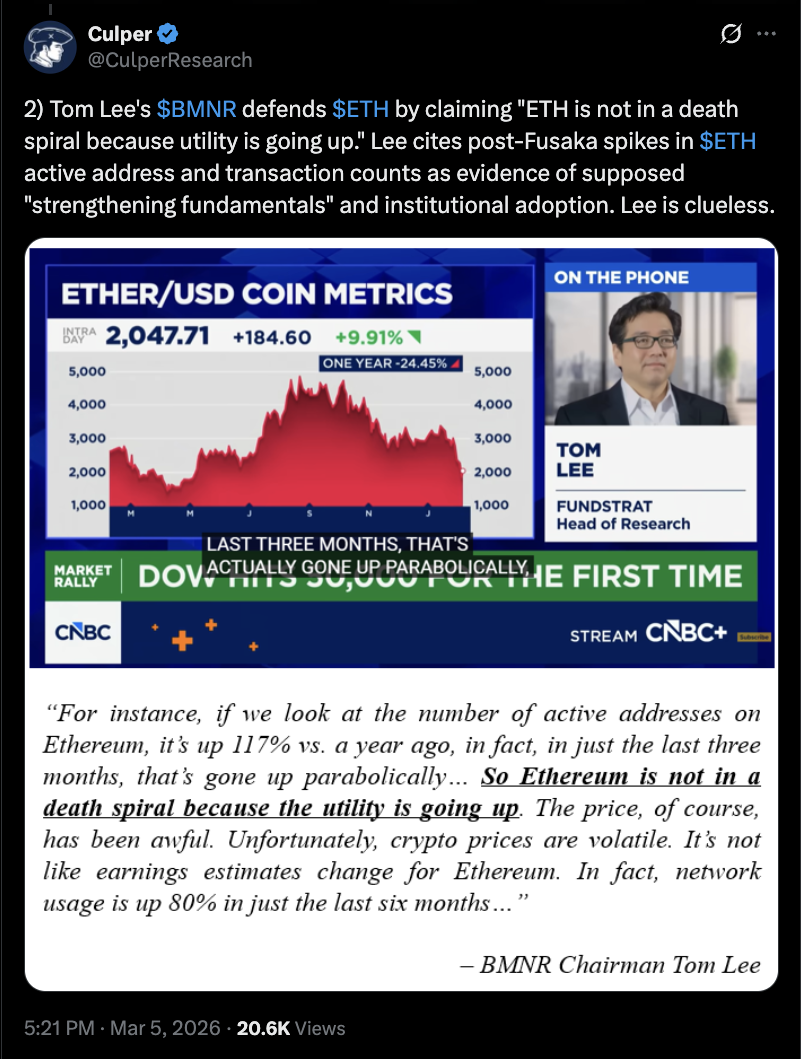
Culper Research also directed much of its criticism at Wall Street analyst Tom Lee, whose bullish outlook on Ethereum has attracted significant attention in recent months.
Lee, chairman of crypto treasury firm Bitmine, has repeatedly argued that Ethereum is entering a “supercycle” with price targets ranging from $10,000 in the near term to as much as $60,000 over the longer term.
Tom Lee came under fire | Source: (X @CulperResearch)
In its thread, Culper said the growth metrics Lee has cited as evidence of institutional adoption are misleading.
Culper also suggested Lee’s bullish thesis depends on network demand and fee dynamics that it believes are weakening.
Backlash From Ethereum Community
The report quickly drew criticism from members of the Ethereum ecosystem.
Dmitriy Buterin, father of Ethereum co-founder Vitalik Buterin, dismissed the claims in a post on X, taking particular issue with Culper’s suggestion that Vitalik’s token sales signaled a lack of confidence in the network.
Vitalik Buterin’s spoke back against the thesis | Source: X (@dimabuterin)
“You can stop reading after this bullshit sentence ‘Vitalik knows it and is selling,’” he wrote.
“They are engagement hungry clowns and not researchers,” he added.
Critics of the short thesis also argued that Ethereum’s development roadmap and continued roll-out of layer-2 scaling solutions contradict the firm’s conclusions.
Price Outlook
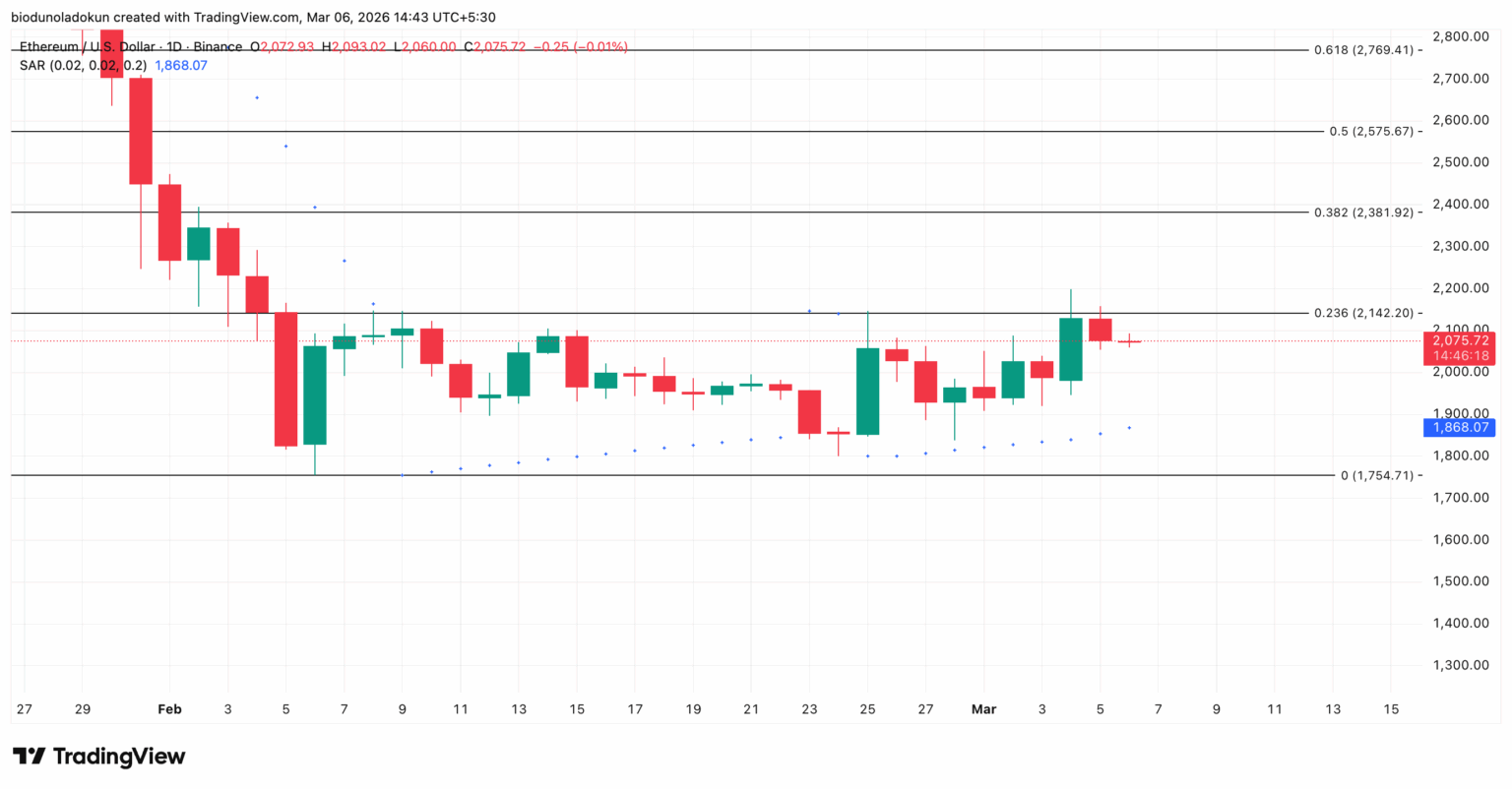
Ethereum’s price has struggled in recent weeks but technical indicators suggest it could see a near-term recovery.
According to analysis by CCN analyst Abiodun Oladokun, persistent selling pressure dominated the past month, leaving many traders transacting at a loss.
However, Oladokun said the Parabolic SAR indicator on the daily chart now shows dots below the price, a technical signal that the short-term trend may be shifting in favor of buyers.
ETH/USD Daily Chart | Credit: TradingView
If bullish momentum continues, Ethereum could break above a key resistance level around $2,142, potentially pushing the price toward $2,381, he said.
However, if Ethereum falls below the indicator’s support level near $1,868, the price could slide further to around $1,754, according to the analysis.
Ethereum is down around 8.5% over the past month and was trading around $2,044 at the time of writing.
Kurt Robson is a London-based reporter at CCN, specialising in the fast-moving worlds of crypto and emerging technology. He began his career covering local news in Cornwall after graduating from Falmouth University with First Class Honours in Journalism. There, he cut his teeth on everything from council meetings to missing swans.
He quickly rose through the ranks to become a frontline journalist at several of the UK’s leading national newspapers. Over the years, he has interviewed musicians and celebrities, reported from courtrooms and crime scenes, and secured multiple front-page exclusives.
Following the upheaval of the COVID-19 pandemic, Kurt shifted his focus to technology journalism—just ahead of the AI boom. With a natural curiosity and a trained eye for emerging trends, he has found a new rhythm in reporting on innovation.
At CCN, Kurt's work focuses on the cutting edge of crypto, blockchain, AI, and the evolving digital world. Drawing on his background in people-first reporting and his deep interest in disruptive tech, Kurt delivers stories that are insightful, entertaining, and human-centric.