Tether (USDT) Exits Revolut by August 31, Not Europe: Hadron Already Built Its Replacement
Share
Key Takeaways
MiCA’s July 1 deadline is final, forcing thousands of unlicensed crypto firms to exit the EU market.
Only about 17% of registered crypto firms have secured MiCA authorization, raising concerns about market concentration.
DeFi remains an option, but only for projects that are genuinely decentralized and outside MiCA’s scope.
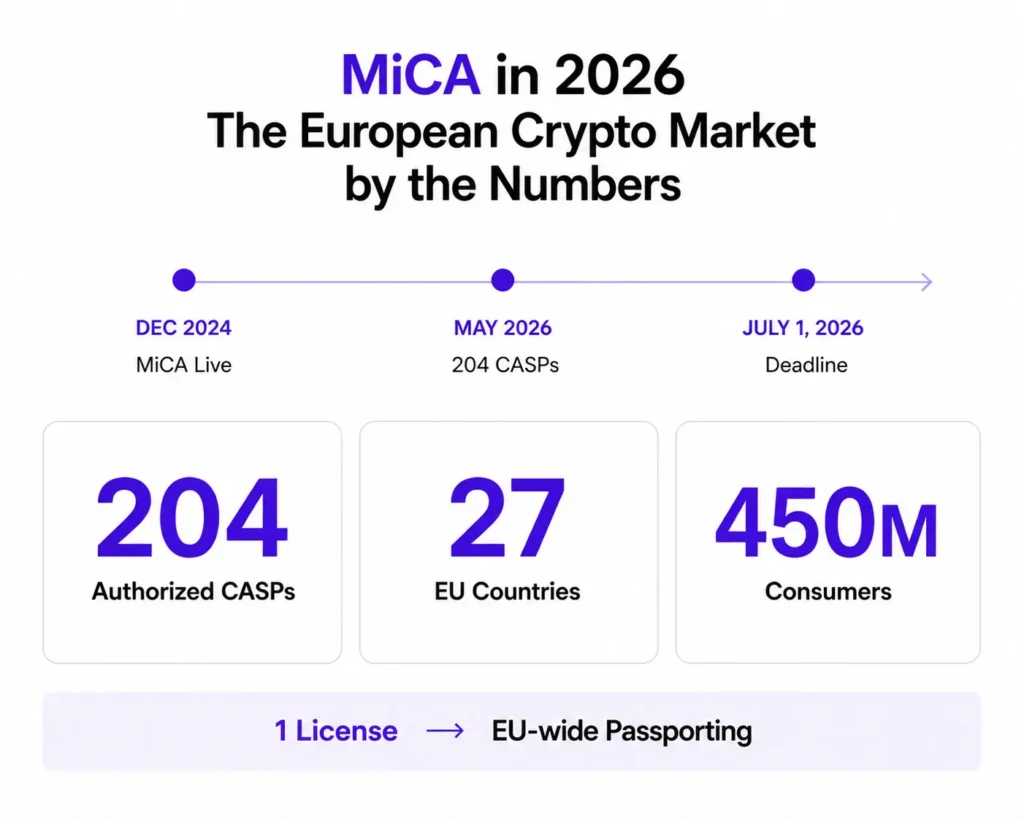
In eight days, the European Union’s crypto market will change permanently. ESMA confirmed on April 17, 2026, that the July 1 deadline is final, with no extensions.
There are an estimated 3,000 registered crypto firms across the European Union, suggesting thousands of unlicensed firms will stop serving EU customers or shut down when the deadline arrives.
The transitional period across the EU will officially expire on 1 July 2026. | Source: Lexology
Abhishek Vaidyanathan, Chief Legal Officer (CLO) at NEAR Foundation, says the numbers reflect a structural problem with MiCA’s design, not just a compliance execution failure.
The One-Size-Fits-All Problem
“The core problem with MiCA is that it takes the rulebook Europe built for banks and traditional brokers and drops it onto crypto firms with completely different business models, risk levels, and resources,” Vaidyanathan said.
A young Web3 team rarely has the capital, the legal staff, or the compliance department of an established bank. Yet, it has to meet broadly the same obligations.”
He points specifically to minimum capital requirements as a structural barrier.
“It is a flat cost just to get in the door that has little to do with how much risk the firm actually poses. Many crypto teams are globally distributed groups building open-source infrastructure, not companies holding customer funds. Forcing the rules written for a custodian onto them does not protect anyone better; it just loads cost onto people who never created the risk in the first place.”
The likely result, he argues, is market concentration. “A market dominated by the biggest, best-funded players, with real innovation pushed out of Europe.”
Tether’s USDT remains shut out of EU-regulated markets after refusing to pursue authorization, with Coinbase, Kraken, Crypto.com, and Binance all having removed or geofenced USDT for EEA users.
What July 1 Looks Like Operationally
According to Vaidyanathan, the operational impact will be immediate.
“On July 1, the grace period that allowed existing firms to keep operating under their old national licenses ends. Having a license application in progress no longer protects you. Once the window closes, an unlicensed firm has no right to serve EU customers,” Vaidyanathan noted.
In practice, he says, firms will have to block European users by location, shut down non-compliant services, and close regional accounts rapidly.
France’s AMF has warned that operating without a license after the deadline can trigger blacklisting and criminal penalties.
“Regulators take a hard line when the customer comes to us for defense,” Vaidyanathan said. “A firm that blocks the EU but still markets there cannot rely on it.”
Poland presents the most urgent case: it was among the most popular European jurisdictions for pre-MiCA crypto licensing, yet as of March 2026, local MiCA implementation legislation had not passed.
Between May 2025 and May 2026, there were 18.5 million crypto app downloads in Europe, of which 7.6 million were to exchanges that are not MiCA-authorized providers.
DeFi Exit Route and Its Limits
Vaidyanathan sees the pressure accelerating a shift toward genuinely decentralized infrastructure, but is careful about what that actually means in practice.
“MiCA does leave a door open: services run in a genuinely decentralized way, with no middleman, fall outside its scope. But that exemption is much narrower than builders hope. It disappears the moment there is an admin key, a company-run app, or a controlling group of token holders. Decentralization has to be real and built-in, not a label.”
On the corporate restructuring side, he notes teams are already rethinking jurisdictional footprints. “Teams are setting up hubs in countries that fit their model better, and keeping the core network and protocol separate from the regional companies built around it. Done right, that lets the industry keep serving a global market, and lets users keep custody of their own assets, even as Europe’s rules tighten.”
Who Is Still Standing
Major exchanges that have secured MiCA licenses include Bitvavo, Bitpanda, Kraken, Coinbase, Crypto.com, OKX, Bitstamp, and Revolut.
Binance has pursued MiCA authorization through its European operations and remains one of several large exchanges adapting its structure to the new regulatory framework, though its regulatory position continues to evolve across different EU jurisdictions.
Ten EU jurisdictions have yet to issue a single CASP authorization, according to the latest available data. The market that emerges after July 1 will be smaller, more concentrated, and governed by a single rulebook applied unevenly across 27 member states.
Vaidyanathan’s longer-term read is cautiously constructive.
“The longer-term effect of all this may be a stronger ecosystem, one that no longer depends on any single country’s license to keep running.”
Whether that outcome materializes depends on how many of the 83% of currently unlicensed firms survive the next eight days.
Disclaimer:
The information provided in this article is for informational purposes only. It is not intended to be, nor should it be construed as, financial advice. We do not make any warranties regarding the completeness, reliability, or accuracy of this information. All investments involve risk, and past performance does not guarantee future results. We recommend consulting a financial advisor before making any investment decisions.
Dr. Guneet Kaur is a senior editor at CCN.com and a Science Fellow at Exponential Science. She is a fintech and blockchain expert with extensive experience in digital finance education, blockchain ecosystems, and cryptocurrency markets. She has worked with global media such as Cointelegraph, as well as education and blockchain platforms, to design and lead strategic content and learning initiatives. As an educator and assessor for top-tier executive programs, she bridges real-world fintech trends with academic insight.
Dr. Kaur is also a published researcher and peer reviewer across fintech and data science journals, including Financial Innovation Journal and International Journal of Big Data Intelligence and Applications. Her work spans data-driven analysis, Web3 innovation, and technical content development. With a strong foundation in both industry and academia, she translates complex financial technologies into practical applications, empowering learners, professionals, and institutions across the rapidly evolving digital finance landscape.