Key Takeaways
- Symbiotic is extending staking and restaking into a broader system where capital is locked against a wider range of financial obligations.
- While crypto has abundant capital seeking yield, Symbiotic is focused on creating demand by connecting that capital to real risk transfer opportunities.
- By combining committed capital with secondary markets, Symbiotic aims to solve liquidity bottlenecks in tokenized assets.
As the crypto industry matures beyond its early yield-driven phase, infrastructure firms are racing to redefine how capital is deployed on-chain.
Symbiotic, a relatively new entrant, is betting that the next evolution lies in more efficient and flexible ways to allocate risk.
At the center of that vision is what the company calls ‘committed capital’ — a model that expands on staking and restaking by allowing assets to be locked against a broader set of financial obligations.
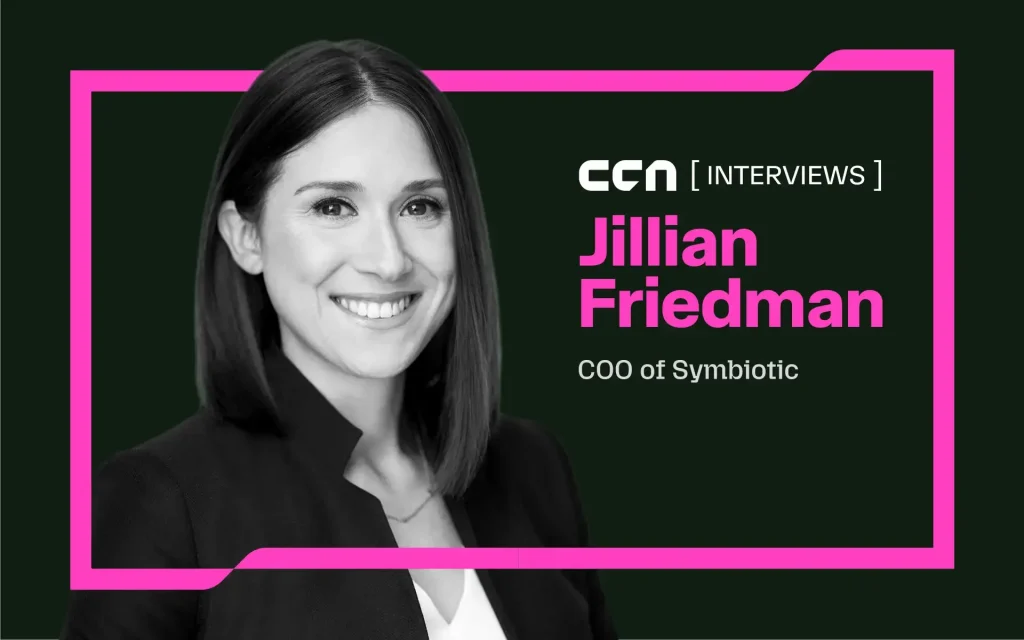
Speaking on the sidelines of Consensus 2026 with CCN, Symbiotic’s COO Jillian Friedman said the firm’s ambition is to build a full-fledged marketplace for collateral — connecting capital seeking yield with counterparties looking to offload risk.
Institutional Staking To Long-Term Infrastructure
Friedman’s path to Symbiotic reflects the broader evolution of crypto markets.
At Ether Capital, she worked at one of the earliest publicly listed Ethereum treasury firms, focusing heavily on staking as a core yield strategy.
But as the market matured, she began looking beyond basic yield generation.
Friedman said the draw to Symbiotic was its dedication towards ‘sustainable long-term value creation versus perhaps shorter-term yield opportunities.’
While high-yield experiments dominated early crypto cycles, many proved unsustainable.
Friedman said Symbiotic is deliberately building for longevity instead.
Committed Capital
Symbiotic’s core concept builds on familiar crypto primitives but extends them into a broader financial framework.
Staking, Friedman explained, is fundamentally about committing capital in exchange for yield while taking on defined risks. Restaking layers adds additional risk on top of that.
Committed capital generalizes this model.
“Committed capital is really just expanding on that idea and going beyond just use cases,” she said.
The defining feature is constraint.
“The key things with committed capital are that it’s capital that is bound to specific obligations that is not able to move or be liquidated unless those specific, predefined obligation criteria are met,” she said.
That structure allows capital to be deployed across more complex financial arrangements while maintaining enforceability through smart contracts.
Solving Liquidity Bottlenecks In Tokenized Assets
While tokenization has been widely touted as a breakthrough, Friedman said it fails to address a key limitation.
“Tokenization is great, but it doesn’t solve the problem that if you’re tokenizing something where the underlying is not liquid,” she said.
This is especially evident in tokenized funds where redemption periods can stretch for months.
To address this, Symbiotic is building infrastructure for secondary markets supported by pre-committed capital.
“Holders of RWAs that are looking to liquidate their positions can sell them on a marketplace,” she said.
Crucially, buyers can access standby capital through vaults, enabling near-instant settlement.
“The transaction and the settlement are automatic, and the capital is also earning yield elsewhere,” she said.
The result is a layered system in which liquidity, risk, and yield are interlinked, she explained.
Symbiotic’s broader goal is to create a functioning market for collateral — one that balances supply (capital) and demand (risk transfer).
“There’s a lot of capital on chain that is looking for yield,” Friedman said.
The missing piece is demand.
“Our focus is on unlocking that demand side of, well, who wants to transfer their risk to a Bitcoin vault? And what does that use case look like?” she said.
To succeed, the model depends on trust from both sides.
“The collateral depositors need to believe in what they’re underwriting, and the risk transfers need to trust that the collateral,” she said.
Curators, Vaults, and Why Not Every Asset Fits
Despite the flexibility of tokenization, Friedman stressed that not all assets are suitable for Symbiotic’s system.
“You need to have an operator of that vault and a curator [who] decides what capital is acceptable,” she said.
Curators play a critical role in selecting assets and deploying strategies — and assets without demand are effectively excluded.
“There needs to be demand on both sides,” she said.
In practice, this means a preference for assets with scale and liquidity.
“Often you want something with a huge market cap, because then there’s lots of it to deposit into the vault,” she added.
Regulatory Clarity Is Moving
Friedman said increasing regulatory clarity, particularly around staking, is reshaping the competitive landscape.
“What regulatory clarity is doing is making it so that the incumbent crypto businesses are in a much better position to succeed,” she said.
Larger firms, she noted, now have the confidence to participate more actively.
“They have the firepower, they have the resources, they have the relationships,” she said.
But uncertainty remains, especially around stablecoin yield.
“It’s really early days, I don’t even think like the ink is dry or the final text is out on what is allowed and what isn’t, and how that’s to be interpreted,” she said.
However, Friedman noted, this could represent an upside for Symbiotic’s model.
“That perhaps creates a viable path for the use of collateral markets for yield generation on stablecoins,” she said.
Navigating Global Markets
With regulatory frameworks diverging globally, from the highly contested US CLARITY Act to the EU’s MicA, Symbiotic is taking a pragmatic approach to expansion.
“We will focus on the markets where we see the most value, and where it makes sense from a risk perspective,” she said.
Ultimately, the company is betting that the future of crypto finance will be defined less by speculative yield and more by structured risk transfer.
“If we can be helpful in enabling more financial activity to happen on chain by providing this infrastructure for committed capital,” Friedman said, “that’s really where we’re focused.”
Top Trending Crypto Articles
The information provided in this article is for informational purposes only. It is not intended to be, nor should it be construed as, financial advice. We do not make any warranties regarding the completeness, reliability, or accuracy of this information. All investments involve risk, and past performance does not guarantee future results. We recommend consulting a financial advisor before making any investment decisions.

Kurt Robson is a London-based reporter at CCN, specialising in the fast-moving worlds of crypto and emerging technology. He began his career covering local news in Cornwall after graduating from Falmouth University with First Class Honours in Journalism. There, he cut his teeth on everything from council meetings to missing swans.
He quickly rose through the ranks to become a frontline journalist at several of the UK’s leading national newspapers. Over the years, he has interviewed musicians and celebrities, reported from courtrooms and crime scenes, and secured multiple front-page exclusives.
Following the upheaval of the COVID-19 pandemic, Kurt shifted his focus to technology journalism—just ahead of the AI boom. With a natural curiosity and a trained eye for emerging trends, he has found a new rhythm in reporting on innovation.
At CCN, Kurt's work focuses on the cutting edge of crypto, blockchain, AI, and the evolving digital world. Drawing on his background in people-first reporting and his deep interest in disruptive tech, Kurt delivers stories that are insightful, entertaining, and human-centric.

Max Moeller is a Chicago‑based writer and video editor passionate about games, tech, and crypto. Whether it’s crafting clear, insightful articles or piecing together engaging video retrospectives, he’s driven by curiosity and takes pride in keeping things human. Since 2017, Max has been published in a variety of notable crypto magazines.
Contact Max: [email protected], reach out on LinkedIn or Youtube.