Meet the Top 101 in Crypto
News
5 min read

Stanford Study Finds Signs of Bitcoin Market Manipulation on Polymarket, $8.2M in Profits Identified

Published 16 July 2026
Giuseppe Ciccomascolo
Authors

Key Takeaways

  • A new study identified patterns consistent with settlement-price manipulation in Polymarket’s five-minute Bitcoin prediction markets.
  • Researchers flagged 821 likely manipulators, estimating they collectively profited around $8.2 million, largely at the expense of retail participants.
  • The vulnerability stems from contracts settling at a single point in time, creating incentives to influence the underlying asset’s price.

A new academic study from researchers at Stanford University and Singapore Management University has identified evidence suggesting that traders may have manipulated Bitcoin-linked prediction markets on Polymarket, potentially generating millions of dollars in profits at the expense of retail participants.

The working paper analyzed roughly 16,000 five-minute Bitcoin prediction contracts over a two-month period and found recurring patterns of concentrated spot buying or selling on Binance in the final seconds before settlement.

According to the researchers, these trades temporarily pushed Bitcoin’s price in a direction that favored specific positions before prices quickly reverted, behavior they say is consistent with settlement-price manipulation rather than normal market activity.

While the study stops short of proving intentional misconduct or directly linking Binance traders to Polymarket accounts, the authors estimate that 821 likely manipulators earned approximately $8.2 million during the sample period, highlighting what they describe as a structural weakness in short-duration crypto prediction markets.

Try Our Recommended Crypto Exchanges
Sponsored
Disclosure
Opened in 2018
Promotions
Deposit $100, Get an Extra $300 in GOLD!
Coins
Shiba Inu Bitcoin PAX Gold Ampleforth Ethereum +70
Promotions
Receive up to $100,000 worth of exclusive gifts for newcomers upon registration.
Coins
Bitcoin Ethereum Tether USD Coin Solana +76
Opened in 2017
Promotions
Experience a 1-minute swap on a non-custodial platform.
Coins
Bitcoin Ethereum Tether Build'N'Build USD Coin +217
Show More

Researchers Identify Vulnerability in Five-Minute Bitcoin Markets

The study argues that financial prediction markets differ fundamentally from markets covering elections or sporting events because participants can trade the underlying asset that determines the outcome of the contract.

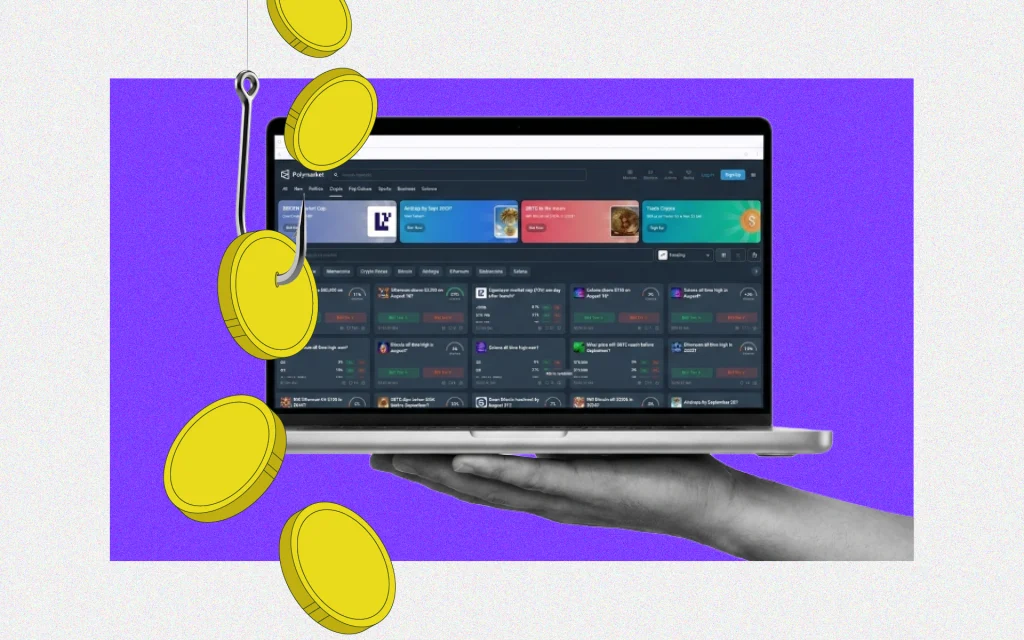
Polymarket’s five-minute Bitcoin contracts ask users to predict whether BTC will finish above or below a predetermined price at the end of each trading window.

Settlement relies on Chainlink price feeds that reference Bitcoin’s spot price at a specific point in time.

According to the researchers, that design creates an incentive for traders with sufficiently large positions to influence the underlying spot market shortly before settlement.

The analysis found that Binance order flow during the most suspicious settlement windows reached approximately 3.9 times normal levels.

These bursts of directional buying or selling occurred primarily during overnight hours and weekends, when thinner liquidity makes it easier for relatively modest trades to move prices.

Although Polymarket aggregates prices from multiple independent oracle providers, the researchers found that the platform’s settlement price roughly matched Binance’s direction 85% of the time during the period studied, making the exchange’s activity particularly influential.

Study Estimates $8.2M in Profits From Suspected Manipulation

Based on their statistical analysis, the researchers identified 821 traders whose activity matched the patterns associated with settlement manipulation.

Collectively, those participants generated an estimated $8.2 million in profits over the two-month sample period, with retail traders absorbing most of the losses.

The paper emphasizes, however, that the findings remain circumstantial.

Researchers did not establish that the Binance accounts executing spot trades were the same entities controlling the Polymarket positions that ultimately profited from the contracts.

Elton Shehdula, head of research at blockchain analytics firm Allium, described the trading pattern as credible while noting that the missing connection between exchange traders and prediction-market wallets remains the study’s biggest unanswered question.

Rather than accusing specific actors of market manipulation, the authors argue that the contract structure itself creates incentives for traders to exploit settlement mechanics whenever the potential payoff exceeds the cost of briefly moving Bitcoin’s spot price.

Longer Settlement Windows Could Reduce Manipulation Risk

One of the study’s most significant findings is that extending contract duration appears to eliminate much of the suspected manipulation.

Researchers found little evidence of similar trading behavior in Polymarket’s 15-minute Bitcoin contracts, suggesting that longer settlement windows make it significantly more expensive and difficult to profitably influence prices.

The authors also recommend replacing single-point settlement prices with time-weighted average prices (TWAP), which would reduce the impact of short-lived price spikes during the final seconds before contract expiration.

Polymarket said it plans to migrate some markets to settlement methods that use prices averaged over longer periods rather than a single timestamp.

The company added that it already uses multiple independent pricing oracles to improve settlement accuracy.

Binance said it maintains market surveillance and anti-manipulation systems on its own exchange but noted that it cannot control how third-party platforms design their settlement mechanisms.

The findings arrive as prediction markets continue expanding beyond cryptocurrency. Cboe has already launched prediction products tied to the S&P 500, while Nasdaq has sought regulatory approval for similar contracts.

According to the researchers, the vulnerability identified in the study is not unique to crypto markets but applies to any prediction market where participants can trade the underlying asset used to determine the outcome, making settlement design an increasingly important issue as the sector moves toward mainstream finance.

Disclaimer: The information provided in this article is for informational purposes only. It is not intended to be, nor should it be construed as, financial advice. We do not make any warranties regarding the completeness, reliability, or accuracy of this information. All investments involve risk, and past performance does not guarantee future results. We recommend consulting a financial advisor before making any investment decisions.
Giuseppe Ciccomascolo

Giuseppe Ciccomascolo began his career as an investigative journalist in Italy, where he contributed to both local and national newspapers, focusing on various financial sectors.

Upon relocating to London, he worked as an analyst for Fitch's CapitalStructure and later as a Senior Reporter for Alliance News. In 2017, Giuseppe transitioned to covering cryptocurrency-related news, producing documentaries and articles on Bitcoin and other emerging digital currencies. He also played a pivotal role in establishing the academy for a cryptocurrency exchange website. Crypto remained his primary area of interest throughout his tenure as a writer for ThirdFloor.

Related

Survey Icon
Help us improve
1 of 4
Is this your first time here?
What brought you here today?
What are you most interested in?
Would you be interested in:
Thank you icon
Thank you for your feedback!
DMCA.com Protection Status