Key Takeaways
- Matthew Graham warns that “AI psychosis” is real as people form unhealthy emotional bonds with digital companions.
- Graham says blockchain could safeguard intimate data and restore user sovereignty.
- The founder said the ethical burden rests on how society chooses to steer it.
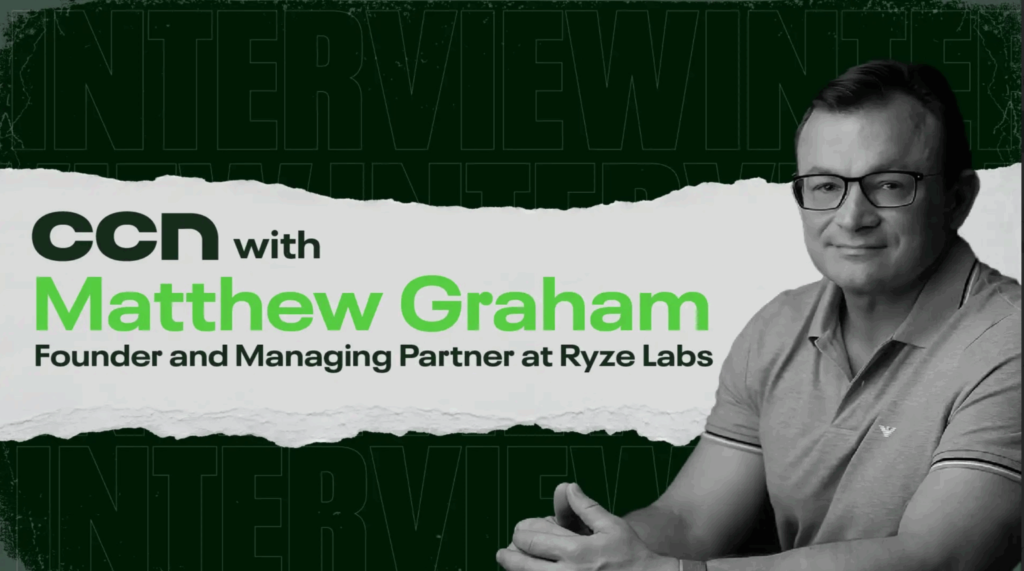
At Token 2049 in Singapore, Matthew Graham, founder of Ryze Labs, delivered one of the event’s most provocative keynotes: a vision of a world where every human has a digital twin, an AI version of themselves that can think and even feel like them.
In an interview with CCN fresh from that keynote, Graham explored the complex future of living with that technology.
As AI continues to enter our lives in completely unexpected ways, with Sam Altman even recently announcing that OpenAI will allow erotica soon, how can society balance the emotional boundaries and ethics when intertwining so closely with technology?
A New Kind of Relationship With Machines
Graham believes the human factor is infiltrating AI and that people are already relating to language models as if they were sentient.
“Have you ever found yourself saying please or thank you to Google?” he asked.
“Probably not, right? But you may have, and I think many people have, found themselves communicating to LLMs … in a way that is highly personal.”
For Graham, that subtle politeness signals something deeper: a shift in how humans see and speak to technology.
“It’s a fundamentally different way that we’re interacting with technology, which I find super fascinating,” he said.
The Ryze of the Digital Twin
Beyond politeness, Graham is exploring what happens when those interactions evolve into extensions of self.
Ryze Labs has been experimenting with “digital twins,” AI versions of individuals capable of holding conversations and managing aspects of their digital lives.
“What we’re talking about is extending humans into the digital realm, an extension of ourselves, a digital twin of ourselves with us being the analog twin,” he said.
Graham describes a near-term world in which a person’s twin could field questions from colleagues, comfort a parent, or schedule meetings while its human counterpart sleeps.
“Your away message is your digital twin,” he said. “It’ll kind of feel like me. It’ll have my personality.”
To make the concept tangible, Graham has even named his own digital twin “Marty,” a joking nod to common typos of his name.
Yet the exercise reflects serious thinking about identity and control in the age of AI.
Ethics, Emotion and Addiction
The founder views technology as “fundamentally amoral — not moral, not immoral, but amoral — having no moral characteristics until applied.”
Still, he warns that the psychological effects of constant AI interaction could be profound.
“I firmly believe AI psychosis is a real thing,” he said, citing early examples of people forming unhealthy emotional attachments to large language models.
“We’re already seeing both the extraordinary and the really quite dangerous.”
Graham likens the coming wave of AI dependence to humanity’s fixation on smartphones and social media.
“We’re also addicted to our phones,” he said. “AI will be no different — a double-edged sword.”
Privacy and Sovereignty
On privacy, Graham remained blunt, stating most users underestimate how much they’ve already shared.
“Sam Altman has my nudes basically,” he joked. “It’s not ideal, but if I’m being honest, he does.”
Behind the humor, however, a serious warning lay underneath.
“The stakes from a privacy perspective have never been higher,” he said.
That warning takes on new weight as OpenAI prepares to allow erotic content on its platform, a decision that blurs the boundary between human intimacy and digital companionship.
If large language models are soon to host or simulate erotic interaction, the question of who owns and secures those data becomes far more pressing.
Graham believes blockchain technology offers one path forward: encrypting personal data and giving individuals ownership of their digital twins.
“This is again a crypto story,” he said. “All these privacy protections can be on-chain and immutable.”
For him, the convergence of AI and crypto isn’t just technical; it’s a matter of autonomy in an era where digital intimacy may soon be mediated and monetized by machines.
When AI Meets Crypto
That crossover between AI and blockchain is where Ryze Labs is betting big.
“We are extremely focused at the intersection of AI and crypto,” Graham said.
He pointed to Amiko, a startup backed by Ryze Labs, which recently pivoted toward digital-twin technology and “AI social” experiences.
“They are squarely focused on digital twins and AI companions,” he said. “I think it has potential to be a smash hit.”
Despite the risks, Graham remains cautiously optimistic.
“Technology has ripped apart the fabric of society in a lot of ways,” he said. “But it can be extremely helpful to solving many of these problems as well.”
He returns to his central premise, that technology itself is neutral, but humans are not.
“It’s really up to us to steer the ship,” he said. “Technology is amoral. That’s my fundamental view.”
Top Trending Crypto Articles

Kurt Robson is a London-based reporter at CCN, specialising in the fast-moving worlds of crypto and emerging technology. He began his career covering local news in Cornwall after graduating from Falmouth University with First Class Honours in Journalism. There, he cut his teeth on everything from council meetings to missing swans.
He quickly rose through the ranks to become a frontline journalist at several of the UK’s leading national newspapers. Over the years, he has interviewed musicians and celebrities, reported from courtrooms and crime scenes, and secured multiple front-page exclusives.
Following the upheaval of the COVID-19 pandemic, Kurt shifted his focus to technology journalism—just ahead of the AI boom. With a natural curiosity and a trained eye for emerging trends, he has found a new rhythm in reporting on innovation.
At CCN, Kurt's work focuses on the cutting edge of crypto, blockchain, AI, and the evolving digital world. Drawing on his background in people-first reporting and his deep interest in disruptive tech, Kurt delivers stories that are insightful, entertaining, and human-centric.