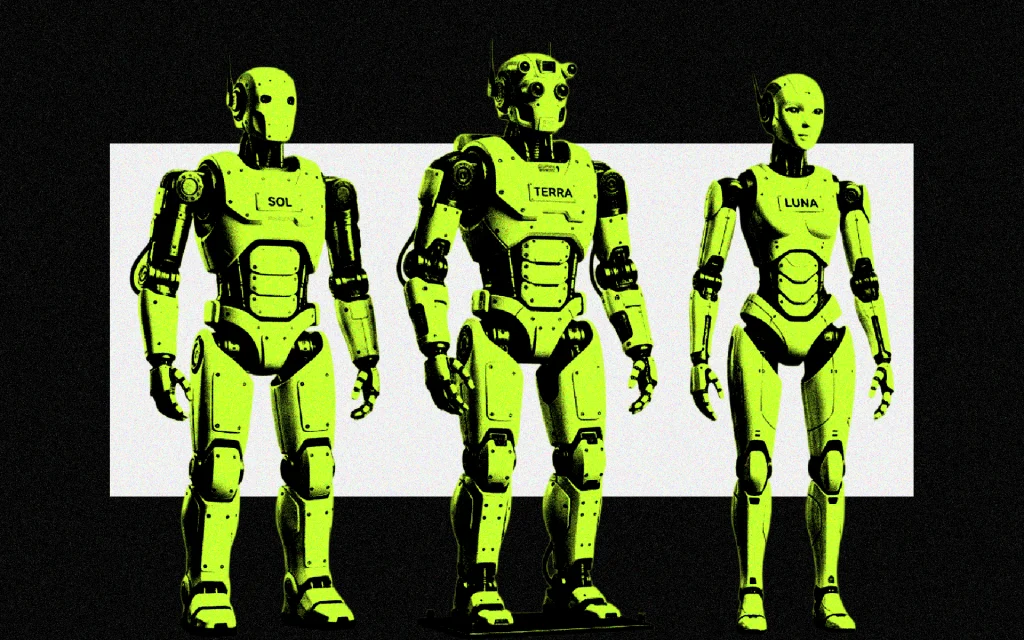
GPT-5.6 Is Here: OpenAI Names Its New AI Models Sol, Terra and Luna
Share
Key Takeaways
OpenAI launches GPT-5.6 Sol, Terra, and Luna, with broader ChatGPT and API access coming in the coming weeks.
The preview is limited to trusted partners, with no public waitlist or ChatGPT access yet.
Solana mocked the launch with “Sam Altcoinman,” a viral jab at OpenAI CEO Sam Altman.
OpenAI launched the GPT-5.6 model family on June 26, introducing three tiers under names that, intentionally or not, landed squarely in crypto cultural territory.
GPT-5.6 Sol is the flagship, described as the most capable model in the family, priced at $5 per million input tokens and $30 per million output tokens. GPT-5.6 Terra is the mid-range option at $2.50 input and $15 output. GPT-5.6 Luna is the fastest and most cost-efficient at $1 input and $6 output.
Introducing a limited preview of GPT-5.6 Sol, our next generation frontier model, as well as GPT-5.6 Terra, a balanced model for efficient, everyday work, and GPT-5.6 Luna, a fast and affordable model for high-volume work.https://t.co/OoM83SyISN
The family targets software engineering, computer use, professional knowledge work, scientific research, and cybersecurity. Access during the preview period runs through the OpenAI API and Codex, limited to a small group of trusted partners and organizations whose participation was shared with the US government before the preview launched.
ChatGPT does not get access during the preview. General availability across ChatGPT, Codex, and the API is planned for the coming weeks with no confirmed date.
The pricing structure introduces a new caching model. Cache writes are billed at 1.25 times the uncached input rate. Cache reads receive a 90% discount. A 30-minute minimum cache life and explicit cache breakpoints make the economics more predictable for high-volume enterprise deployments than prior OpenAI models.
Solana’s Two-Word Joke Stole the Spotlight
Before most people had finished reading OpenAI’s announcement, the crypto community had already found its favorite moment.
Solana’s official X account responded with just two words: “Sam Altcoinman.”
Solana’s response to OpenAI’s new models, Sol, Terra, Luna | Source: @solana on X.
The joke landed instantly.
“SOL” is the ticker of Solana’s native token, while Terra and Luna are inseparable from the collapse of the Terra ecosystem in 2022, one of the biggest failures in crypto history. The implosion wiped out roughly $40 billion in market value and helped trigger a broader contagion that contributed to the bankruptcies of Celsius, Three Arrows Capital, and Voyager.
OpenAI almost certainly chose the names for their astronomical meaning: the Sun, Earth, and Moon. But to anyone in crypto, they carry a very different association.
The government coordination angle that nobody else is highlighting
The detail in OpenAI’s launch documentation that has received the least attention is also the most structurally significant. The preview was deliberately sequenced in coordination with the US government, specifically to allow a trusted partner cohort to access the models before broader public release, giving government stakeholders time to assess capabilities in dual-use areas before general availability.
The documentation explicitly states that requests in biological and cybersecurity work may trigger real-time safety checks that slow or block responses, and that layered safeguards run at both the model level and the infrastructure level.
This is the most direct public acknowledgment to date that OpenAI’s frontier models are being previewed in a framework that treats national security screening as a prerequisite for public launch rather than a concurrent process.
For crypto and Web3 developers, the launch raises a broader question than model performance. GPT-5.6 is debuting through a tightly controlled rollout, first to a small group of government-coordinated trusted partners before expanding more widely. That approach stands in sharp contrast to the permissionless ethos that underpins much of the crypto industry.
Whether GPT-5.6 Sol eventually powers onchain AI agents, DeFi automation, trading systems, or oracle infrastructure will depend not only on OpenAI’s rollout timeline, but also on whether developers building open networks embrace software released through a controlled access model.
Solana summed up the moment with two words: “Sam Altcoinman.” Behind the joke was a broader point about the growing intersection of AI and crypto.
Disclaimer:
The information provided in this article is for informational purposes only. It is not intended to be, nor should it be construed as, financial advice. We do not make any warranties regarding the completeness, reliability, or accuracy of this information. All investments involve risk, and past performance does not guarantee future results. We recommend consulting a financial advisor before making any investment decisions.
Dr. Guneet Kaur is a senior editor at CCN.com and a Science Fellow at Exponential Science. She is a fintech and blockchain expert with extensive experience in digital finance education, blockchain ecosystems, and cryptocurrency markets. She has worked with global media such as Cointelegraph, as well as education and blockchain platforms, to design and lead strategic content and learning initiatives. As an educator and assessor for top-tier executive programs, she bridges real-world fintech trends with academic insight.
Dr. Kaur is also a published researcher and peer reviewer across fintech and data science journals, including Financial Innovation Journal and International Journal of Big Data Intelligence and Applications. Her work spans data-driven analysis, Web3 innovation, and technical content development. With a strong foundation in both industry and academia, she translates complex financial technologies into practical applications, empowering learners, professionals, and institutions across the rapidly evolving digital finance landscape.