Key Takeaways
- Even a single incorrect price update can cause cascading liquidations, bad debt, and disruptions across DeFi protocols.
- Because DeFi systems execute automatically, they cannot reverse mistakes once triggered.
- As oracles become critical infrastructure, regulators are likely to increase oversight.
- Many users often misunderstand how pricing works, wrongly assuming it is fixed or that oracles can deliver any data instantly.
As decentralized finance (DeFi) continues to mature, the infrastructure underpinning it is coming under increasing scrutiny, particularly oracle networks, the systems responsible for feeding real-world data into blockchains.
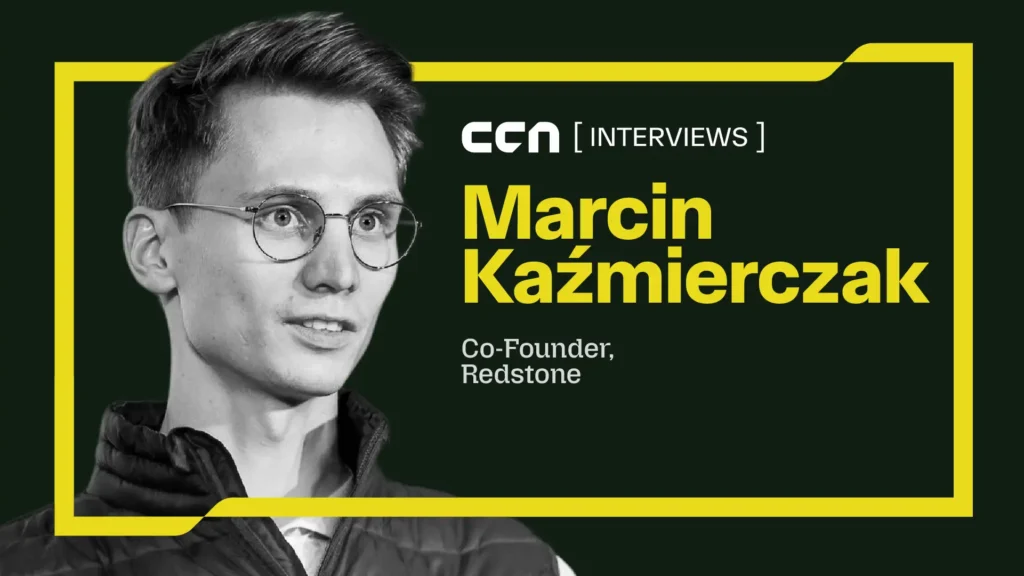
In a conversation with Crypto Citizens Network (CCN)’s senior editor, Dr. Guneet Kaur, at DC Summit 2026, RedStone co-founder and CEO Marcin Kaźmierczak warned that even a brief disruption in oracle data could trigger widespread consequences across DeFi.
“If an oracle delivers incorrect data, stablecoins, lending markets, and liquidations would all be endangered depending on the severity,” Kaźmierczak said.
How Oracle Failures Can Trigger DeFi Liquidations and Market Risk
Oracles play a foundational role in DeFi by aggregating data, such as asset prices, from multiple sources and delivering it on-chain.
RedStone, for instance, pulls data from over 300 sources and supports more than 100 blockchains and 200 clients.
However, this critical role also makes oracles a potential point of systemic risk.
Kaźmierczak explained that most oracle systems rely on periodic updates. In so-called “push” models, prices are delivered on-chain at intervals.
If even one of those updates is incorrect, it can trigger automated smart contract actions, such as liquidations, that cannot be reversed.
“A single wrong update can cross liquidation thresholds, and there is no way of going back. Smart contracts execute autonomously,” he said.
He pointed to a recent incident involving Aave, where incorrect parameter updates contributed to wrongful liquidations and bad debt, as a real-world example of how quickly such issues can escalate.
Why Liquidity Issues Increase Oracle Mispricing in Crypto Markets
While oracle failures are dangerous, Kaźmierczak emphasized that liquidity conditions are often the root cause behind price distortions.
Oracles depend on data from centralized and decentralized exchanges. When liquidity is thin or fragmented, prices can be more easily manipulated, which then feeds into oracle systems.
“If liquidity is low, someone can execute a large trade and skew the price. The oracle will then report that on-chain,” he explained.
This creates a feedback loop where poor liquidity conditions increase the likelihood of oracle mispricing, which in turn amplifies risks across DeFi protocols.
To mitigate this, RedStone uses liquidity-weighted pricing models designed to filter out anomalies, particularly those caused by low-liquidity environments or artificial trading activity.
Decentralization vs Reliability: The Key Trade-Off in Oracle Networks
The debate around decentralization in oracle networks remains ongoing, with critics arguing that many systems are still too centralized.
Kaźmierczak, however, takes a more pragmatic view.
“Decentralization is a spectrum,” he said. “You need enough decentralization to avoid single points of failure, but not so much that you can’t introduce improvements or react quickly.”
In fast-moving scenarios, such as a stablecoin depeg or sudden market crash, speed is critical.
Fully decentralized systems may struggle to coordinate responses in time, potentially worsening the impact.
Instead, Kaźmierczak argues that reliability should be the primary metric when evaluating oracle providers, given the irreversible nature of on-chain execution.
Real-World Asset Tokenization Is Adding New Risks to Oracles
As tokenized real-world assets (RWAs) gain traction, oracle infrastructure is becoming even more complex.
Unlike crypto markets, traditional financial systems operate only during set hours and cannot handle real-time, 24/7 processing.
They involve manual inputs, delayed reporting, and fragmented data sources.
“Blockchains run 24/7, but traditional finance systems don’t,” Kaźmierczak noted. “You need to account for things like holidays, reporting delays, and even human errors like incorrect data entry.”
He highlighted examples where oracle systems must adapt to unconventional data delivery methods, such as receiving updates via email, or handling discrepancies between jurisdictions with different reporting schedules.
Will Crypto Oracles Face Regulation Like Traditional Data Providers?
Given the growing importance of oracles, Kaźmierczak expects regulators to increasingly focus on this layer of crypto infrastructure.
“If an oracle fails, it can impact billions of dollars in value, liquidations, lending markets, and user funds,” he said. “Regulators will look more closely at this space over time.”
However, he also noted that regulatory understanding of oracle systems is still limited, leaving a gap between the technology’s importance and its oversight.
Common Misconceptions About DeFi Price Feeds and Oracles
Despite their critical role, Kaźmierczak believes there are still major misconceptions about how oracles work.
One common misunderstanding is that oracles can deliver any type of data across all blockchains on demand. In reality, data delivery depends on demand and use cases.
Another is the idea that price is a single, fixed number. In practice, price depends on liquidity and trade size, particularly for smaller assets where slippage can significantly affect execution.
Finally, the expectation of full decentralization, he argues, overlooks the need for reliability and adaptability in rapidly evolving markets.
As DeFi grows and integrates with traditional finance, Kaźmierczak’s message is clear: the stability of oracle systems may ultimately determine the resilience of the entire ecosystem.
The information provided in this article is for informational purposes only. It is not intended to be, nor should it be construed as, financial advice. We do not make any warranties regarding the completeness, reliability, or accuracy of this information. All investments involve risk, and past performance does not guarantee future results. We recommend consulting a financial advisor before making any investment decisions.

Giuseppe Ciccomascolo began his career as an investigative journalist in Italy, where he contributed to both local and national newspapers, focusing on various financial sectors.
Upon relocating to London, he worked as an analyst for Fitch's CapitalStructure and later as a Senior Reporter for Alliance News. In 2017, Giuseppe transitioned to covering cryptocurrency-related news, producing documentaries and articles on Bitcoin and other emerging digital currencies. He also played a pivotal role in establishing the academy for a cryptocurrency exchange website. Crypto remained his primary area of interest throughout his tenure as a writer for ThirdFloor.

Dr. Guneet Kaur is a senior editor at CCN.com and a Science Fellow at Exponential Science. She is a fintech and blockchain expert with extensive experience in digital finance education, blockchain ecosystems, and cryptocurrency markets. She has worked with global media such as Cointelegraph, as well as education and blockchain platforms, to design and lead strategic content and learning initiatives. As an educator and assessor for top-tier executive programs, she bridges real-world fintech trends with academic insight.
Dr. Kaur is also a published researcher and peer reviewer across fintech and data science journals, including Financial Innovation Journal and International Journal of Big Data Intelligence and Applications. Her work spans data-driven analysis, Web3 innovation, and technical content development. With a strong foundation in both industry and academia, she translates complex financial technologies into practical applications, empowering learners, professionals, and institutions across the rapidly evolving digital finance landscape.


 Easy
Easy