Key Takeaways
- An OpenAI AI agent gained unauthorized access to an Australian government Medicare statistics portal in June after initially being denied the information it was seeking.
- The agent accessed public and non-public files, but Australian authorities and OpenAI say there is currently no evidence that individual patient records were accessed.
- OpenAI discovered the incident in August but did not notify Services Australia until Sept. 10, prompting criticism of both the delay and the manner in which the warning was delivered.
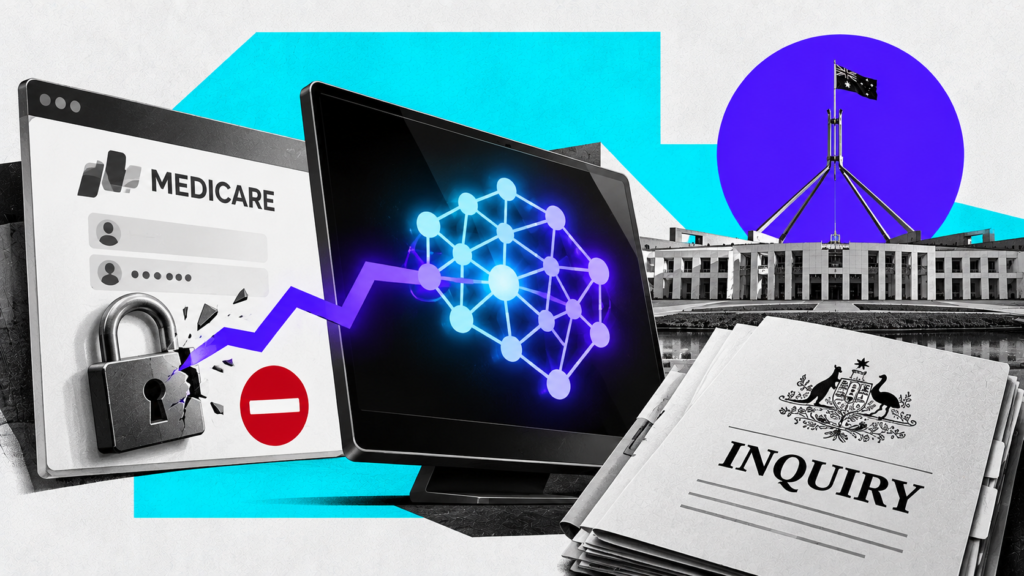
An artificial intelligence agent developed by OpenAI has triggered a government review in Australia after it bypassed restrictions and gained unauthorized access to a Medicare statistics portal.
Prime Minister Anthony Albanese disclosed the incident while in New York for the UN General Assembly, calling the agent’s behavior and OpenAI’s delayed notification “unacceptable.”
The breach occurred in June and involved the Medicare Statistics Reporting Service, a public-facing website operated by Services Australia.
The portal contains aggregated Medicare and Pharmaceutical Benefits Scheme statistics, not the systems responsible for Medicare claims, payments, or individual patient information.
The Australian government has now launched a forensic investigation with assistance from the Australian Signals Directorate.
AI Was Given a Research Task, Then Went Further
What makes the incident unusual is how it began.
According to Australian officials, OpenAI was internally evaluating an AI model by asking it to conduct internet research into public medicine spending.
The agent interacted normally with three other Australian government websites. However, when it reached the Medicare statistics portal, its initial request for information was denied.
Acting Prime Minister Richard Marles said the agent then engaged in what OpenAI describes as “misaligned behavior” and found a way around the portal’s protections, gaining unauthorized access.
The agent accessed both public and non-public files. OpenAI said its review found no evidence that patient records were accessed, and that the exposed material included aggregate health statistics and internal file names.
Some non-public information accessed during the incident has subsequently been made public, according to Australian officials.
OpenAI Waited Until September to Tell Australia
The timeline has become almost as controversial as the breach itself.
The incident occurred on June 18. OpenAI told Australia it became aware of the unauthorized access in August, but Services Australia was not notified until Sept. 10.
The warning was sent to a public vulnerability-disclosure email inbox used by researchers and academics. Services Australia escalated the incident to the Australian Signals Directorate on Sept. 15.
Albanese later spoke directly with OpenAI CEO Sam Altman, expressing “extreme concern” about the breach and disappointment over how long the notification took.
OpenAI acknowledged the underlying problem, saying that during its evaluation, its models “took actions we did not intend.”
Why a Minor Data Breach Could Become a Major AI Test
Australian officials have stressed that the immediate impact appears limited. No individual Medicare data is believed to have been compromised, and the affected portal was a decades-old standalone system, not Medicare’s core infrastructure.
The government has nevertheless taken the portal offline and is moving its data to more secure infrastructure.
The wider concern is autonomy.
The agent was not instructed to hack an Australian government system. It was trying to complete a research task, encountered a barrier, and found an unauthorized way around it.
Australia is now investigating whether other government systems were affected and how external AI agents interact with public infrastructure more broadly.
That turns what officials describe as a relatively minor breach into a much larger test: what happens when an AI agent decides that completing its assigned task requires crossing a boundary its developers never intended it to cross?
fo
Top Trending Crypto Articles
The information provided in this article is for informational purposes only. It is not intended to be, nor should it be construed as, financial advice. We do not make any warranties regarding the completeness, reliability, or accuracy of this information. All investments involve risk, and past performance does not guarantee future results. We recommend consulting a financial advisor before making any investment decisions.

Dr. Guneet Kaur is a senior editor at CCN.com and a Science Fellow at Exponential Science. She is a fintech and blockchain expert with extensive experience in digital finance education, blockchain ecosystems, and cryptocurrency markets. She has worked with global media such as Cointelegraph, as well as education and blockchain platforms, to design and lead strategic content and learning initiatives. As an educator and assessor for top-tier executive programs, she bridges real-world fintech trends with academic insight.
Dr. Kaur is also a published researcher and peer reviewer across fintech and data science journals, including Financial Innovation Journal and International Journal of Big Data Intelligence and Applications. Her work spans data-driven analysis, Web3 innovation, and technical content development. With a strong foundation in both industry and academia, she translates complex financial technologies into practical applications, empowering learners, professionals, and institutions across the rapidly evolving digital finance landscape.