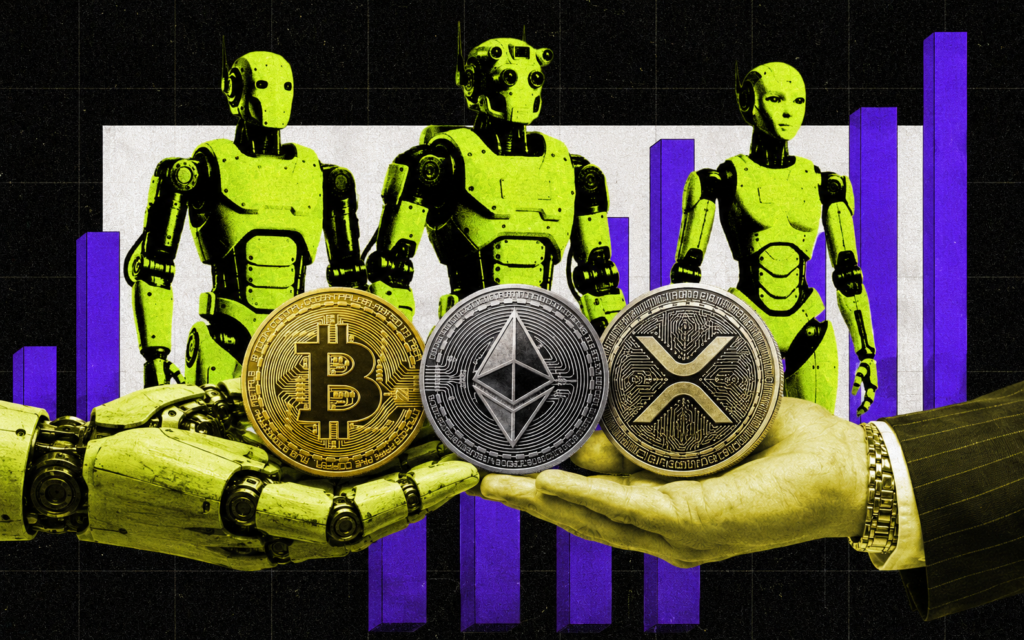
OpenAI’s GPT-6 Astra revives debate over whether AI agents could help drive Bitcoin to $1M, Ethereum to $250K and XRP to $750.
Share
Key Takeaways
OpenAI says GPT-6 Astra can navigate computers, browse the web, and complete complex multistage assignments with less human involvement.
Crypto trader Ansem expects more than 10 new protocols to surpass $1 billion within 12–18 months, helped by improving AI models.
Tom Lee’s most bullish Ethereum calls could rest on AI agents creating a new machine-driven digital economy.
OpenAI’s launch of GPT-6 Astra has reignited speculation that increasingly autonomous AI could accelerate the next phase of crypto development.
That debate intensified after prominent crypto trader Ansem predicted that more than 10 protocols could grow from nothing into projects worth over $1 billion during the next 12 to 18 months.
OpenAI had unveiled Astra only hours earlier, pitching an AI system capable of performing work on a computer with substantially less human supervision.
The move has put some of the most extreme crypto price calls back into the spotlight, and many of the figureheads who predicted them placed AI agents as a catalyst.
Try Our Recommended Crypto Exchanges
Sponsored
Disclosure
We sometimes use affiliate links in our content, when clicking on those we might receive a commission at no extra cost to you. By using this website you agree to our terms and conditions and privacy policy.
GPT-6 Astra combines advanced reasoning with the ability to interact with software and complete a sequence of actions on its own.
OpenAI said Astra can analyze data, build and test software, and produce documents, presentations, and spreadsheets.
The company’s testing found that Astra completed simulated computer assignments in approximately 47% less time than GPT-5.6 Sol while achieving a higher score.
“There will be 10+ 0->1B+ crypto protocols formed over the next 12-18 months.”
He attributed the forecast primarily to real-world assets moving on-chain, stronger incentives attracting talented developers, and rapidly improving AI models making crypto products easier to create.
In theory, Astra’s new capabilities could reduce the time and money required to launch a crypto protocol.
there will be 10+ 0->1B+ crypto protocols formed over the next 12-18 months, mostly driven by RWAs moving on-chain + increased interest from talented developers realizing the immediate incentive alignment & made easier by constantly improving AI models
Developers could also use advanced models to examine existing code, run tests, and investigate failures.
Meanwhile, Astra could potentially help developers create the systems needed to issue and manage RWAs on-chain.
Could AI Agents Help Push Bitcoin Toward $1 Million?
Bitcoin’s connection to the emerging AI-agent economy may be less direct than that of other crypto, but one macro analyst believes it could trigger an enormous BTC rally.
Jordi Visser, head of macro research at 22V Research, recently predicted that Bitcoin could eventually reach between $600,000 and $1 million as AI-driven financial activity attracts more capital to crypto.
His model assumes the total cryptocurrency market could grow to approximately $100 trillion.
If Bitcoin captured roughly one-third of that market, Visser estimated that it could command a valuation of around $33 trillion.
This would support a price somewhere within his $600,000–$1 million range.
Under that thesis, stablecoins would handle much of the everyday transaction activity generated by AI agents, while Bitcoin would serve as collateral.
GPT-6 Astra could help advance one part of that forecast by making it easier for developers to create wallets and tokenization infrastructure.
If better AI tools accelerate the growth of blockchain-based finance, some of the capital entering that ecosystem could ultimately flow into Bitcoin.
The Lightning Network also enables near-instant Bitcoin payments with minimal fees, potentially giving autonomous agents another way to make small machine-to-machine transfers.
However, Astra does not automatically create demand for BTC, and OpenAI has announced no direct integration with Bitcoin.
Reaching $1 million from Bitcoin’s current price of approximately $81,000 would require a gain of more than 1,100%.
AI Agents Support XRP Bull’s $750 Prediction?
XRP has a more direct connection to the emerging AI-agent economy because the XRP Ledger is already being positioned for autonomous payments and RWA tokenization.
That link has also appeared in commentary from now under-fire XRP commentator Jake Claver, who believes crypto such as XRP could support value transfers between autonomous agents.
In a February analysis, Claver predicted increasingly capable AI agents would soon run entire business workflows.
Claver, in one of the market’s most extreme forecasts, separately predicted that XRP could trade above $750 before the end of 2026.
His target is based on a broader “domino theory” involving institutional tokenization, a possible BlackRock XRP ETF, Japanese capital flows, and XRP’s use to settle stock-market transactions.
GPT-6 Astra could potentially reinforce one element of that thesis by making autonomous financial software easier to develop.
If Astra-class models increase the number of agents making payments, networks designed for high-volume automated settlement could experience greater demand.
Official XRPL documentation already presents the network as infrastructure for agent-driven transactions.
AI systems can use it to prepare and execute payments in XRP, RLUSD, and other issued currencies, with deterministic settlement taking approximately three to five seconds.
At XRP’s current price of approximately $1.45, reaching $750 would require an increase of more than 51,000%.
An AI-agent boom could help expand XRP’s addressable market, but Claver’s forecast would still require one of the most unprecedented surges in financial history.
Tom Lee’s $250K Ethereum Prediction In Spotlight
Fundstrat co-founder and BitMine chairman Tom Lee has built a similar AI-agent thesis into his bullish outlook for Ethereum.
He has suggested ETH could eventually reach $250,000 if Ethereum becomes the dominant settlement layer for tokenized markets and machine-driven commerce.
Lee expects autonomous agents to increasingly pay one another for data and other digital services.
He predicted that AI-powered crypto payments could become mainstream within five years as machines require always-available, programmable money.
Ethereum already supports AI-controlled wallets and stablecoin payments for online resources.
Disclaimer:
The information provided in this article is for informational purposes only. It is not intended to be, nor should it be construed as, financial advice. We do not make any warranties regarding the completeness, reliability, or accuracy of this information. All investments involve risk, and past performance does not guarantee future results. We recommend consulting a financial advisor before making any investment decisions.
Kurt Robson is a London-based reporter at CCN, specialising in the fast-moving worlds of crypto and emerging technology. He began his career covering local news in Cornwall after graduating from Falmouth University with First Class Honours in Journalism. There, he cut his teeth on everything from council meetings to missing swans.
He quickly rose through the ranks to become a frontline journalist at several of the UK’s leading national newspapers. Over the years, he has interviewed musicians and celebrities, reported from courtrooms and crime scenes, and secured multiple front-page exclusives.
Following the upheaval of the COVID-19 pandemic, Kurt shifted his focus to technology journalism—just ahead of the AI boom. With a natural curiosity and a trained eye for emerging trends, he has found a new rhythm in reporting on innovation.
At CCN, Kurt's work focuses on the cutting edge of crypto, blockchain, AI, and the evolving digital world. Drawing on his background in people-first reporting and his deep interest in disruptive tech, Kurt delivers stories that are insightful, entertaining, and human-centric.