Trading fees. Meet cashback.
Get crypto back on eligible trading fees.
Crypto
5 min read

Hackers Claim FBI Employee and Spouse Data Breach as 5,000 Record Sample Raises National Security Fears

Published 23 September 2026
Giuseppe Ciccomascolo
Authors

Key Takeaways

  • ShinyHunters claims it stole data on nearly all FBI employees and job applicants, but the FBI has not confirmed the scale of any breach.
  • A sample of roughly 5,000 alleged agent records includes addresses and family details; Reuters partially verified some entries but could not determine the data’s source.
  • The FBI is investigating activity affecting its jobs website. Exposure of agents’ family details could create risks of harassment and targeted threats.

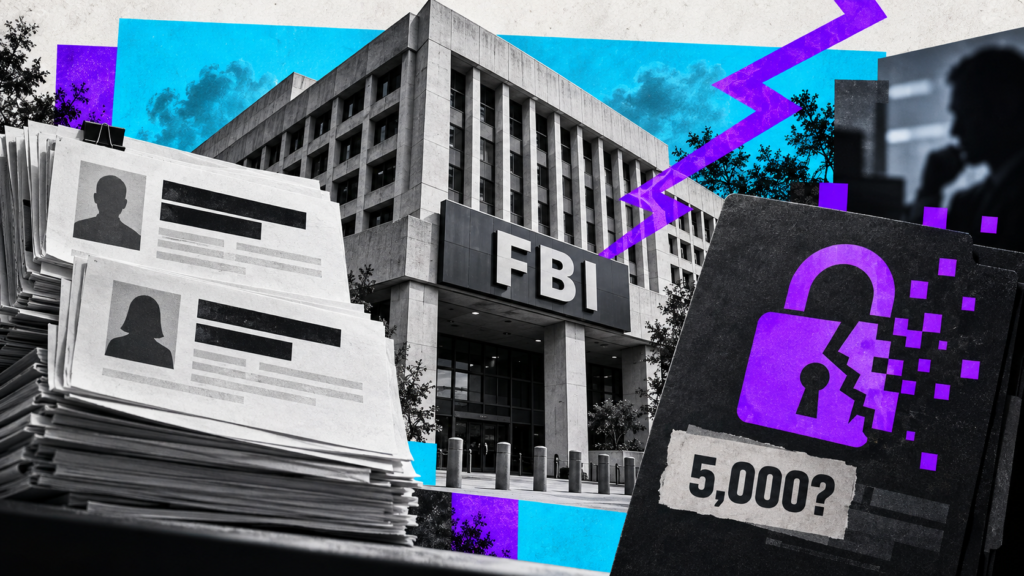
A hacking group claims it stole personal information on nearly all FBI employees and job applicants, raising concerns about the safety of agents and their families.

The FBI says it is investigating claims of unauthorized activity affecting its jobs website, but has not confirmed the scale or source of any stolen data.

ShinyHunters provided journalists with a sample it said contained roughly 5,000 agents’ records. 404 Media said the sample included names, home addresses, phone numbers, and information about employees’ spouses.

Reuters independently examined the data and partially verified some records, though it could not determine the source of the information.

Top Crypto Tax Accounting Software
Sponsored
Disclosure
Opened in 2017
Promotions
Get 20% off your first year
Coins
Ethereum Tether Build'N'Build USD Coin Solana +245

What the 5,000-Record Sample Shows

ShinyHunters told 404 Media it held data on “all FBI employees and applicants.” In a public statement, the group described the haul as covering almost all agents and people who had applied to work for the bureau. Those sweeping claims remain unverified.

The sample offers firmer, but still limited, evidence. It appeared to contain agents’ names, home addresses, Social Security numbers, and assignments, as well as family members’ names in some cases.

The news agency checked details against credit bureau records and previously breached data, finding apparent matches in at least 10 cases. A person familiar with the matter also said that some job descriptions matched.

That does not establish that every person listed is a current agent or that the records came from an FBI system. Some information could have appeared in earlier breaches.

However, it could not determine the data’s origin or confirm the hackers’ claim that they took it from the bureau’s internal systems.

The distinction matters for understanding the incident’s reach. A sample containing accurate personal details would pose a risk to the people named, even if investigators ultimately found that ShinyHunters overstated how it obtained the information. It would not, by itself, prove the group accessed every employee’s record.

FBI Investigates Jobs Website Activity

The FBI said it was “aware of claims regarding unauthorized activity affecting FBIjobs.gov” and was investigating. The agency did not confirm that attackers had entered its internal network or disclose how many people might be affected.

Reuters observed that the FBI jobs website and its Special Agent Applicant Portal displayed an unavailable-service notice on Tuesday.

It could not verify a screenshot the hackers offered as purported proof that they had vandalized the site. The disruption and the data sample are part of the investigation; neither establishes the route the attackers used.

One possible route under scrutiny is Oracle PeopleSoft, software used for human resources functions. ShinyHunters has claimed it exploited a previously unknown flaw, according to reporting on the incident, but investigators have not established that account.

There is a reason the possibility has attracted attention. In June, Google Threat Intelligence Group and Mandiant documented a ShinyHunters campaign that exploited a then-unknown PeopleSoft vulnerability against other organizations.

That earlier campaign shows the group has used the software as an entry point. It does not show whether the same flaw, another vulnerability, or a different method was involved here.

Why Family Details Heighten the Risk

Home addresses and information about spouses could allow criminals to identify, contact, or threaten people close to agents.

Assignments, if accurately linked to employees, could also interest groups seeking to learn who is working on particular investigations. These are potential consequences of exposure, not evidence that such misuse has occurred in this case.

The alleged motive adds an unusual dimension. ShinyHunters said it targeted the FBI in response to a May bureau warning about the group.

That alert described large-scale data theft and extortion and warned that attackers may use threatening calls, messages, and harassment to pressure victims and their relatives. The hackers dispute the FBI’s characterization.

For now, the confirmed picture is narrower than the hackers’ announcement: the FBI is investigating activity affecting its jobs site, and journalists have examined a sample containing apparently authentic personal information.

Investigators have yet to establish the full number of affected people, the source of the records, or whether ShinyHunters accessed the bureau systems it claims to have breached.

Disclaimer: The information provided in this article is for informational purposes only. It is not intended to be, nor should it be construed as, financial advice. We do not make any warranties regarding the completeness, reliability, or accuracy of this information. All investments involve risk, and past performance does not guarantee future results. We recommend consulting a financial advisor before making any investment decisions.
Giuseppe Ciccomascolo

Giuseppe Ciccomascolo began his career as an investigative journalist in Italy, where he contributed to both local and national newspapers, focusing on various financial sectors.

Upon relocating to London, he worked as an analyst for Fitch's CapitalStructure and later as a Senior Reporter for Alliance News. In 2017, Giuseppe transitioned to covering cryptocurrency-related news, producing documentaries and articles on Bitcoin and other emerging digital currencies. He also played a pivotal role in establishing the academy for a cryptocurrency exchange website. Crypto remained his primary area of interest throughout his tenure as a writer for ThirdFloor.

Related

Survey Icon
Help us improve
1 of 4
Is this your first time here?
What brought you here today?
What are you most interested in?
Would you be interested in:
Thank you icon
Thank you for your feedback!
DMCA.com Protection Status