Meet the Top 101 in Crypto
News
3 min read

Diamond Hands Mentality Backfires as Locked Token Holders Face Major Losses

Published 23 April 2025
Giuseppe Ciccomascolo
Authors

Key Takeaways

  • Locked token holders are now sitting on nearly 50% average losses compared to May 2024 OTC valuations.
  • Despite strong OTC demand, many investors chose not to sell, often holding out for more gains that never came.
  • Newer tokens are struggling to hold value as secondary market pressure builds.

Early access to crypto projects might sound like a golden ticket, but for many locked token investors, that promise has become a painful lesson.

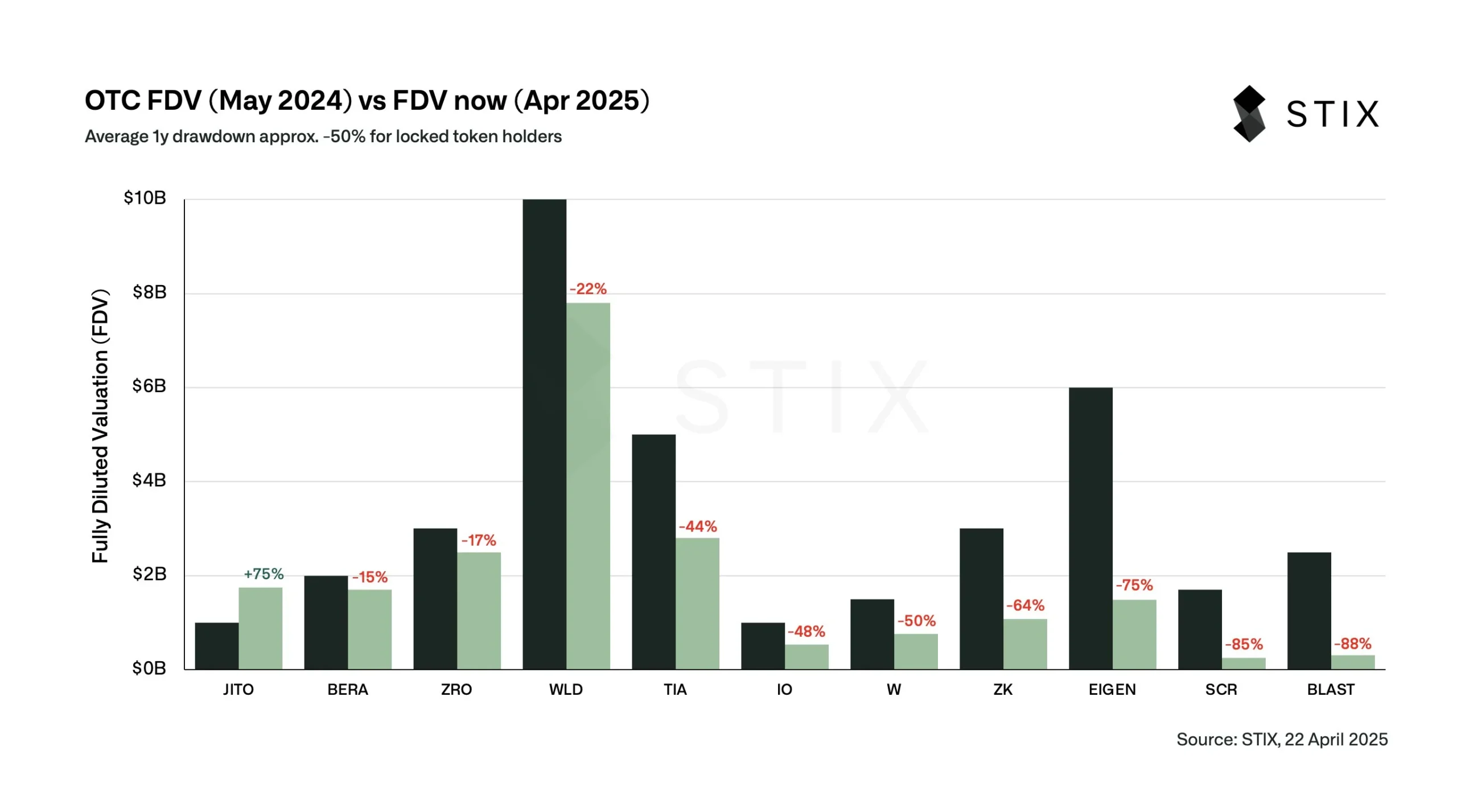
New data shows that locked token holders face average losses of nearly 50% compared to over-the-counter valuations from just a year ago.

Many had opportunities to exit at much higher prices but held on, expecting more upside. Now they’re dealing with the fallout.

Locked Token Holders Face Steep Losses

According to STIX founder Taran Sabharwal, there was no shortage of demand from OTC buyers in 2024.

The problem? Sellers were scarce, often unwilling to part with tokens that had already been marked up several times. That decision has come back to haunt them.

Even projects that once drew significant hype are now trading at deep discounts, raising questions about how investors price risk in early-stage deals and whether they truly understand the limits of illiquid positions.

Locked token holders losses
Locked token holders have taken massive losses over the last 12 months. | Credit: STIX

Top Projects See Sharp Declines

These losses outpaced the broader crypto market, which saw an average sector-wide correction of 41% over the same period, even with Bitcoin (BTC) and Ethereum (ETH) factored in.

Among the worst performers:

  • SCR: -85%
  • BLAST: -88%
  • EIGEN: -75%
  • ZK: -64%
  • W: -50%
  • IO: -48%
  • TIA: -44%

Only one project, JITO, posted a gain over the last year, up +75%.

The Price of Illiquidity

The data tells a clear story: locked token rounds carry risks that aren’t always obvious on paper.

Illiquidity, vesting schedules, and speculative valuations create a minefield for early investors. When exit windows close, the downside comes fast.

Many are now rethinking their strategy, especially as fully diluted valuations (FDVs) continue to adjust downward across secondary markets.

The pressure is only growing for newer projects that are still in the lock-up phase.

Giuseppe Ciccomascolo

Giuseppe Ciccomascolo began his career as an investigative journalist in Italy, where he contributed to both local and national newspapers, focusing on various financial sectors.

Upon relocating to London, he worked as an analyst for Fitch's CapitalStructure and later as a Senior Reporter for Alliance News. In 2017, Giuseppe transitioned to covering cryptocurrency-related news, producing documentaries and articles on Bitcoin and other emerging digital currencies. He also played a pivotal role in establishing the academy for a cryptocurrency exchange website. Crypto remained his primary area of interest throughout his tenure as a writer for ThirdFloor.

Related

Survey Icon
Help us improve
1 of 4
Is this your first time here?
What brought you here today?
What are you most interested in?
Would you be interested in:
Thank you icon
Thank you for your feedback!
DMCA.com Protection Status