Key Takeaways
- Ripple’s former CTO David Schwartz said he reduced his crypto holdings over a decade after a viral post compressed the sales into a few months.
- Dark Defender revised his XRP chart after the token fell below $1, retaining a $30.30 upside scenario.
- Reaching $30.30 from Monday’s price near $0.94 would require a roughly 3,120% rally and put XRP’s market cap near $1.92 trillion at today’s circulating supply.
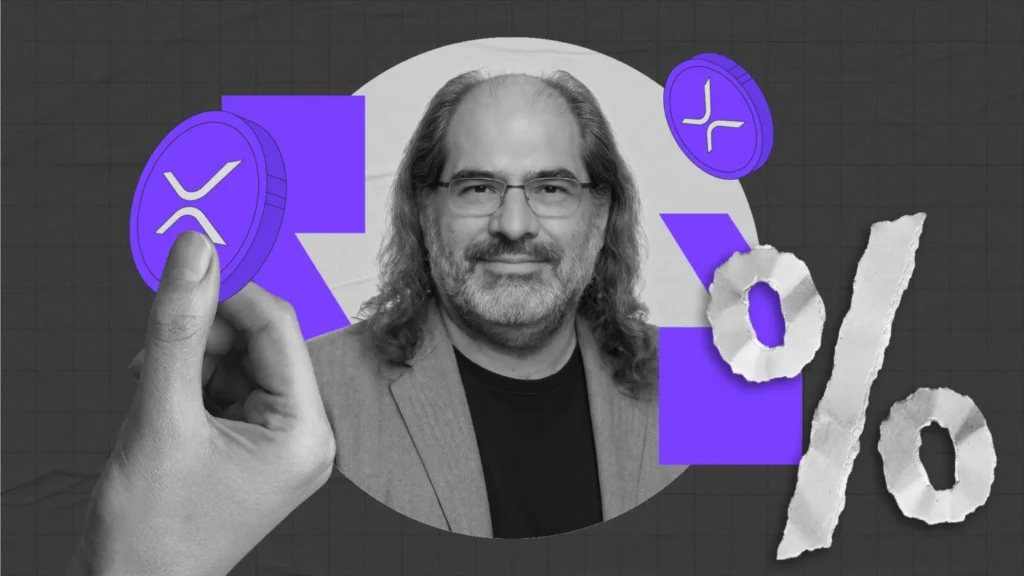
XRPL co-creator David Schwartz says he cut his crypto holdings over roughly a decade, correcting a viral post that suggested he had sold most of his XRP, Bitcoin and Ethereum in just a few months.
Separately, chart analyst Dark Defender kept a $30.30 upside scenario on his weekly chart even after the drop below $1 forced him to rethink his recovery call.
From around $0.94, XRP would have to rise more than 32-fold to reach that level, putting its market cap near $1.92 trillion at the current circulating supply.
Schwartz Points to 2019 Post to Explain XRP Sales
“That wasn’t in the last few months, that was in the last decade,” he responded on X.
Schwartz pointed to an April 2019 post in which he described a plan he and his wife agreed on when they began putting their own money into crypto.
The couple had decided to reduce their exposure over time, and Schwartz said at the time that selling during a bull run still hurt. u.today
Earlier this month, he said his XRP balance had fallen from a peak of about 26 million tokens to roughly 3 million, a reduction of about 88%. The two balances show how much his position shrank.
In a follow-up reply, Ripple’s CTO emeritus said most of the major risks he had taken had worked out well.
However, his appetite for taking them remained low.
“I hate risk. I can’t help it.”
Schwartz faced a similar question last week, when an XRP holder asked why he had sold if the token could eventually reach $1,000.
In response, he recalled that even 10 cents once seemed extraordinary.
Dark Defender Revises XRP Outlook After $1 Break
Earlier this month, Dark Defender stood by the chart setup behind a $10.11 XRP call, writing, “Nothing has changed in the structure.”
When XRP broke below $1, however, he revised his reading of the rally.
In his Nov. 22 update on X, the analyst said he had treated XRP’s move from about $0.99 to $1.70 as the start of a new advance, provided the next pullback held above $1.
After that level gave way, he recast the rally as a temporary rebound within a longer correction.
“White Wave 2 is still Wave 2. The letters inside it changed; the primary structure did not,” he wrote.
His revised weekly chart marks potential support near $0.88 and $0.64 and plots longer-term upside levels at $5.86, $18.23 and $30.30.
XRP Edges Higher, With $1 Still the First Test
XRP was up 0.67% over 24 hours at $0.943 according to CoinMarketCap, while Bitcoin fell 1.7% and the broader crypto market shed about 1.1%.
XRP trading volume more than doubled, although the cause of the gain was unclear.
CoinMarketCap’s analysis identified support near $0.913 and resistance at $0.968 on the way back to $1. A break below $0.90 would bring Dark Defender’s $0.88 level into focus.
From $0.943, XRP would need to gain about 6% to reclaim $1 and about 80% to revisit the $1.70 high of its last rally.
The earlier $10.11 call would put XRP at nearly 11 times that price, while the revised chart’s $30.30 level would put it at about 32 times that price.
For now, the first test is whether XRP can reclaim and hold the $1 level that forced Dark Defender to redraw his chart.
What a $30 Price Would Mean
With XRP trading around $0.94 at the time of reporting and around 63.52 billion tokens in circulation, the top level on Dark Defender’s chart would put XRP’s market capitalization at around $1.92 trillion.
| Level on Dark Defender’s chart |
Gain from $0.94 |
Implied market cap |
| $5.86 |
523% |
$372 billion |
| $18.23 |
1,839% |
$1.16 trillion |
| $30.30 |
3,124% |
$1.92 trillion |
At $18.23, XRP would be worth nearly as much as Bitcoin, which had a market cap of about $1.23 trillion on Tuesday.
At $30.30, XRP alone would be worth about $690 billion more than Bitcoin was that day and roughly 32 times its own $60 billion valuation at the time of reporting.
Sustaining that price would take enough buying demand to absorb selling as holders take profits and more XRP enters circulation.
Sustained ETF inflows or wider use of XRP itself in payments could help build that demand.
Wider use of the XRPL could help, but how institutions use it matters.
Cross River, for example, lets customers settle dollar payments in Ripple’s RLUSD stablecoin, with XRP used to cover the network fee.
XRPL co-creator David Schwartz has also questioned how much demand fees can generate.
“I don’t think anyone knowledgeable has suggested that XRP’s use as gas would be a significant driver of the price of XRP,” Schwartz previously said.
For payments to make a stronger case for $30.30, financial firms would need to use the token itself to move money between currencies often enough for market makers to hold substantially more of it.
Until demand grows on that scale, $30.30 remains a massively speculative chart projection.
The information provided in this article is for informational purposes only. It is not intended to be, nor should it be construed as, financial advice. We do not make any warranties regarding the completeness, reliability, or accuracy of this information. All investments involve risk, and past performance does not guarantee future results. We recommend consulting a financial advisor before making any investment decisions.

Kurt Robson is a London-based reporter at CCN, specialising in the fast-moving worlds of crypto and emerging technology. He began his career covering local news in Cornwall after graduating from Falmouth University with First Class Honours in Journalism. There, he cut his teeth on everything from council meetings to missing swans.
He quickly rose through the ranks to become a frontline journalist at several of the UK’s leading national newspapers. Over the years, he has interviewed musicians and celebrities, reported from courtrooms and crime scenes, and secured multiple front-page exclusives.
Following the upheaval of the COVID-19 pandemic, Kurt shifted his focus to technology journalism—just ahead of the AI boom. With a natural curiosity and a trained eye for emerging trends, he has found a new rhythm in reporting on innovation.
At CCN, Kurt's work focuses on the cutting edge of crypto, blockchain, AI, and the evolving digital world. Drawing on his background in people-first reporting and his deep interest in disruptive tech, Kurt delivers stories that are insightful, entertaining, and human-centric.












 Ex-Ripple CTO Pushes Back on Epstein-Related Claims, but XRP and Stellar (XLM) May Struggle to Rebound