Traders have wagered more than $400,000 on where SpaceX's market capitalization will stand at the end of its first month. | Source: CCN.
Share
s
Key Takeaways
SpaceX’s IPO raised a record $85.7 billion.
Crypto traders are betting on a valuation of multi-trillions.
Analysts remain cautious despite the rally.
Crypto traders are betting that Elon Musk’s SpaceX could be worth as much as $3 trillion within weeks of its stock market debut, as the company’s record-breaking initial public offering continues to fuel speculation over how far the rally can run.
Try Our Recommended Crypto Exchanges
Sponsored
Disclosure
We sometimes use affiliate links in our content, when clicking on those we might receive a commission at no extra cost to you. By using this website you agree to our terms and conditions and privacy policy.
SpaceX joined the Nasdaq on June 12 after raising $75 billion in its initial share sale.
The company later disclosed that underwriters exercised an overallotment, or “greenshoe,” option, increasing total proceeds to $85.7 billion.
This allowed banks involved in the offering, including Goldman Sachs and JPMorgan, to purchase additional shares from the company to satisfy stronger-than-expected investor demand, the BBC reported.
The extra $10 billion raised through the option alone would rank among the largest IPOs on record.
SpaceX shares were offered at $135 each, valuing the company at roughly $1.8 trillion.
Musk told employees that proceeds from the offering would help fund a “significant growth phase” for the company.
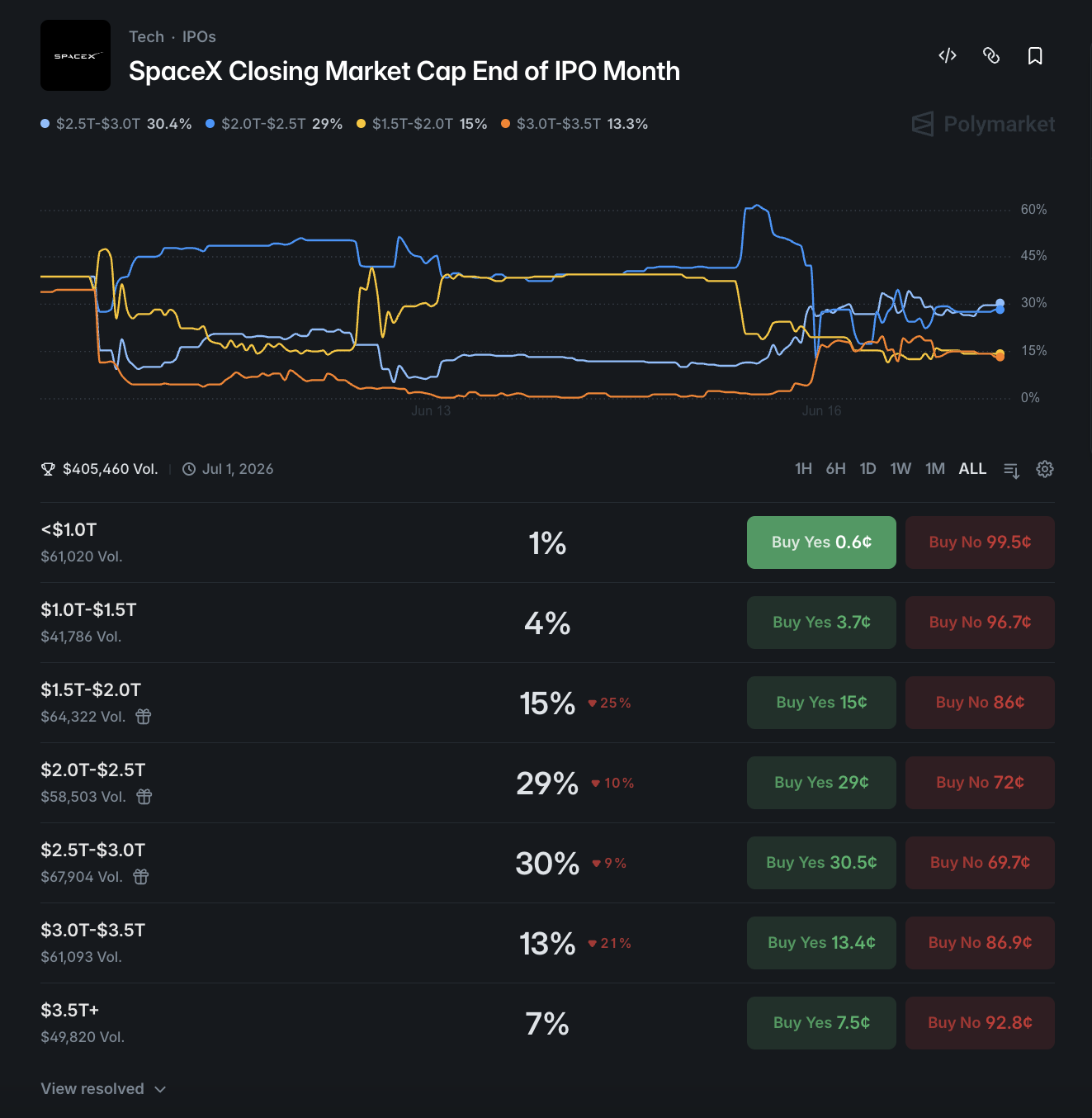
On prediction market platform Polymarket, traders have wagered more than $400,000 on where SpaceX’s market capitalization will stand at the end of its first month as a publicly traded company.
The largest share of bets currently points to a valuation between $2 trillion and $3 trillion, while a smaller group of traders is backing the company to exceed $3 trillion.
More speculative wagers are also drawing interest.
Contracts predicting SpaceX’s valuation will fall below $1 trillion were trading at roughly 0.6 cents, meaning a trader could purchase about 166 contracts for $1.
Some contracts are offering massive odds. | Source: Polymarket
If the unlikely outcome were to occur, those contracts would pay out $166, representing a return of more than 16,000%.
Similarly, contracts tied to valuations of $1 trillion to $1.5 trillion traded at around 3.7 cents, while contracts tied to valuations of $1.5 trillion to $2 trillion traded near 15 cents.
Under Polymarket’s structure, each winning contract settles at $1, with profits determined by the difference between the purchase price and the settlement value.
SpaceX Favored Over OpenAI in IPO Valuation Bets
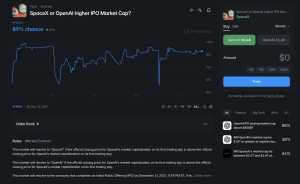
Crypto traders are also wagering on whether SpaceX or OpenAI will command the higher market capitalization after their respective stock market debuts.
On Polymarket, the market currently assigns an 89% probability that SpaceX will have a higher IPO market cap than OpenAI, while OpenAI is given just an 11% chance.
Traders are also pitting OpenAI vs. SpaceX | Source: Polymarket
At current prices, a trader buying a SpaceX contract for about 90.4 cents would earn 9.6 cents per share if SpaceX ultimately debuts with the larger market value, representing a return of roughly 10.6%.
By contrast, an OpenAI contract trading at around 11.8 cents would return 88.2 cents per share if OpenAI emerges with the higher valuation, equivalent to a nearly 750% gain.
The maker of ChatGPT confidentially filed paperwork with the US Securities and Exchange Commission earlier this month, opening the door to a future IPO.
However, Chief Executive Sam Altman has described the filing as a strategic option, saying the company may ultimately decide that remaining private better serves its long-term goals.
If a public listing were to take place, several OpenAI executives and investors have indicated that it could occur as early as later this year.
Analysts Question Whether SpaceX IPO Momentum Can Continue
Despite the strong debut, some market observers have cautioned that SpaceX’s valuation leaves little room for disappointment.
Harvey Jones, an analyst at The Motley Fool, said investor sentiment had shifted rapidly from concerns about a broader technology sell-off to enthusiasm surrounding Musk’s latest venture.
Jones said the stock’s continued rise has prompted comparisons with some of the world’s largest companies and raised the possibility that SpaceX could eventually reach a $3 trillion valuation.
At the same time, he questioned whether the pace of gains was sustainable given the company’s financial profile.
SpaceX reported a loss of nearly $5 billion last year and roughly $4 billion in the first quarter of 2026.
Jones also noted that the company’s xAI business continues to consume significant capital while advancing its long-term ambitions.
“The opportunity is hard to judge on conventional metrics,” Jones wrote.
He said that investors are placing greater weight on future growth prospects and Musk’s ability to attract capital than on traditional earnings measures.
Kurt Robson is a London-based reporter at CCN, specialising in the fast-moving worlds of crypto and emerging technology. He began his career covering local news in Cornwall after graduating from Falmouth University with First Class Honours in Journalism. There, he cut his teeth on everything from council meetings to missing swans.
He quickly rose through the ranks to become a frontline journalist at several of the UK’s leading national newspapers. Over the years, he has interviewed musicians and celebrities, reported from courtrooms and crime scenes, and secured multiple front-page exclusives.
Following the upheaval of the COVID-19 pandemic, Kurt shifted his focus to technology journalism—just ahead of the AI boom. With a natural curiosity and a trained eye for emerging trends, he has found a new rhythm in reporting on innovation.
At CCN, Kurt's work focuses on the cutting edge of crypto, blockchain, AI, and the evolving digital world. Drawing on his background in people-first reporting and his deep interest in disruptive tech, Kurt delivers stories that are insightful, entertaining, and human-centric.